


Featured Summary:
- Africa integration faces a stress test as health emergencies trigger border closures and public resistance
- Kenya’s Ebola protest and Uganda’s temporary border closure reveal tensions between public safety and regional mobility
- AfCFTA and free-movement agreements depend on cooperation that becomes harder during crises
- The Ebola response raises broader questions about how Africa manages risk across interconnected markets
Africa’s push for open borders and deeper regional integration is facing a difficult test.
In Kenya, protesters opposed a proposed Ebola quarantine facility.
In Uganda, authorities temporarily closed the border with the Democratic Republic of Congo to limit the spread of the virus.
Both reactions emerged from the same concern: perceived risk.
The events reveal a tension that extends beyond public health. Africa’s integration agenda depends on the movement of people, goods, and services across borders.
Yet moments of crisis often trigger a different response.
Citizens demand protection. Governments move to contain threats. The challenge is that everyone supports integration until the risks become personal.
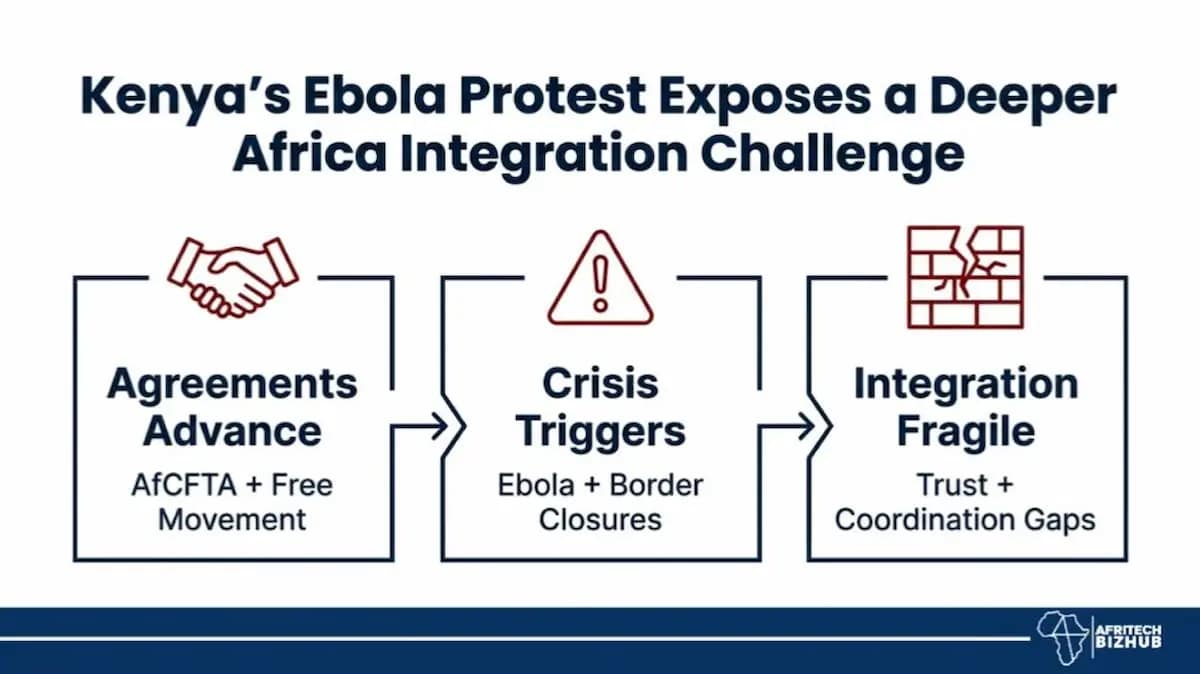
Why Do Ebola Responses Expose Limits of Africa Integration?
Regional integration is easiest to support during periods of stability.
Borders remain open, trade flows continue, and movement across countries is viewed as an economic opportunity.
The real test comes when risks begin moving across those same borders.
The reaction to Ebola in Kenya and Uganda illustrates this challenge.
Communities worried about exposure demanded protection. Governments faced pressure to act quickly.
In those moments, national interests and local concerns often move faster than regional commitments.
The result is a reality that integration frameworks cannot ignore.
A continent may agree on mobility and cooperation in principle, but crises reveal how much trust exists when citizens are asked to share risk across borders.
Why Does Public Trust Matter More Than Policy During Crises?
Policies can create frameworks for cooperation, but they cannot automatically create public confidence.
During periods of uncertainty, citizens make decisions based on what they believe will keep them safe, regardless of what regional agreements may require.
Kenya’s reaction to the proposed Ebola quarantine facility illustrates this reality.
The protest was not a rejection of integration itself. It was a response to perceived risk.
Communities wanted assurance that the systems managing that risk could be trusted.
That distinction matters.
Regional integration depends on agreements between governments, but its success often depends on whether citizens trust the institutions responsible for protecting them when crises emerge.
What Gaps Exist in Africa’s Crisis-Response Architecture?
Regional integration assumes that countries can respond to shared risks in a coordinated way.
That becomes difficult when emergencies require multiple governments, agencies, and institutions to make decisions simultaneously.
Recent events highlight the challenge. Uganda responded with a temporary border closure.
Kenya faced public resistance to a quarantine facility. Both reactions reflected national responses to a regional threat.
The outcome was not necessarily policy failure, but it revealed how differently countries can react when pressure rises.
That is where the architecture is tested.
Africa integration requires more than open borders and trade agreements.
It requires systems that can manage crises across borders without forcing countries to choose between regional coordination and domestic concerns.
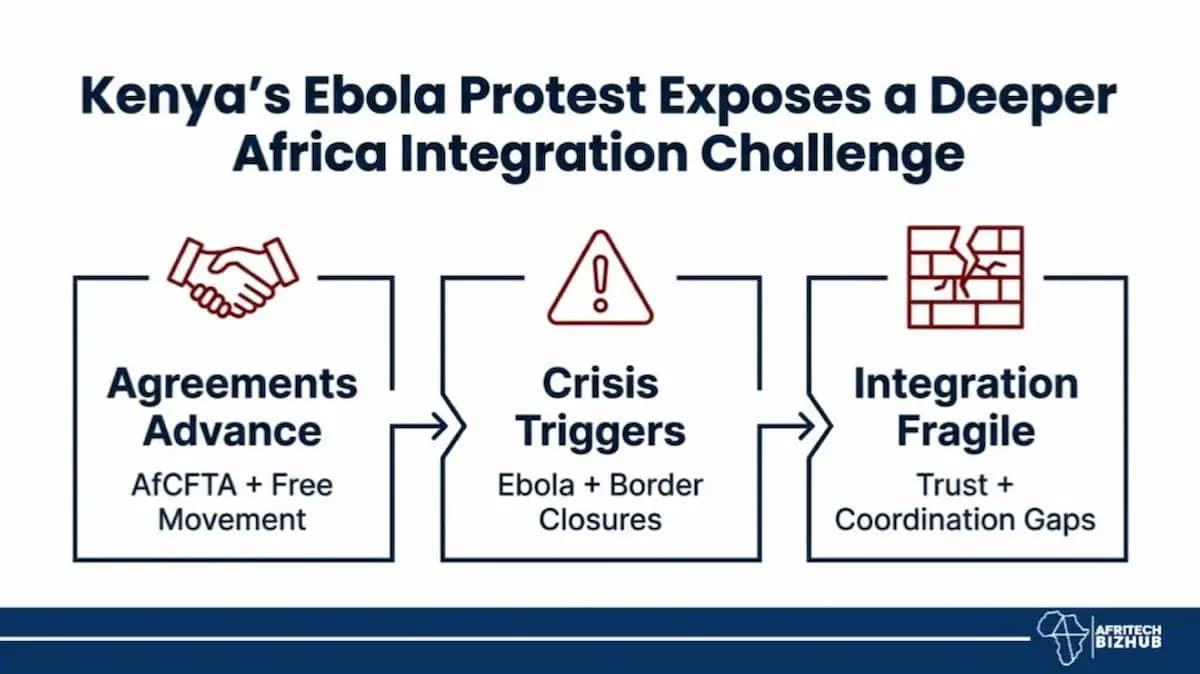
How Is Africa CDC Involved in Maintaining Cross-Border Coordination?
Continental integration depends on more than agreements between governments.
It also depends on institutions that can coordinate responses when risks move across borders.
Health emergencies often test whether those systems can function across multiple countries at the same time.
This is where Africa CDC becomes relevant.
The institution provides guidance on epidemic surveillance, risk communication, cross-border monitoring, and coordinated response measures.
Its role is designed to help countries respond to shared threats using common frameworks rather than isolated national actions.
The significance extends beyond public health.
When countries rely on shared information, harmonized assessments, and coordinated responses, the pressure on borders, mobility, and regional cooperation becomes easier to manage.
That makes institutions such as Africa CDC an important part of the infrastructure supporting Africa integration.
Can Africa Integration Succeed Without Public Trust?
Africa has spent years building trade agreements, mobility frameworks, and cross-border institutions designed to support a more connected continent.
The harder challenge is ensuring that citizens trust those systems when crises emerge.
The events in Kenya and Uganda show that public confidence can influence integration as much as policy itself.
Borders can be opened through agreements. Trade corridors can be established through negotiations. Trust, however, cannot be legislated.
Africa integration will ultimately be tested not during periods of stability, but during moments of uncertainty.
The next phase of integration may depend less on removing barriers and more on building confidence in the institutions responsible for managing shared risks across borders.


Recent Comments