


Last updated: May 16, 2026
AfCFTA is expanding, but execution gaps still threaten to slow Africa’s trade ambitions.
Featured Summary:
- Africa’s trade integration is expanding, but execution remains AfCFTA’s biggest challenge.
- Customs delays, logistics gaps, and weak implementation still constrain intra-African trade.
- AfCFTA’s long-term success now depends on execution, not policy ambition.
Africa’s trade integration faces a critical test in 2026 as AfCFTA moves from treaty expansion to operational delivery.
The next phase of the continent’s trade agenda will depend on whether governments and institutions can turn policy momentum into working payment, customs, logistics, and border systems that move goods more efficiently across African markets.
Intra-African trade is advancing, but until those systems improve at scale, Africa’s integration push will remain limited more by execution than ambition.
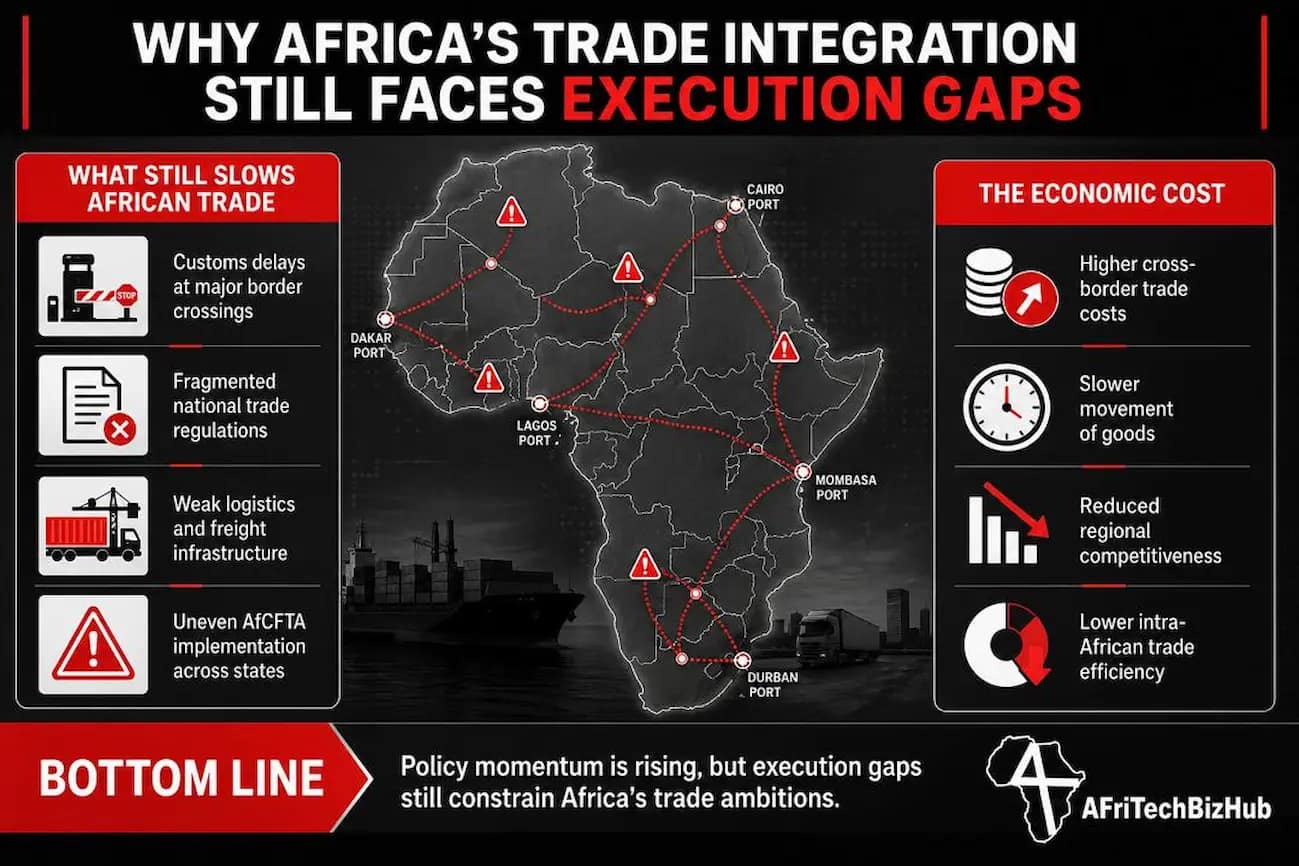
How Fast Is Intra-African Trade Growing in 2026?
Institutional forecasts point to stronger intra-African trade growth in 2026 as AfCFTA expands and regional payment systems improve.
But outside a handful of active trade corridors, much of Africa’s broader integration still feels limited in practical terms.
For many businesses and consumers, seamless continental trade remains more policy ambition than daily reality.
That gap reflects the difference between momentum on paper and execution on the ground.
Trade frameworks are advancing, but customs delays, weak logistics networks, and fragmented border systems still slow the movement of goods across much of the continent.
Why AfCFTA Still Faces Major Execution Gaps
AfCFTA’s biggest constraints now lie less in continental policy design than in uneven execution across member states.
The framework continues advancing at the institutional level, but implementation still depends on national governments aligning customs systems, border procedures, tariffs, and domestic regulations, an area where progress remains inconsistent.
That fragmentation continues slowing integration. Differing national priorities, uneven administrative capacity, and policy misalignment across the continent have made seamless cross-border trade harder to achieve in practice.
Africa’s trade challenge is increasingly operational: continental ambition now depends on whether national systems can execute in sync.
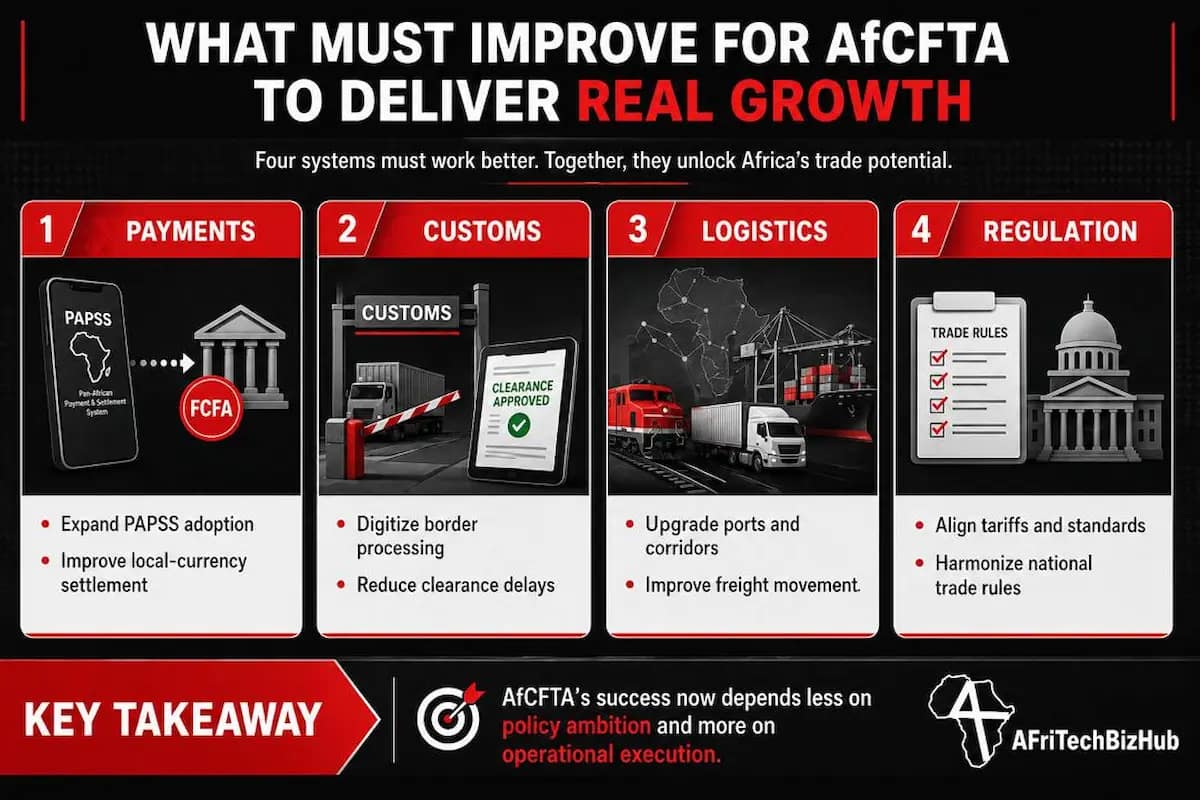
Which Systems Are Improving Cross-Border Trade in Africa?
Several core systems are improving Africa’s cross-border trade environment, though progress remains uneven.
The Pan-African Payment and Settlement System is expanding local-currency settlement infrastructure aimed at reducing payment friction in intra-African trade, while customs digitization and electronic border-processing reforms are advancing in selected markets seeking to modernize trade administration.
Trade corridors are also seeing targeted upgrades as governments and development partners invest in ports, border posts, and regional transport links to improve freight movement.
AfCFTA-related regulatory harmonization is progressing alongside these efforts as member states work to align tariffs, standards, and trade procedures.
Together, those systems are gradually improving the mechanics of African trade, even if execution remains inconsistent across the continent.
What Must Happen for Africa’s Trade Integration to Deliver Real Growth?
Africa’s trade integration will deliver real growth only when execution begins matching ambition.
AfCFTA’s policy architecture is largely in place; the deeper problem is that implementation still lags across the national systems meant to make continental trade function.
The next phase of Africa’s integration push will be decided by whether governments remove the operational barriers still slowing commerce across borders.
Customs friction, fragmented regulation, and administrative bottlenecks now matter more than additional policy debate.
Africa’s trade ambitions will be measured not by agreements signed, but by whether institutions can make continental commerce work in practice.


Recent Comments