


Last updated: June 16, 2026
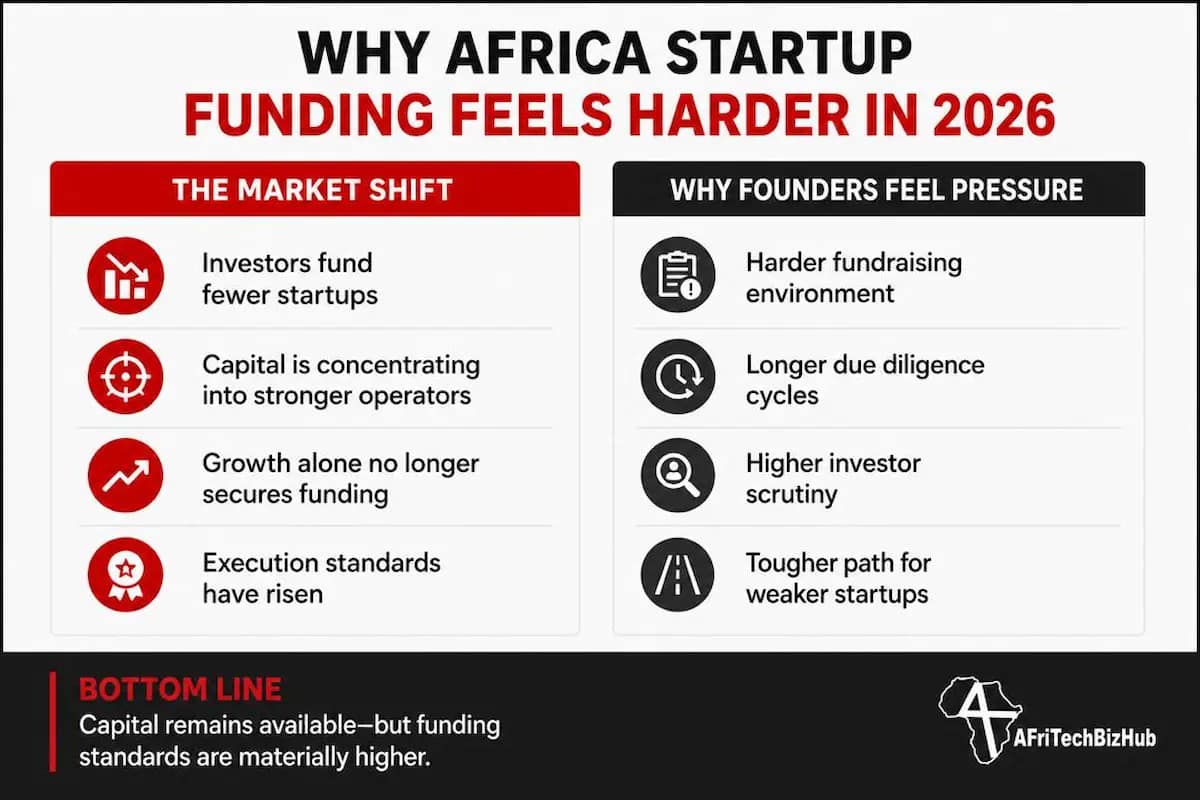
Investors are backing fewer startups as the market shifts from growth-at-all-costs to stronger fundamentals and clearer differentiation.
Featured Summary:
- Africa startup funding 2026 is flowing into fewer startups as investors tighten deployment standards across the market.
- Capital is concentrating around companies with stronger execution, clearer revenue models, and differentiated technology.
- For many founders, raising capital is harder as investors move away from broad venture deployment toward more disciplined bets.
Africa startup funding in 2026 reflects a tougher venture market, not a disappearance of capital.
Funding remains available across the continent, but investors are directing more capital toward startups with stronger execution, clearer revenue models, and credible long-term scalability.
The broad post-boom funding correction has largely passed; the market’s defining shift is that capital now concentrates more heavily around stronger operators and more defensible business models.
How Much Funding Are African Startups Raising in 2026?
Large venture rounds continue to show that capital remains available for African startups with scale, traction, and defensible market positions.
Recent financings across sectors such as mobility, fintech, and infrastructure-backed technology underscore that investors are still deploying meaningful capital into the continent’s venture ecosystem despite tighter market discipline.
Broader funding data supports that trend. African tech startups raised roughly $1.6 billion in disclosed funding during 2025, according to Disrupt Africa, with total capital increasing year over year even as the number of funded startups declined.
The pattern suggests funding has not disappeared. It is concentrating into fewer companies viewed as stronger long-term bets.
Why Is Africa Startup Funding Becoming More Selective?
Africa’s last major startup funding cycle was driven by the post-2020 fintech boom, when investors poured capital into payment, banking, and financial-access startups seeking to modernize fragmented financial infrastructure across the continent.
Fintech dominated venture deployment during that period and emerged as the ecosystem’s principal funding engine.
That cycle has matured. Many of the sector’s most obvious opportunities are now funded, more competitive, or deeper into execution phase, reducing the breadth of broad-based fintech deployment seen in earlier years.
Funding has not stopped flowing into Africa, but the market currently lacks another breakout sector absorbing capital at the scale fintech once did.
Investors are responding by concentrating more capital into a narrower group of startups viewed as stronger long-term bets.
Is African Fintech Funding Slowing Down?
African fintech funding is no longer growing at the pace seen during the sector’s peak venture cycle, but capital continues flowing into startups tackling deeper infrastructure constraints within the continent’s payment ecosystem.
As the market matures, investors are moving away from broad consumer-payment plays and toward infrastructure-led models focused on settlement, liquidity, and cross-border transaction efficiency.
The shift reflects changing priorities rather than fading interest in fintech. Payment digitization exposed the limitations of Africa’s underlying financial rails; investors are now directing more capital toward startups building around those bottlenecks rather than simply layering new payment apps on top of them.
Which African Startup Sectors Are Attracting Capital Now?
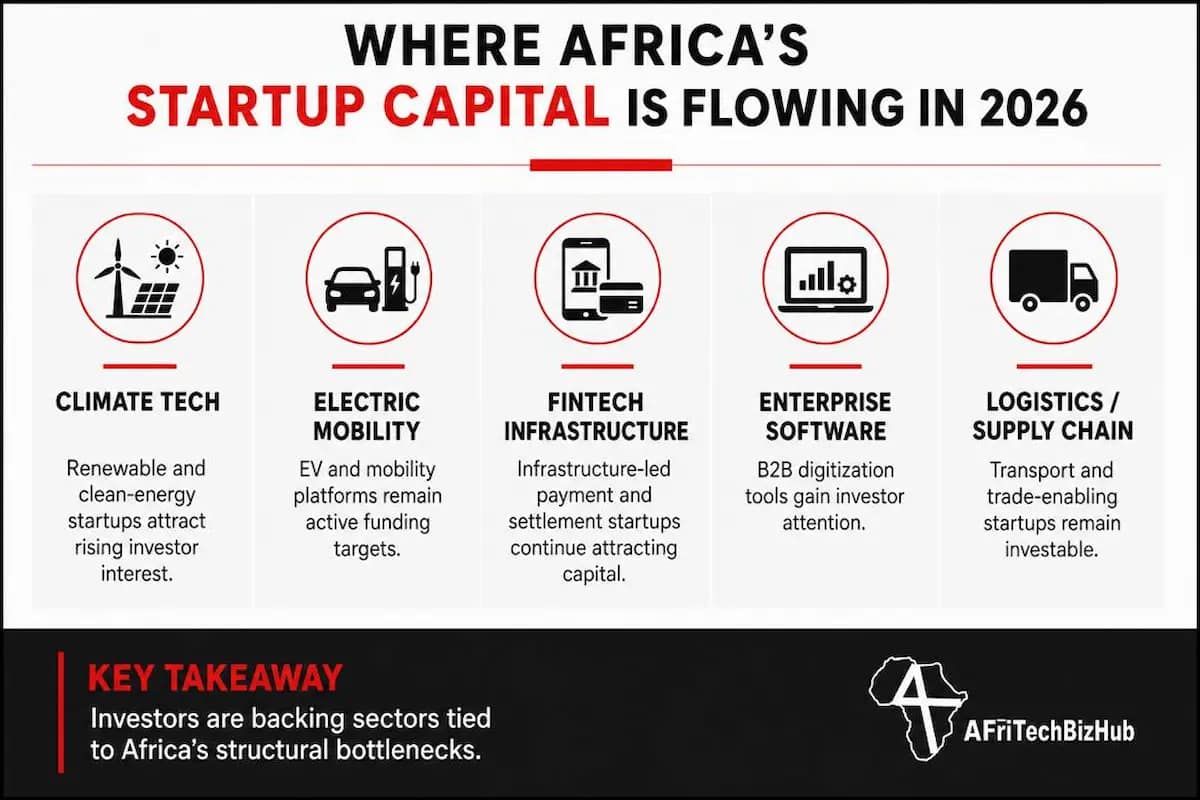
Investor capital in Africa is increasingly moving toward infrastructure-led sectors tied to long-term structural demand.
Climate and energy technology, electric mobility, logistics, enterprise software, and fintech infrastructure remain among the areas attracting the strongest investor interest as venture funding shifts beyond the fintech-heavy cycle that defined the last boom.
The change reflects where investors now see the continent’s next major growth opportunities.
Rather than broad consumer-facing plays, capital is flowing more heavily into startups addressing Africa’s energy shortages, transport bottlenecks, enterprise digitization needs, and financial infrastructure gaps.
What Africa Startup Funding Trends Mean for Founders in 2026
Capital is still available in Africa’s venture market, but investors are putting money into a narrower group of startups.
Africa startup funding in 2026 is being shaped less by a shortage of capital than by tighter standards on where that capital goes.
What founders build now matters more than during the last funding cycle.
Startups solving larger structural problems and showing clearer paths to scale remain attractive to investors, while weaker or less differentiated ventures face a much harder funding environment.
In Africa’s current market, funding is still available, but not every startup will attract it.


Recent Comments