


Featured Summary:
- Africa Health Security depends overwhelmingly on imports, with the continent producing only 1% of its medicines and 0.5% of its vaccines
- AfDB’s new medicines platform may improve procurement, but procurement alone cannot eliminate dependence on foreign supply chains
- Africa’s medicine crisis increasingly appears to be a manufacturing challenge rather than an access challenge
A continent of more than 1.4 billion people produces only 1% of the medicines it consumes and approximately 0.5% of its vaccines.
Those figures alone suggest that Africa Health Security is confronting a challenge that extends far beyond hospitals, procurement systems, or medicine distribution.
The African Development Bank’s proposed African Medical Equipment and Medicines Facility aims to improve access to essential medicines through better procurement and coordination.
That may help address shortages and delays. The deeper question is whether Africa can secure medicines it does not produce.
A continent that depends overwhelmingly on external supply chains will remain vulnerable to disruptions, shortages, and global shocks regardless of how efficiently medicines are purchased.
The real debate is no longer about access. It is increasingly about production.
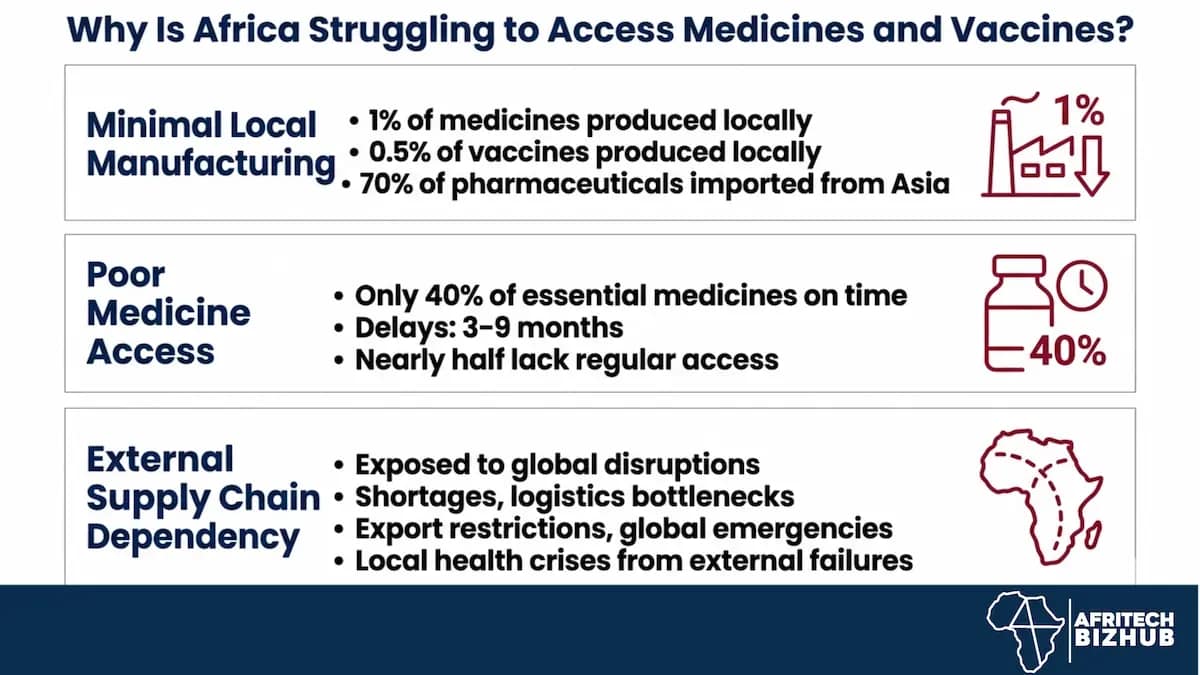
Why Is Africa Struggling to Access Medicines and Vaccines?
The scale of the dependency is difficult to ignore.
According to the African Development Bank, Africa manufactures only 1% of the medicines it consumes and approximately 0.5% of its vaccines.
Only 40% of essential medicines reach populations on time, while delays can extend from three to nine months.
Those figures expose a structural vulnerability within Africa Health Security.
A continent that relies heavily on external supply chains remains exposed to disruptions that originate beyond its borders.
Shortages, logistics bottlenecks, export restrictions, and global emergencies can quickly become local health crises.
The result is that access to medicines often depends not only on healthcare systems, but on the reliability of production and supply networks located elsewhere.
What Is the African Medical Equipment and Medicines Facility?
The African Medical Equipment and Medicines Facility is the African Development Bank’s proposed response to one of the continent’s most persistent health challenges: getting essential medicines, vaccines, and medical products to populations more reliably and with fewer delays.
Rather than focusing on manufacturing, the platform focuses on procurement.
The objective is to improve coordination, strengthen purchasing power, mobilise financing, and create a more predictable system for acquiring health products across African markets.
The Bank believes that a larger, better-coordinated procurement mechanism can help reduce delays and improve access to critical medicines.
The logic is straightforward. Individual countries often negotiate separately, purchase at different scales, and face varying financing constraints.
AMEF seeks to create a framework capable of bringing governments, suppliers, financiers, and development partners into a more coordinated system.
The goal is not to produce medicines. The goal is to improve how medicines are purchased and delivered.
Can Better Procurement Solve Africa’s Medicine Shortages?
Better procurement can improve access. It can reduce delays, strengthen coordination, and make medicine supply chains more predictable.
Those outcomes matter, particularly in a continent where essential medicines often arrive late or remain unavailable.
The question is whether procurement can solve a shortage rooted in production. Medicines cannot be purchased if they are not manufactured.
Vaccines cannot be secured if supply remains concentrated elsewhere.
A more efficient procurement system may improve access to available products, but it does not eliminate dependence on external producers.
This is where the debate around Africa Health Security begins to change.
The challenge is no longer only about how medicines are acquired. It is increasingly about where they are made. Procurement can manage dependence. It cannot remove it.
Why Is Pharmaceutical Manufacturing Becoming Central to Africa Health Security?
The conversation is increasingly shifting beyond procurement and toward production.
Africa imports most of its medicines, most of its vaccines, and many of the ingredients required to manufacture them.
That dependence creates vulnerabilities that become visible whenever supply chains tighten or global demand surges.
This is why pharmaceutical manufacturing is moving closer to the centre of Africa Health Security.
A continent that produces only a fraction of what it consumes will remain exposed to decisions made elsewhere, regardless of how efficiently medicines are purchased or distributed.
The deeper challenge is therefore industrial rather than logistical.
Improving access remains important. Building the capacity to manufacture medicines at scale may prove even more important.
Health security increasingly depends not only on the ability to buy medicines, but on the ability to produce them.
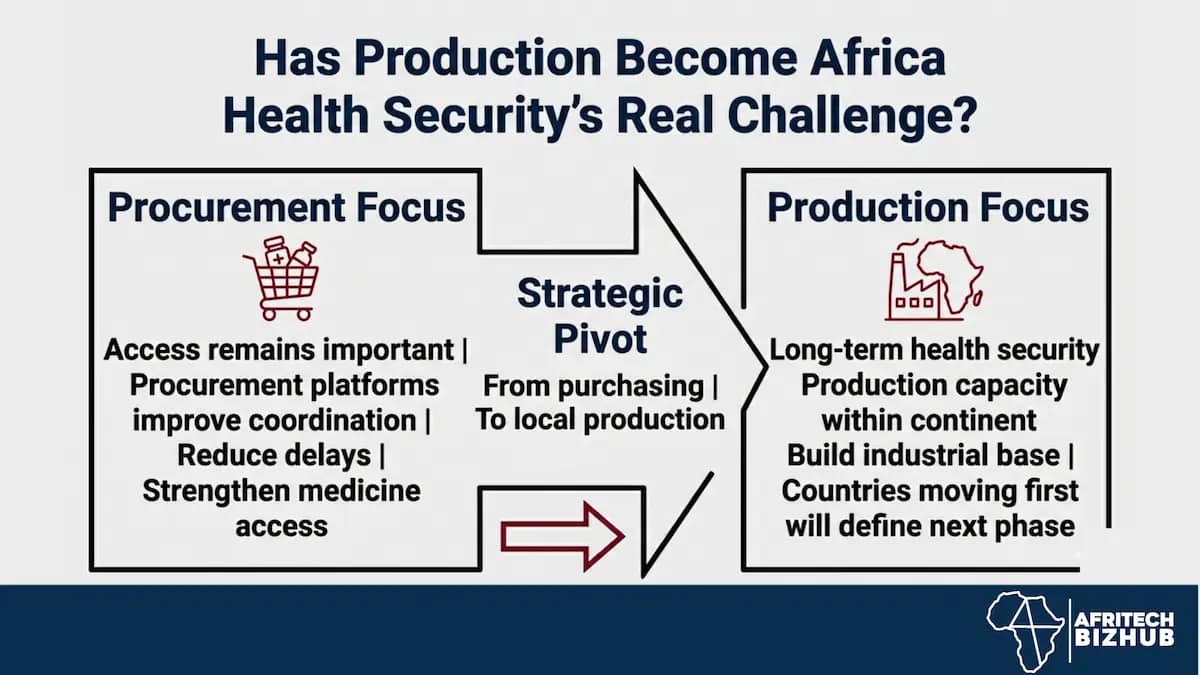
Has Production Become Africa Health Security’s Real Challenge?
The direction is becoming increasingly difficult to ignore.
Africa Health Security is moving beyond questions of procurement and toward questions of production.
Access remains important, but access alone cannot guarantee resilience in a world where supply chains, manufacturing capacity, and strategic industries increasingly shape national security.
The significance of the current debate is not that procurement platforms are unnecessary.
They may improve coordination, reduce delays, and strengthen access to essential medicines.
The larger issue is that long-term health security ultimately depends on production capacity that exists within the continent itself.
Africa’s next health challenge may not be securing medicine deliveries.
It may be building the industrial base required to produce more of what it consumes.
The countries that move first on pharmaceutical manufacturing are likely to define the next phase of Africa Health Security.


Recent Comments