


Featured Summary:
- Flutterwave has promoted more than 100 employees while introducing new welfare measures across its workforce.
- Talent retention is becoming a strategic priority as fintech companies compete for skilled professionals.
- Career growth and employee support are increasingly influencing workforce stability across the Nigeria fintech sector.
- Fintech companies are placing greater emphasis on retaining talent rather than simply recruiting it.
Africa’s fintech boom was built on rapid expansion, aggressive customer acquisition, and relentless product development.
As the sector matures, a different competitive challenge is emerging.
Companies are increasingly competing for the engineers, product specialists, compliance professionals, and operational teams required to sustain growth.
Flutterwave’s decision to promote more than 100 employees while introducing cost-of-living support, tax-relief assistance, and additional welfare measures reflects a broader shift taking place across the industry.
Talent retention is moving from a human-resources concern to a business-performance priority.
The fintech firms that retain expertise most effectively may ultimately execute more effectively than those focused primarily on recruitment.
What Drives Flutterwave Career Growth Initiatives?
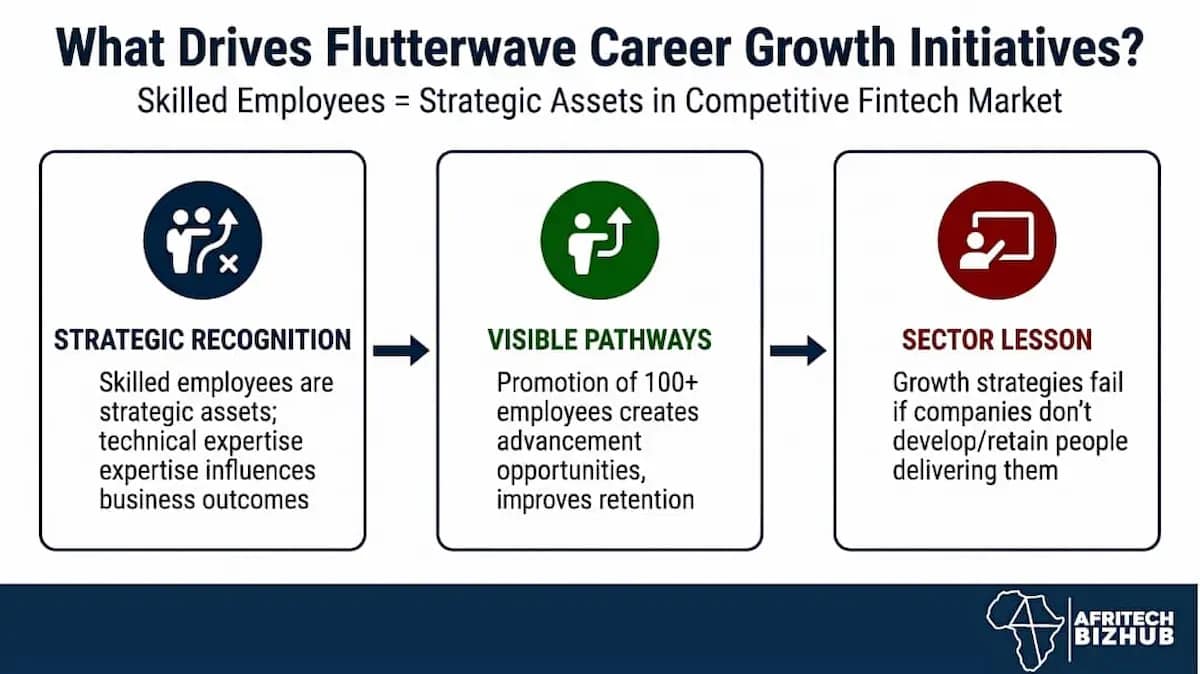
Flutterwave’s career growth initiatives are driven by the recognition that skilled employees are increasingly becoming strategic assets.
Fintech companies operate in highly competitive environments where technical expertise, institutional knowledge, and execution capacity directly influence business outcomes.
The company’s promotion of more than 100 employees signals an effort to create visible pathways for advancement within the organisation.
Employees are more likely to remain committed when they can see opportunities for progression rather than seeking growth elsewhere.
Career development therefore serves both individual ambitions and organisational stability.
The wider lesson for the sector is clear.
Growth strategies built solely around products and market expansion eventually face limits if companies fail to develop and retain the people responsible for delivering them.
Why does Nigeria’s Fintech Boost Talent Retention?
Nigeria’s fintech sector is strengthening talent-retention efforts because the industry increasingly depends on specialised expertise.
Building payment infrastructure, maintaining regulatory compliance, strengthening cybersecurity, managing risk, and developing financial products all require experienced professionals.
The sector is no longer operating in an environment where rapid hiring alone can solve workforce challenges.
Fintech companies are becoming larger, more complex organisations that depend on continuity, accumulated expertise, and operational consistency.
Losing experienced workers can slow execution, increase recruitment costs, and weaken institutional memory.
The reality many firms are confronting is straightforward: replacing talent is often more expensive than retaining it.
That calculation is helping push retention higher on the strategic agenda.
How Does Tech Talent Retention Strategy Work?
Effective tech talent retention strategies combine career progression, employee support, competitive compensation, wellbeing initiatives, and long-term development opportunities.
The objective is not simply to reduce employee departures.
It is to create conditions where skilled workers can build long-term careers within an organisation.
Flutterwave’s latest measures include employee promotions, cost-of-living adjustments, tax-support initiatives for employees in Nigeria, and a global economic-relief package.
Together, these actions suggest a retention strategy that addresses both professional development and financial wellbeing.
The strongest retention strategies rarely focus on compensation alone.
They combine financial support, career visibility, and professional growth into a single workforce strategy.
According to reports on the initiative, the company views employee growth and workforce support as important components of long-term organisational performance rather than standalone HR programmes.
Are Fintech Companies Improving Staff Welfare Packages?
Staff welfare is becoming a more important feature of competition within fintech because employee expectations are changing.
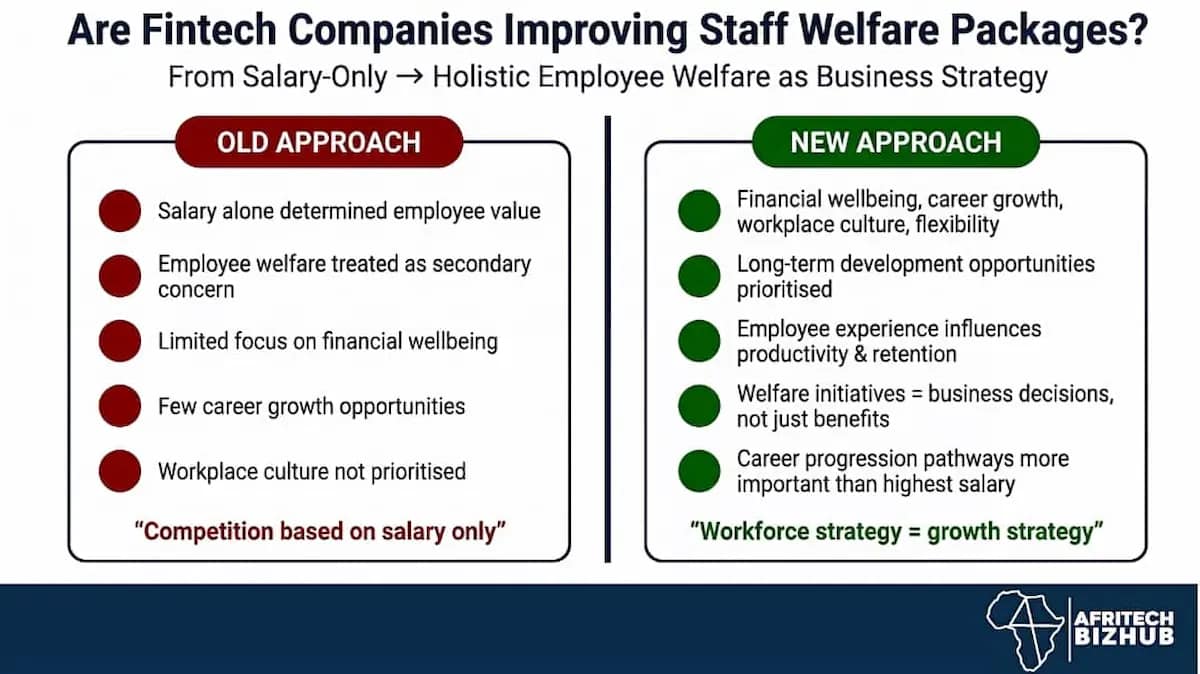
Skilled workers increasingly evaluate employers based on financial wellbeing, career growth, workplace culture, flexibility, and long-term development opportunities rather than salary alone.
The trend reflects a broader shift occurring across technology sectors globally.
Companies that depend on highly specialised talent are recognising that employee experience influences productivity, retention, and organisational performance.
Welfare initiatives are therefore becoming business decisions as much as employee benefits.
The fintech companies most likely to retain skilled workers over the next decade may not be those offering the highest salaries.
They may be those creating the clearest pathways for career progression, financial stability, professional development, and long-term employee growth.
Africa’s fintech sector spent much of the last decade competing for customers.
Increasingly, it is competing for talent.
The companies that recognise workforce strategy as growth strategy may hold a stronger competitive advantage than those that continue treating employee welfare as a secondary concern.


Recent Comments