


Featured Summary:
- Digital procurement is gaining momentum as experts push for greater transparency, efficiency, and accountability across African organisations.
- Financial leakages remain a major challenge across procurement systems in both public and private sectors.
- Supply chain digitisation is becoming increasingly important as businesses manage rising operational complexity.
- Stronger procurement management is emerging as a key driver of business resilience and long-term competitiveness.
Africa’s digital transformation is increasingly moving into areas that receive less public attention but carry significant economic consequences.
Procurement sits near the top of that list.
During recent industry discussions on procurement efficiency, governance, and operational performance, experts argued that African organisations must accelerate digital procurement adoption to reduce financial leakages and strengthen supply-chain visibility.
Across governments, corporations, manufacturers, logistics providers, and service organisations, procurement decisions influence costs, operational efficiency, supplier performance, and financial accountability.
Yet many procurement systems continue relying on fragmented processes that create opportunities for inefficiency, delays, and financial leakages.
The debate is no longer whether procurement will digitise.
It is how quickly organisations can adapt before inefficiencies become a competitive disadvantage.
How is Digital Procurement Transforming Africa’s Industries?
Experts increasingly argue that Digital procurement is becoming necessary rather than optional as organisations face growing pressure to improve transparency, accountability, and operational efficiency.
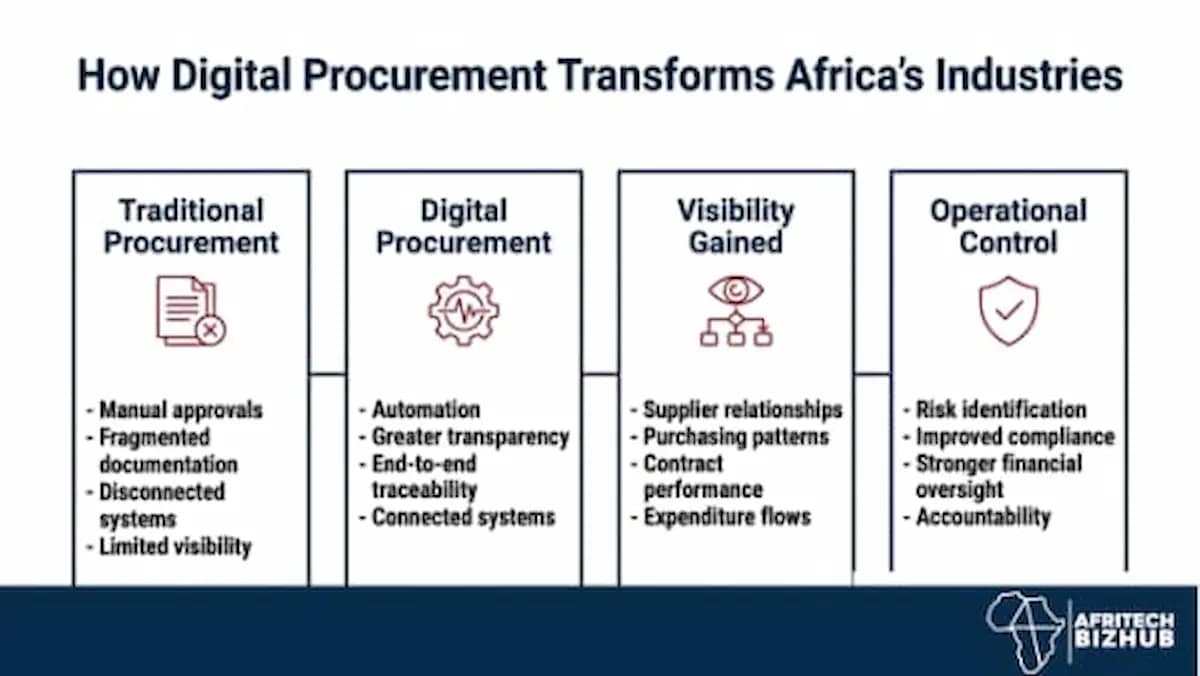
Traditional procurement processes often rely on manual approvals, fragmented documentation, disconnected systems, and limited visibility across procurement cycles.
These conditions create inefficiencies that increase costs and weaken accountability.
Digital procurement introduces greater transparency, automation, and traceability throughout the procurement process.
Organisations gain better visibility into supplier relationships, purchasing patterns, contract performance, and expenditure flows.
The significance extends beyond efficiency.
Digital procurement is increasingly becoming an operational control system that helps organisations identify risks, improve compliance, and strengthen financial oversight.
How can Financial Leakages be Reduced Effectively?
Financial leakages remain one of the most persistent challenges facing procurement systems.
Leakages can emerge through duplicate payments, weak oversight, procurement fraud, unauthorised spending, poor record-keeping, supplier manipulation, and inefficient approval processes.
The consequences often extend beyond financial losses.
They can undermine trust, distort decision-making, and weaken organisational performance.
Reducing financial leakages requires more than stronger controls.
It requires better visibility.
Digital procurement systems provide organisations with real-time monitoring, audit trails, automated verification processes, and stronger reporting capabilities.
The organisations most successful at reducing financial leakages are often those capable of identifying problems before losses occur rather than after investigations begin.
Many organisations still treat procurement as an administrative function even though procurement decisions often determine where financial leakages originate.
Why is Procurement Management Shifting to Digital?
Procurement management is shifting to digital because operational complexity continues increasing across modern supply chains.
Organisations now manage larger supplier networks, more regulatory requirements, greater reporting obligations, and increasingly complex purchasing decisions.
Manual processes struggle to keep pace with those demands.
Digital systems allow procurement teams to automate routine activities, improve data accuracy, monitor supplier performance, and generate more reliable operational insights.
These capabilities support faster decision-making while reducing administrative burdens.
The shift is also becoming a strategic necessity.
Organisations increasingly compete on speed, efficiency, transparency, and operational resilience.
Procurement management increasingly determines how efficiently organisations deploy capital, manage risk, and maintain operational continuity.
What Drives Supply Chain Digitisation in Africa?
Supply chain digitisation is accelerating because businesses require greater visibility into how goods, services, and information move across operational networks.
Recent disruptions across global logistics systems exposed weaknesses in supply chains that lacked transparency, real-time monitoring, and coordinated decision-making capabilities.
Those lessons continue shaping investment decisions across African markets.
According to the World Economic Forum, digital technologies are becoming increasingly important for improving supply-chain visibility, efficiency, resilience, and risk management.
Organisations adopting digital tools are generally better positioned to respond to disruptions, improve forecasting, and strengthen operational performance.
The countries and organisations gaining the greatest advantage from Supply chain digitisation are not necessarily those spending the most on technology.
They are increasingly those integrating technology most effectively into operational decision-making.
How Does Supply Chain Improve Business Resilience?
Business resilience increasingly depends on the ability to anticipate disruption, adapt quickly, and maintain operational continuity under changing conditions.
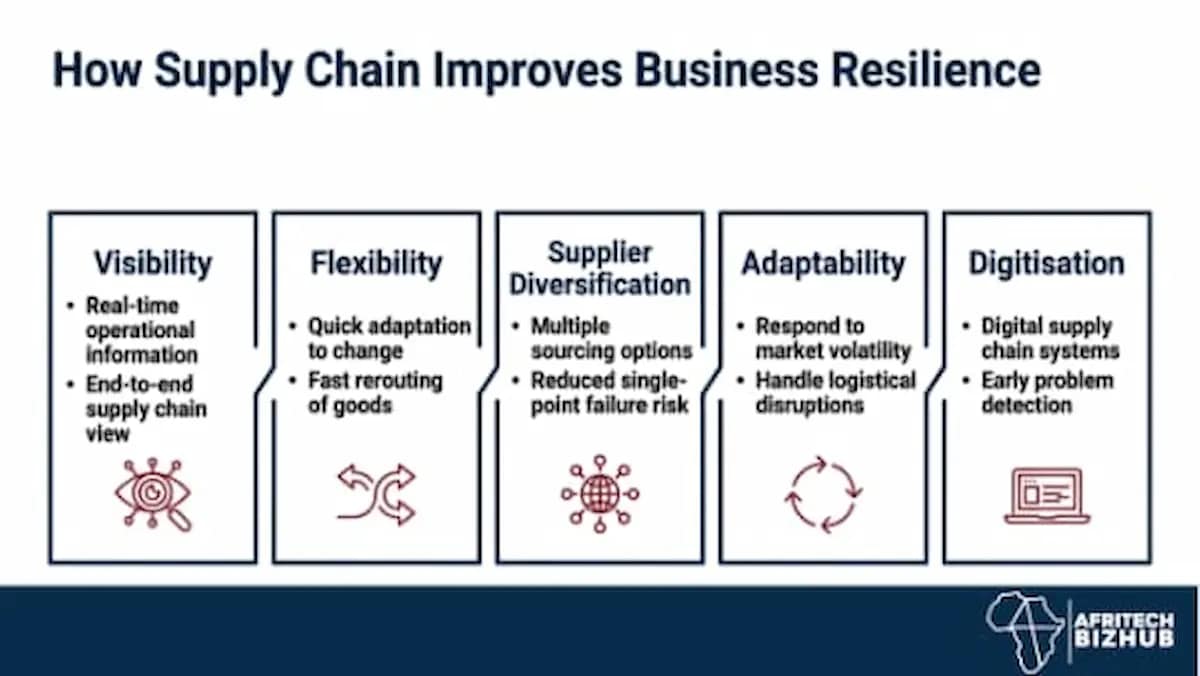
A strong Supply chain improves resilience by providing visibility, flexibility, supplier diversification, and better access to operational information.
Organisations with stronger supply-chain capabilities are generally better positioned to respond to market volatility, logistical disruptions, supplier challenges, and changing customer demand.
The relationship between Supply chain performance and resilience is becoming more important as economic uncertainty increases across global markets.
Businesses can no longer assume that suppliers, logistics networks, or procurement systems will operate without interruption.
The larger lesson emerging across Africa is that resilience is no longer built primarily through inventory or cost control.
It is increasingly built through information, visibility, and adaptability.
Supply chain digitisation may reduce costs and improve efficiency, but its greatest value could be something far more important: helping organisations remain operational when conditions become unpredictable.
In the next phase of competition, organisations may discover that resilience is no longer determined by who spends the most.
It may be determined by who sees problems first.


Recent Comments