


Featured Summary:
- AI Infrastructure is becoming the new battleground for global capital as technology companies pour hundreds of billions into data centres, compute capacity, and energy systems
- Governments increasingly view AI infrastructure as a strategic asset tied to economic competitiveness, digital sovereignty, and national security
- The next AI divide may not be talent or software. It may be who owns the data centres, cloud systems, chips, and power required to run them
- Africa risks becoming a consumer of AI rather than an owner of AI infrastructure unless investment shifts from skills alone to compute, energy, and digital infrastructure
The global AI race is no longer primarily a software race. It is becoming an infrastructure race.
As technology companies and investors pour hundreds of billions of dollars into data centres, compute capacity, energy systems, and cloud infrastructure, the foundations of artificial intelligence are increasingly shifting from algorithms to physical assets.
That shift is becoming visible across global capital markets. Companies such as Meta and Oracle are helping drive an unprecedented wave of investment into the infrastructure required to power the next generation of AI systems.
The countries that build that infrastructure will increasingly shape how AI is developed, deployed, and monetised.
For Africa, the signal is difficult to ignore.
While much of the continent’s AI conversation remains focused on skills, training, and adoption, the world is rapidly investing in the infrastructure that determines who owns the technology stack itself.
The next AI divide may not be about software. It may be about infrastructure.
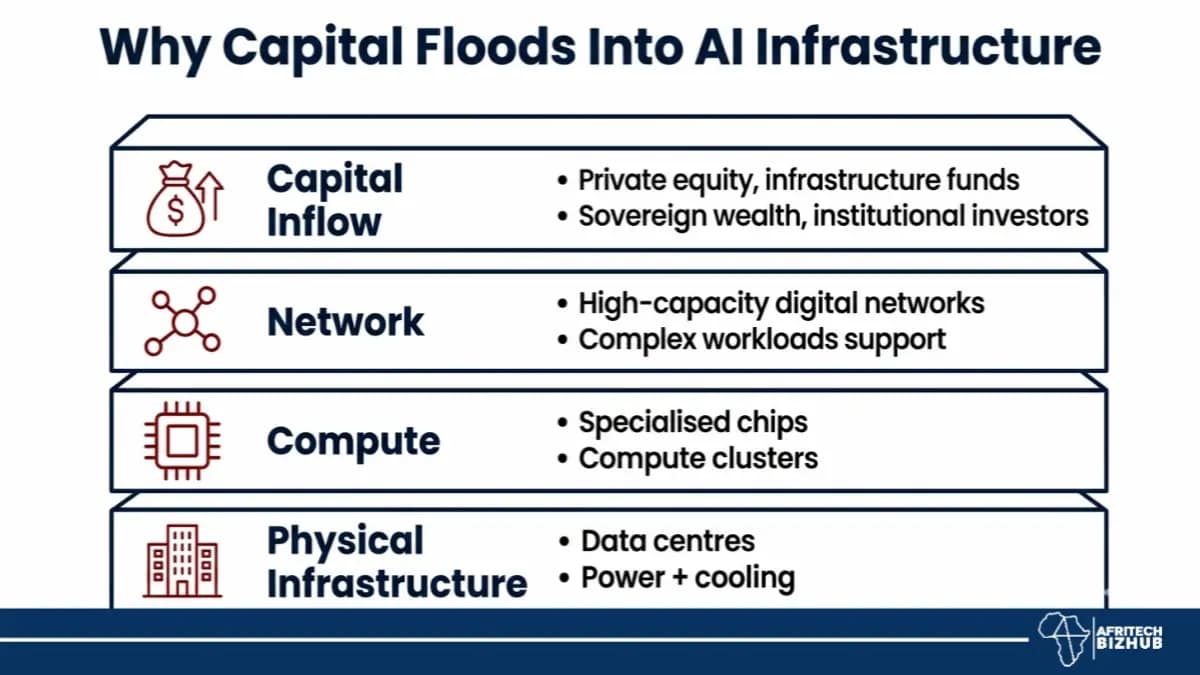
Why Is Capital Flooding Into AI Infrastructure?
The scale of investment reflects the scale of the infrastructure being built.
AI systems require far more than software.
They require data centres, specialised chips, compute clusters, power generation, cooling systems, and high-capacity digital networks capable of supporting increasingly complex workloads.
That reality is reshaping capital markets.
Companies linked to the AI ecosystem are raising unprecedented amounts of financing as investors position for what many now view as a long-term infrastructure cycle rather than a temporary technology trend.
The billions flowing into AI are not being directed primarily toward applications. They are being directed toward the physical systems that make those applications possible.
This helps explain why AI Infrastructure is attracting attention from private equity firms, infrastructure funds, sovereign wealth funds, and institutional investors that historically focused on energy, transport, telecommunications, and utilities.
AI increasingly resembles an infrastructure asset class rather than a software category.
Why Are Governments Treating AI Infrastructure as a Strategic Asset?
Governments are increasingly treating AI infrastructure as a matter of national competitiveness rather than a purely commercial opportunity.
The United States, China, Europe, and Gulf states are all moving to strengthen domestic AI capabilities through investments in compute capacity, data centres, cloud systems, semiconductors, and supporting infrastructure.
The shift reflects a broader recognition that artificial intelligence is becoming part of the strategic foundations of modern economies.
Countries that control critical AI infrastructure are likely to exert greater influence over innovation, productivity, digital services, and future industrial development.
Dependence on infrastructure located elsewhere increasingly carries economic and geopolitical risks.
This is where questions of AI sovereignty become more visible.
Governments are not simply competing to develop better AI systems. They are competing to ensure that the infrastructure powering those systems remains aligned with their national interests.
AI Infrastructure is increasingly being viewed through the same lens as energy security, telecommunications, and other strategic assets that shape long-term economic power.
What Does the Global AI Infrastructure Race Actually Require?
The AI race increasingly depends on assets that rarely appear in discussions about artificial intelligence itself.
Behind every advanced AI system sits a physical infrastructure stack that requires enormous amounts of electricity, specialised chips, cloud capacity, fibre networks, land, cooling systems, and water resources.
That reality is changing the economics of the industry.
Building and operating AI Infrastructure requires long-term financing, skilled technical talent, engineering expertise, and continuous investment in supporting systems capable of handling growing compute demand.
The challenge is no longer simply developing better models. It is sustaining the infrastructure required to run them at scale.
This is the contradiction at the centre of the global AI race.
Artificial intelligence is often presented as a digital technology, yet its future increasingly depends on physical infrastructure.
The countries and companies that secure those foundations are likely to hold a significant advantage as AI adoption accelerates.
Where Does Africa Fit Into the AI Infrastructure Race?
Africa risks entering the AI era from the consumption side rather than the ownership side.
While governments, technology companies, and investors across major economies are financing AI infrastructure, much of Africa remains focused on adoption, skills development, and digital inclusion.
The constraint is increasingly physical.
According to the World Bank, hundreds of millions of people across Sub-Saharan Africa still lack reliable access to electricity, one of the foundational requirements for data centres, cloud infrastructure, and large-scale compute systems.
AI infrastructure cannot operate without power, regardless of how much software talent exists.
The continent also continues to face shortages in data-centre capacity, compute resources, and cloud infrastructure relative to the scale of investment taking place elsewhere.
This is where the global AI race becomes more consequential for Africa.
The continent does not primarily face a talent deficit. It faces an infrastructure deficit.
Unless investment increasingly shifts toward electricity, data centres, connectivity, and compute capacity, Africa risks becoming a consumer of AI technologies whose underlying infrastructure is financed, owned, and controlled elsewhere.
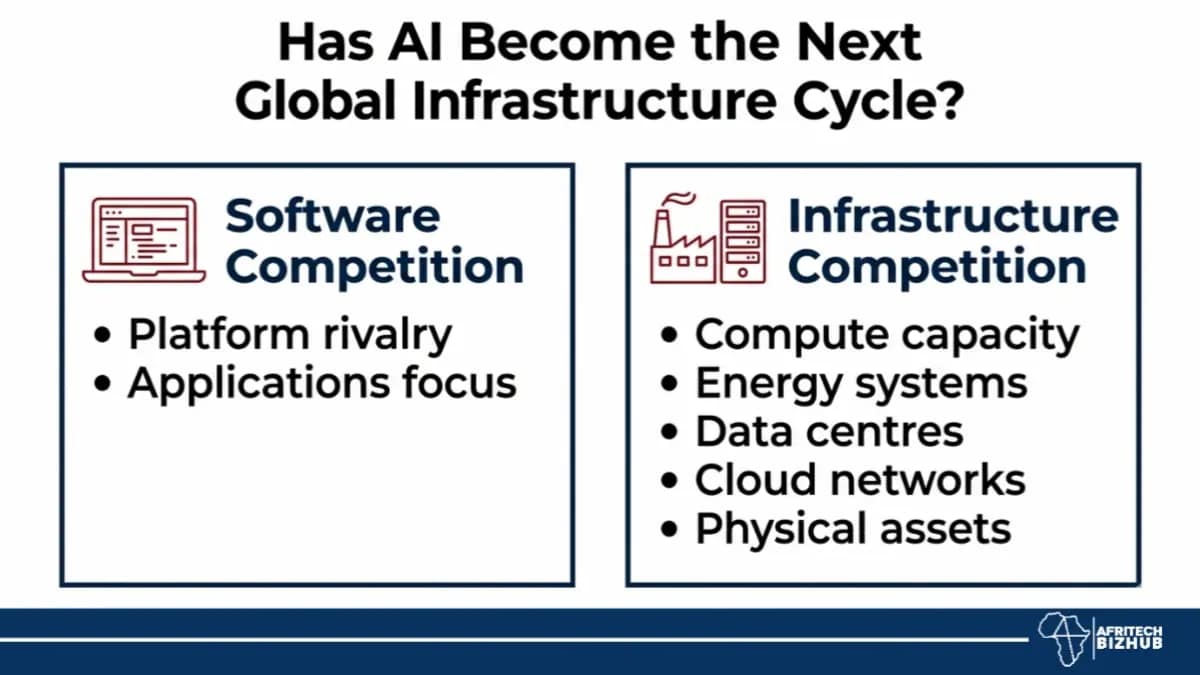
Has AI Become the Next Global Infrastructure Cycle?
The direction of travel is becoming increasingly clear.
AI is evolving from a technology sector into an infrastructure sector.
What began as a competition between software platforms is gradually becoming a competition over compute capacity, energy systems, data centres, cloud networks, and the physical assets that support them.
That shift carries consequences far beyond the technology industry.
Previous infrastructure cycles helped determine which countries captured industrial growth, productivity gains, and economic influence for decades.
AI appears increasingly positioned to follow a similar path.
The value is no longer concentrated solely in applications. It is increasingly being built into the infrastructure that powers them.
The next phase of the AI race may not be decided by who develops the smartest models.
It may be decided by who owns the infrastructure those models depend on.
Countries investing early are positioning themselves to capture that value. Those that delay risk becoming long-term consumers of systems built elsewhere.


Recent Comments