

Featured Summary:
- Global Africa Agenda is becoming a financial project as Afreximbank expands capital deployment beyond the continent
- Afreximbank’s $5 billion Caribbean commitment suggests the bank is building future trade corridors rather than financing existing ones
- Financial infrastructure is increasingly being used to extend Africa’s economic influence across diaspora-linked markets
- The Bahamas strategy signals that Africa’s leading trade bank increasingly views its market as transatlantic rather than purely continental
Afreximbank is increasingly operating beyond the traditional boundaries of African development finance.
What began as a continental trade institution is gradually evolving into something larger: a financial platform designed to connect Africa with diaspora-linked markets through capital, trade, and investment.
The bank’s latest commitment to The Bahamas reflects that shift. On the surface, the announcement appears to be a Caribbean development story.
The deeper signal is that Africa’s premier trade bank increasingly views economic integration through the lens of Global Africa rather than geography alone.
The question is no longer where Africa’s borders end. It is where Africa’s economic influence can reach.
Why Is Afreximbank Investing in The Bahamas?
Afreximbank’s $5 billion Caribbean commitment makes little sense under a traditional trade-finance framework.
Current trade volumes between Africa and the Caribbean remain relatively small, yet the bank continues expanding its financing presence across the region.
The explanation appears increasingly strategic rather than transactional.
Afreximbank is treating parts of the Caribbean not as external markets but as components of a broader Global Africa economic space.
The objective is not simply to support existing commerce. It is to strengthen the financial, institutional, and commercial links that could support future trade and investment flows.
That distinction matters. Most trade banks finance activity that already exists.
Afreximbank increasingly appears willing to position capital ahead of commercial activity in the belief that the corridor will eventually follow.
What Is the Global Africa Agenda?
The Global Africa Agenda expands economic integration beyond the continent itself.
Rather than viewing Africa as a geographically defined market, the framework increasingly treats diaspora-linked economies as potential participants in shared trade, investment, and financial systems.
This represents a significant departure from earlier integration efforts.
AfCFTA focuses on connecting African markets to one another.
The Africa Global Agenda seeks to connect African institutions to a wider economic space that includes parts of the Caribbean and other diaspora-linked regions.
The objective is not cultural solidarity. It is commercial integration.
That helps explain why Afreximbank continues deploying capital into relationships that may appear peripheral today.
The institution increasingly appears to be positioning for a future market that extends beyond Africa’s physical borders.
Why Is Afreximbank Building New Africa-Caribbean Trade Corridors?
Current trade volumes between Africa and the Caribbean remain small compared with Africa’s commercial relationships with Europe, Asia, and North America.
By conventional development banking standards, that reality would justify caution rather than aggressive capital deployment.
Afreximbank is taking a different view. The institution has expanded its Caribbean financing commitment to $5 billion despite relatively modest trade flows.
The significance lies in the gap between present activity and future ambition.
The bank appears less focused on financing existing commerce than on creating the conditions for larger commercial relationships to emerge.
That reflects a broader strategic calculation.Trade corridors rarely appear spontaneously.
They are built through infrastructure, financing, settlement systems, and institutional relationships that make commercial activity possible.
Afreximbank is positioning capital ahead of demand in the belief that the corridor will eventually follow.
Most trade banks finance activity. Afreximbank increasingly finances geography itself.
How Does Financial Infrastructure Expand Economic Influence?
Economic influence increasingly follows infrastructure rather than diplomacy.
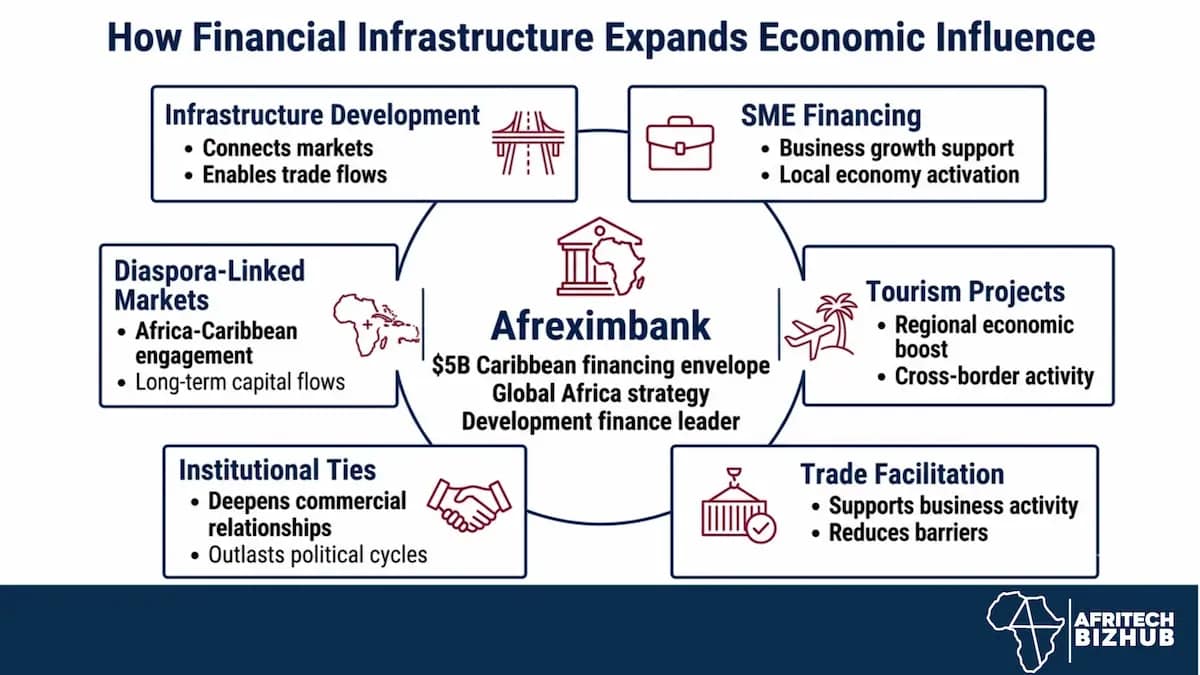
According to Afreximbank, the institution has expanded its Caribbean financing envelope to $5 billion while supporting infrastructure development, SME financing, tourism projects, trade facilitation initiatives, and broader economic development efforts across the region.
These investments do more than finance projects.
They deepen commercial relationships, strengthen institutional ties, and create networks that can outlast political cycles. Infrastructure connects markets.
Trade facilitation supports business activity. Financing creates long-term engagement between institutions operating across different regions.
This is where the Global Africa Agenda strategy becomes more visible.
Development finance has always carried strategic implications, but the scale is changing.
Influence increasingly follows capital deployment rather than diplomatic presence.
Afreximbank appears to be building financial relationships that could shape future trade and investment flows across Africa and diaspora-linked markets.
Is Afreximbank Becoming a Global Africa Financial Platform?
The deeper implication of the Bahamas strategy is not about The Bahamas.
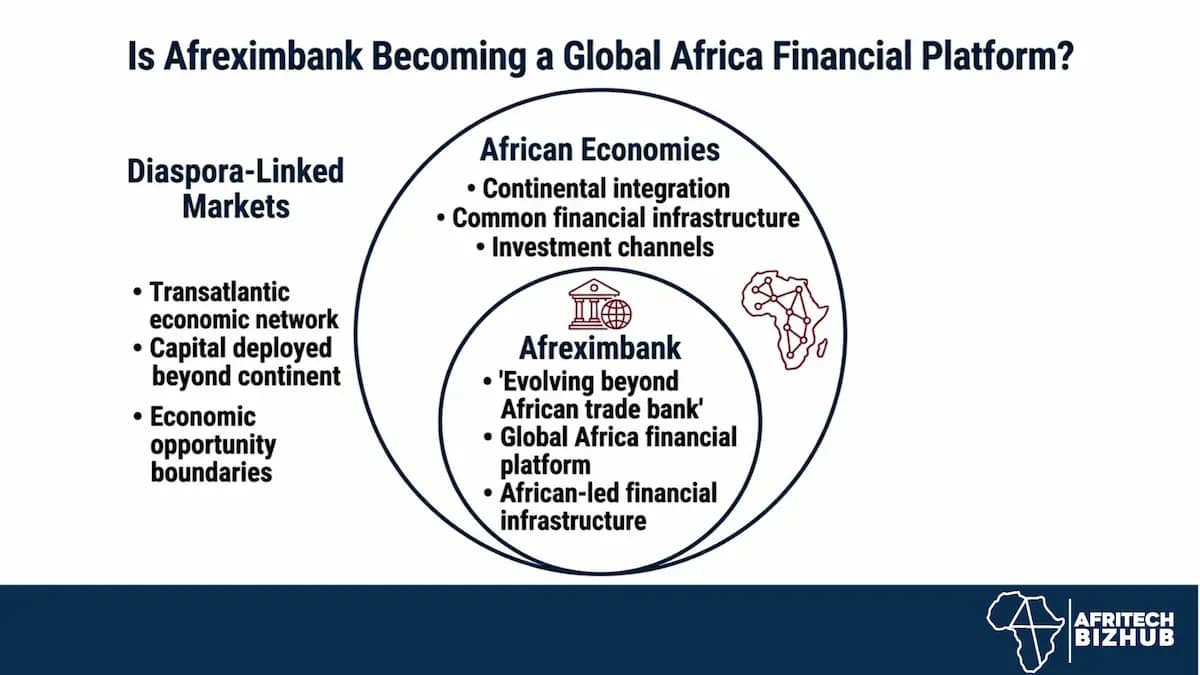
It is about the evolution of Afreximbank itself. The institution increasingly resembles more than an African trade bank.
It is positioning itself as a Global Africa Agenda financial platform capable of connecting African economies with diaspora-linked markets through common financial infrastructure, investment channels, and commercial networks.
For decades, African institutions largely operated within boundaries defined by geography.
Afreximbank increasingly appears to operate within boundaries defined by economic opportunity.
That shift is becoming visible through its willingness to deploy capital beyond the continent in pursuit of longer-term commercial integration.
If the Global Africa Agenda strategy continues to advance, the most important market Africa builds during the next decade may not be confined to the continent itself.
It may be a transatlantic economic network shaped by African institutions, financed through African capital, and connected through African-led financial infrastructure.
The next phase of African integration may not be geographic. It may be institutional.


Recent Comments