


Last updated: May 30, 2026
Featured Summary:
- Federal Reserve Rate Cuts may lower borrowing costs, but they are unlikely to restore the cheap-money era that powered global risk-taking
- Global capital has already repriced risk, rewarding resilience, policy credibility, and domestic funding strength over growth narratives
- Africa and other frontier markets remain exposed to dollar scarcity, refinancing pressure, and more selective capital flows
- The next winners may be economies that adapt to tighter capital conditions rather than wait for Western monetary relief
Global markets remain fixated on one question: when will the Federal Reserve begin cutting interest rates?
That question continues to shape investment decisions, sovereign borrowing strategies, and corporate refinancing plans across much of the developing world.
Governments are hoping lower U.S. rates will ease pressure on external debt markets.
Corporate treasurers are delaying difficult refinancing decisions. Investors continue searching for signals that financial conditions are preparing to loosen.
The assumption behind those decisions is simple: Federal Reserve Rate Cuts will eventually restore easier access to capital and revive the conditions that defined the cheap-dollar era.
Markets may be underestimating how much the underlying structure of global capital has already changed.
The problem is that lower rates may arrive without restoring the financial environment everyone is waiting for.
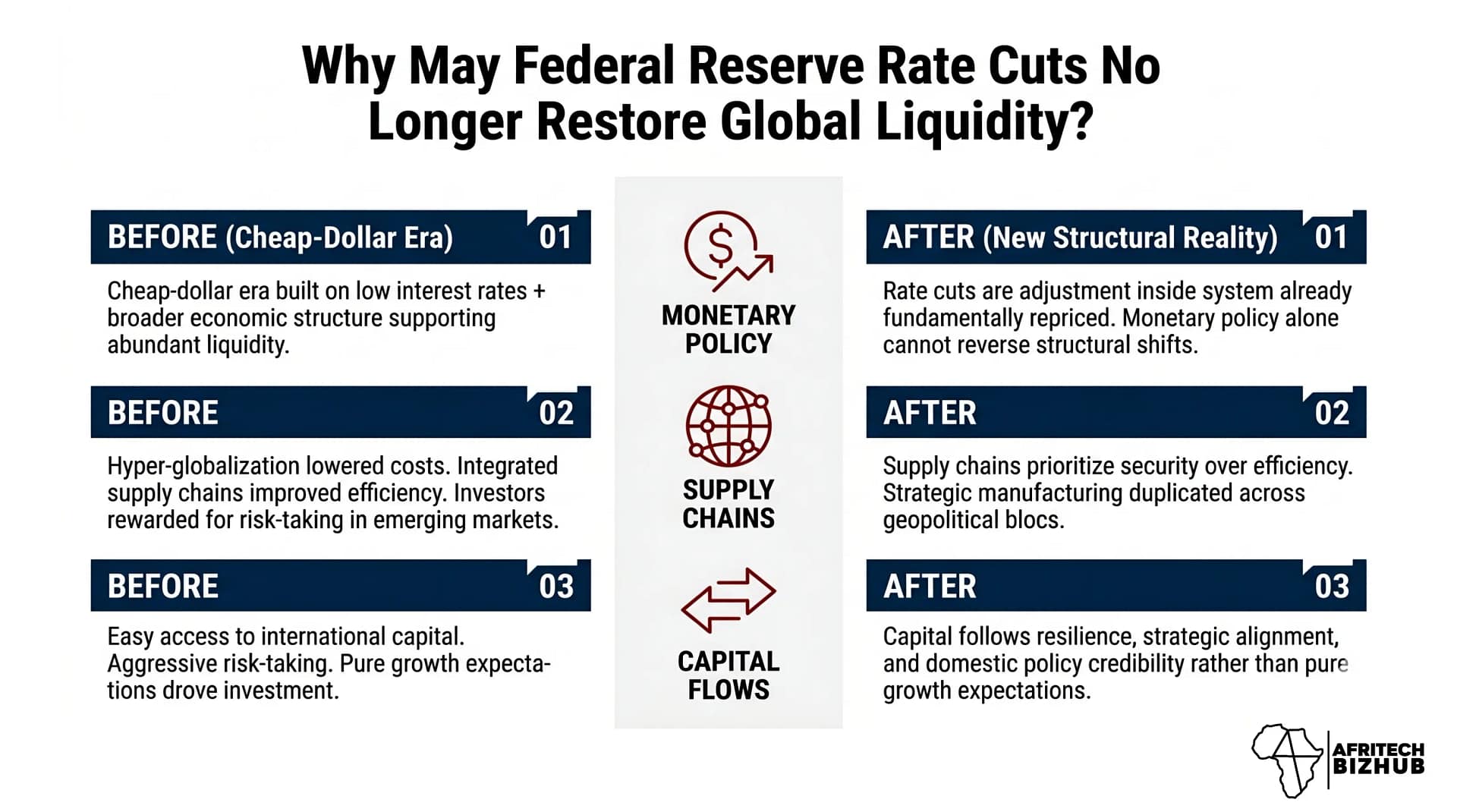
Why May Federal Reserve Rate Cuts No Longer Restore Global Liquidity?
Markets are treating Federal Reserve Rate Cuts as a catalyst for easier capital conditions.
They may prove to be an adjustment inside a system that has already been fundamentally repriced.
The cheap-dollar era was never simply a product of low interest rates. It was built on a broader economic structure that supported abundant global liquidity, aggressive risk-taking, and relatively easy access to international capital.
Hyper-globalization lowered costs. Integrated supply chains improved efficiency. Investors were rewarded for extending risk into emerging and frontier markets.
The conditions that supported that environment are becoming less durable. Supply chains increasingly prioritize security over efficiency. Industrial policy has returned.
Strategic manufacturing is being duplicated across geopolitical blocs. These are structural shifts that monetary policy alone cannot reverse.
Capital increasingly follows resilience, strategic alignment, and domestic policy credibility rather than pure growth expectations.
That may prove more important to the next global capital cycle than the timing of Federal Reserve Rate Cuts.
How Has Global Capital Repriced Risk Since Higher Interest Rates Returned?
The most important shift is not happening inside the Federal Reserve. It is happening inside capital allocation itself.
The result is a more selective capital environment. Investors are demanding stronger policy credibility, deeper domestic funding capacity, greater resilience to external shocks, and clearer paths to financial stability.
Growth potential alone is no longer enough. Markets with fragile currencies, elevated debt burdens, and heavy external financing dependence face a much higher hurdle than they did during the low-rate era.
Risk has already been repriced. Many governments simply continue operating as though it has not.
Why Are Frontier Markets Still Exposed to Dollar Scarcity?
For frontier markets, stronger dollar conditions continue to create pressure across balance sheets.
Debt-servicing costs remain elevated. Foreign portfolio flows have become more selective.
Dollar scarcity continues to expose vulnerabilities across import-dependent economies.
Sovereigns facing refinancing pressure remain vulnerable to shifts in investor sentiment, while corporates must navigate borrowing conditions that are structurally tighter than those of the previous decade.
Dollar liquidity is no longer constrained only by interest rates. It is increasingly shaped by where global capital chooses to take risk.
Yet many financing assumptions still reflect a world in which Federal Reserve Rate Cuts automatically translate into easier access to capital.
That assumption is becoming increasingly dangerous.
What Does This Mean for Africa’s Debt Refinancing Outlook?
Africa remains particularly exposed because many economies continue managing external debt obligations while waiting for global financing conditions to improve.
The IMF’s April 2026 Regional Economic Outlook warned that many Sub-Saharan African economies continue facing elevated refinancing risks as global financing conditions remain tight and external borrowing costs remain above pre-pandemic norms.
Debt vulnerabilities remain closely linked to shifts in global financial conditions and investor risk appetite.
Many refinancing strategies still assume external liquidity will become materially cheaper.
That assumption may be carrying more risk than the debt itself. The longer governments and firms delay adjustment, the more expensive that adjustment becomes.
Refinancing pressure gradually becomes solvency pressure. Temporary funding stress evolves into a structural competitiveness challenge.
The uncomfortable reality is that some African economies may not be facing a temporary financing squeeze. They may be confronting a more durable shift in how international capital prices risk.
Which Economies Will Benefit Most From the Next Global Capital Cycle?
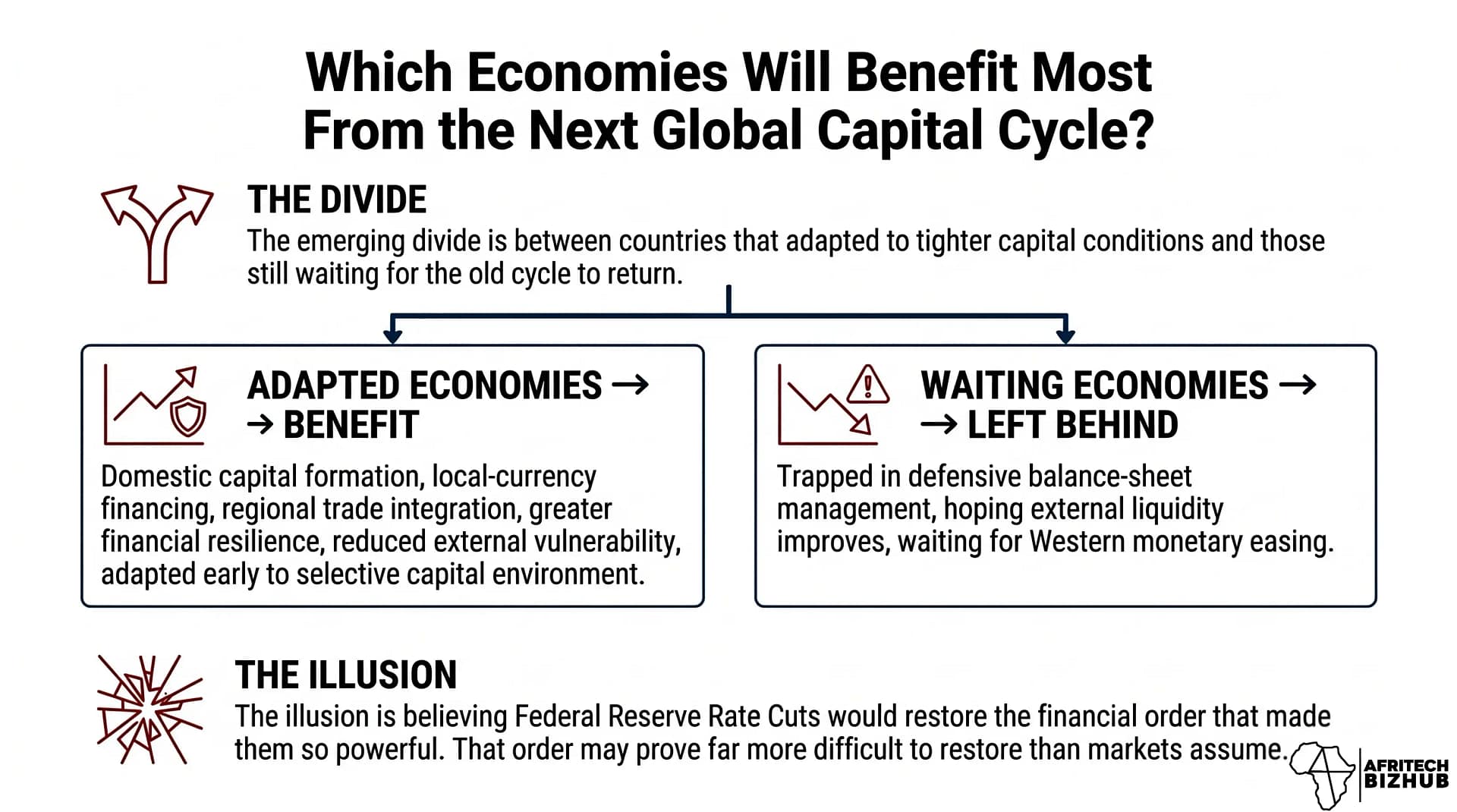
The emerging divide is no longer between countries that receive rate relief and those that do not.
It is between countries that adapted to tighter capital conditions and those still waiting for the old cycle to return.
Some are moving toward domestic capital formation, local-currency financing, regional trade integration, and greater financial resilience.
Others remain trapped in defensive balance-sheet management while hoping external liquidity conditions improve.
The illusion is not that Federal Reserve Rate Cuts may eventually happen.
The illusion is believing Federal Reserve Rate Cuts would restore the financial order that made them so powerful in the first place.
That order may prove far more difficult to restore than markets currently assume.
The next global capital cycle is likely to reward economies that strengthened domestic funding capacity, reduced external vulnerability, and adapted early to a more selective capital environment, not those that waited longest for Western monetary easing.


Recent Comments