


Featured Summary:
- Africa private capital posted a stronger fundraising quarter, but weaker disclosure made recovery harder to fully evaluate
- Development finance remained disproportionately important to fundraising momentum while broader market participation stayed less visible
- Domestic African asset pools remain substantially larger than deployed growth capital, yet industrial financing still depends heavily on external balance sheets
- External liquidity can stabilize investment cycles, but industrial scale will depend on whether domestic capital begins financing production
Africa private capital market produced a number large enough to change the narrative.
Fundraising commitments reached $870 million in Q1 2026, the strongest opening quarter since 2023 according to Stears reporting published by BusinessDay. Recovery headlines followed quickly.
The underlying signal was less straightforward.
Only 42 percent of limited-partner commitments disclosed actual commitment values, down from 47 percent in the previous quarter.
More capital entered the headline while less of the market became measurable.
That distinction matters because durable recoveries usually become easier to evaluate as participation broadens, not harder.
The rebound was real. The confidence attached to it remains less certain.
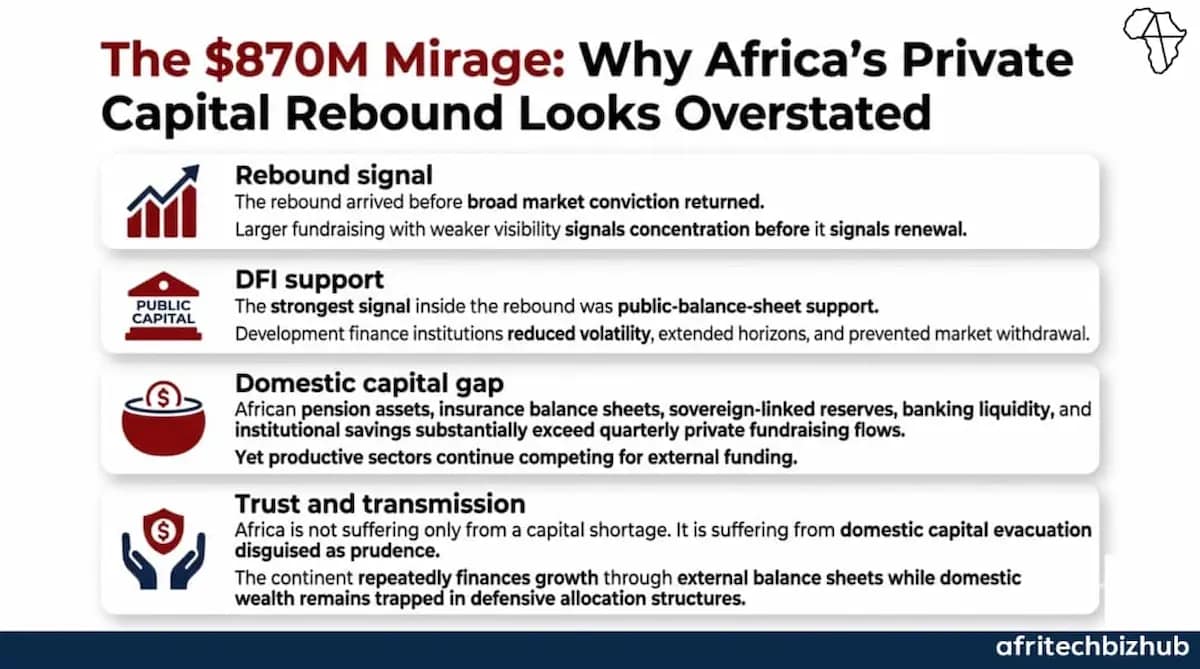
The $870M Mirage: Why Africa Private Capital Rebound Looks Overstated
The fundraising rebound arrived before broad market visibility improved. Stears recorded 78 LP commitments in Q1 2026 against 57 in the previous quarter.
The headline suggests stronger activity. The disclosure profile complicates that conclusion.
Less than half of commitments disclosed values, making the rebound easier to headline than to fully evaluate across the market.
That distinction changes the meaning of recovery. Private capital does not become durable because a quarterly total improved.
It becomes durable when participation broadens, pricing becomes easier to interpret, and disclosure strengthens.
Larger fundraising with weaker visibility signals concentration before it signals renewal.
The State-Subsidized Market: Why DFI Liquidity Is Replacing Commercial Conviction
The strongest visible signal inside the rebound did not come from broad private-capital participation.
It came from development-finance balance sheets. The largest disclosed allocation came from the European Investment Bank at approximately $210 million.
European development institutions remained among the most visible allocators in the quarter.
That concentration matters because it changes how the fundraising rebound should be interpreted.
This pattern did not begin in 2026. AVCA reported that development finance institutions accounted for approximately 42 percent of Africa private capital fundraising value in 2024.
DFIs matter. They reduce volatility, extend investment horizons, and absorb uncertainty. But stabilisation is not the same thing as market recovery.
The fundraising rebound appears more concentrated than broad-based and continued to rely heavily on visible development-finance participation.
That does not invalidate the recovery. It suggests public-backed capital remained disproportionately important to sustaining fundraising momentum while broader market participation stayed harder to observe.
The $4 Trillion Constraint: Why African Capital Struggles To Finance Production
The harder number in this story is not $870 million. It is roughly $4 trillion.
African institutional and financial asset pools are measured in the trillions of dollars across banking assets, pensions, insurers, sovereign assets, and reserves, although only a portion is realistically available for long-duration productive deployment.
Yet productive sectors continue competing for external funding.
That contrast exposes a deeper structural constraint inside Africa private capital. The continent is not suffering only from a capital shortage.
It is also facing a deployment challenge where large domestic asset pools remain positioned more defensively than industrial financing demand.
Risk controls, prudential requirements, currency instability, and governance concerns explain caution. They do not fully explain the financing gap.
The continent continues relying heavily on external balance sheets for long-duration and higher-risk financing while substantial domestic assets remain concentrated in lower-risk allocation structures.
That is not scarcity.
That is transmission failure.
The Regulatory Contradiction: Africa Built Payment Rails but Preserved Capital Fear
Africa integrated movement faster than it integrated capital allocation. AfCFTA was created to deepen regional trade and investment.
PAPSS was launched to reduce settlement friction and support local-currency payment execution across African markets.
The infrastructure logic is clear. Goods should move faster. Settlement should become cheaper. Regional commerce should deepen.
Financial integration remains harder.
Cross-border payment architecture improved across the continent, but institutional capital still operates under fragmented regulatory environments, prudential requirements, currency constraints, and market structures that continue shaping where long-duration capital is willing to move.
Africa reduced friction around moving transactions faster than it reduced friction around deploying capital across borders.
That distinction matters.
PAPSS can improve settlement efficiency. AfCFTA can lower commercial barriers. Neither mechanism automatically creates institutional risk appetite, deeper regional balance sheets, or larger pools of deployable industrial finance.
Africa liberalized movement infrastructure faster than it liberalized institutional trust.
Trade corridors moved.
Balance sheets moved more slowly.
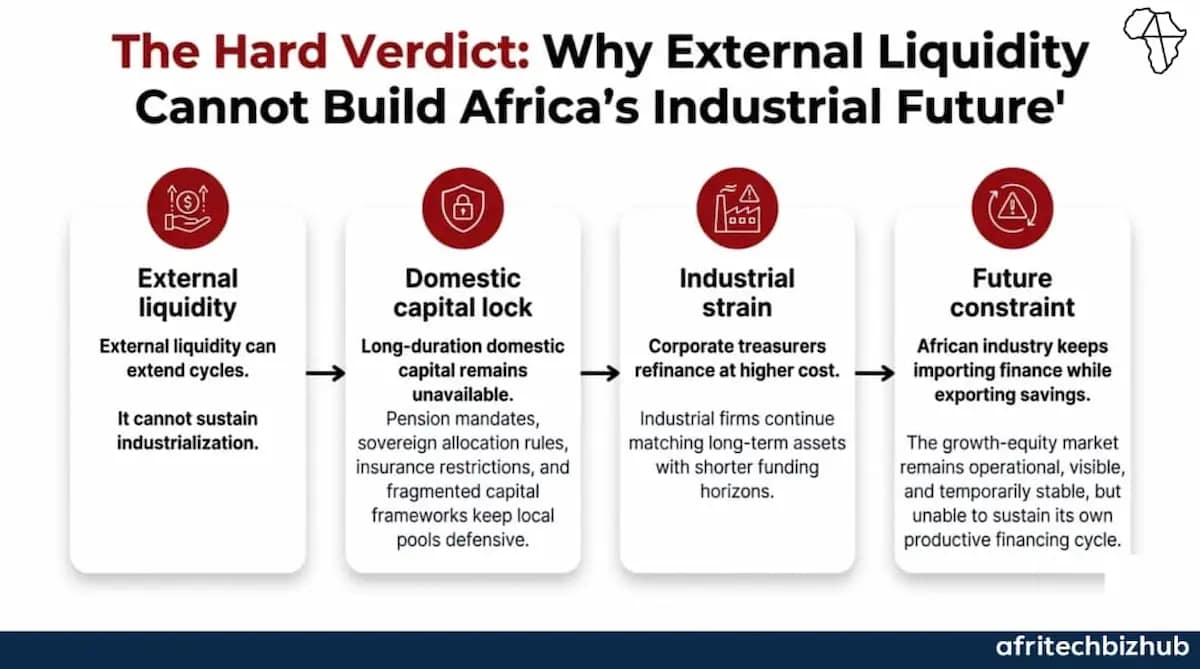
The Hard Verdict: Why External Liquidity Cannot Build Africa’s Industrial Future
External liquidity can extend cycles. It cannot sustain industrialization. The immediate consequence does not appear in fundraising reports. It appears inside treasury desks.
Corporate treasurers refinance at higher cost because long-duration domestic capital remains unavailable.
Industrial firms continue matching long-term assets with shorter funding horizons.
Infrastructure developers keep structuring projects around external lenders because local pools rarely move at comparable scale.
That model works while external conditions remain supportive. It becomes more expensive the moment external liquidity reprices.
If pension mandates remain defensive, sovereign allocation rules remain inward-looking, insurance restrictions continue limiting productive deployment, and regional capital frameworks remain fragmented, African industry will continue importing finance while exporting savings.
Africa private capital increasingly resembles an externally supported financing system: operational, visible, and temporarily stable, but still unable to sustain its own productive capital cycle.
The next phase of African growth will likely be determined less by new trade agreements, fundraising headlines, or payment infrastructure announcements and more by whether domestic balance sheets begin financing production before external liquidity becomes more selective.


Recent Comments