


Featured Summary:
- MTN Nigeria plans to pass 8 million homes with fibre infrastructure over the next five years.
- Broadband expansion increasingly supports streaming, remote work, cloud services, and connected households.
- Telecom infrastructure investment is shifting toward higher-capacity fixed broadband networks.
- Fixed broadband is expanding alongside mobile internet rather than replacing it.
Nigeria’s digital economy was built on mobile connectivity, but rising data consumption is exposing the limits of a mobile-first infrastructure model.
Households, businesses, and digital platforms are placing heavier demands on network capacity as internet usage becomes more data-intensive.
MTN Nigeria’s plan to pass 8 million homes with fibre over the next five years signals a broader shift in telecom infrastructure investment toward fixed broadband networks capable of supporting long-duration, high-capacity connectivity.
How will MTN Nigeria Fibre Connect Homes?
The rollout marks a deeper push into residential broadband infrastructure as internet usage moves beyond basic smartphone activity.
Fibre networks provide the capacity required for households where multiple users, devices, and digital services operate simultaneously.
That includes video consumption, online learning, connected devices, enterprise applications, and other activities that place sustained pressure on network performance.
The significance extends beyond speed alone.
MTN Nigeria fibre expands access to infrastructure built for heavier and more consistent data demand.
As digital participation becomes increasingly embedded in daily economic activity, fixed broadband is becoming an important layer of connectivity rather than a premium alternative.
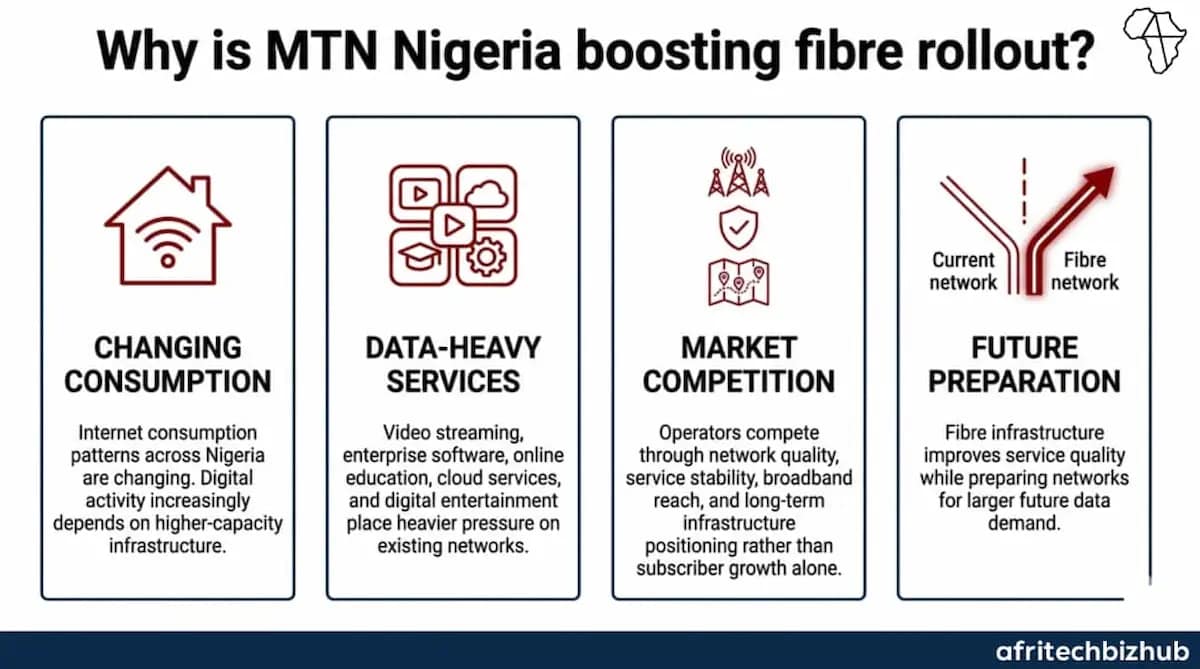
Why is MTN Nigeria Boosting Fibre Rollout?
Internet consumption patterns are changing faster than traditional network architecture.
Data traffic continues to rise as businesses digitise operations, households consume more online content, and cloud-based services become more widely used across the economy.
Those trends are increasing demand for broadband networks capable of handling larger and more continuous workloads.
The investment also reflects a competitive shift inside Nigeria’s telecom sector.
Subscriber growth is no longer the only measure of market position.
Network quality, service reliability, broadband reach, and infrastructure ownership are becoming increasingly important as operators position for the next phase of digital growth.
Fibre rollout strengthens MTN Nigeria’s long-term position in that environment.
How Fast is Broadband Expansion Across Nigeria?
Broadband expansion is increasingly becoming a central component of Nigeria’s digital infrastructure strategy.
Telecom operators, infrastructure providers, and policymakers continue pushing for wider internet penetration as demand grows across households, businesses, schools, and digital platforms.
The expansion of fibre networks reflects expectations that internet usage will continue rising across nearly every segment of the economy.
MTN Nigeria’s FibreX programme forms part of that wider trend.
According to the company, the service is designed to provide high-speed fixed broadband access to homes and businesses through fibre infrastructure.
The continued expansion of broadband networks suggests operators are positioning for a future where digital activity requires greater capacity, reliability, and coverage than mobile networks alone can efficiently provide.
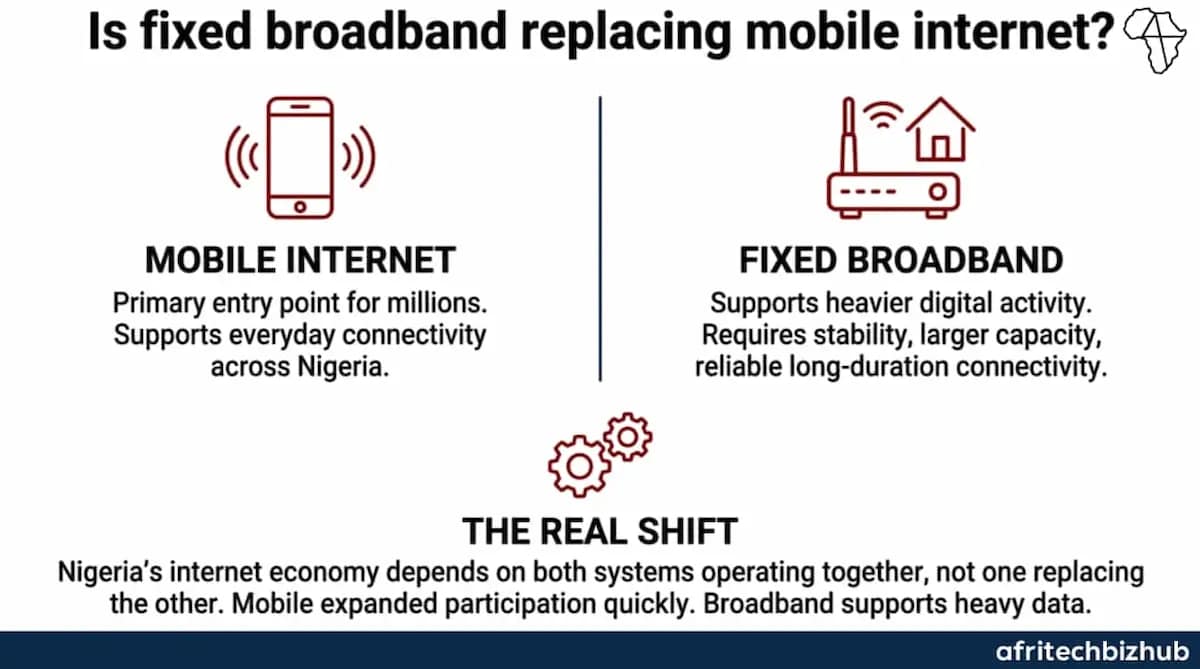
Is fixed Broadband Replacing Mobile Internet?
Nigeria’s internet economy still runs primarily on mobile connectivity.
Smartphones remain the main access point for digital services, financial transactions, communication, and online participation for millions of users across the country.
That foundation is unlikely to change in the near term.
The larger shift is occurring underneath the market.
Mobile networks created digital access at scale, while fixed broadband is increasingly being deployed to handle the growing volume of data-intensive activity that follows.
The question is no longer whether mobile internet remains relevant.
The question is whether Nigeria’s digital economy can continue expanding without a corresponding increase in fixed broadband capacity.
Fibre investment is increasingly becoming part of that answer.


Recent Comments