


Featured Summary:
- Africa Jobs Fund plans to mobilise $100 million toward job creation across African industries.
- Export manufacturing and labour mobility sit at the center of the fund’s employment strategy.
- African employment pressure increasingly reflects limited access to stable and higher-income work.
- African job funds are focusing more on industries capable of employing workers at larger scale.
Africa’s employment challenge is becoming increasingly structural.
Millions of workers enter labour markets every year, yet formal job creation remains concentrated in too few sectors to absorb demand at scale.
Daniel Yu’s Africa Jobs Fund enters that debate with a $100 million employment thesis centred on export manufacturing and labour mobility.
The proposition is straightforward: Africa does not lack workers. It lacks enough industries capable of employing them productively.
How will Jobs Fund Transform Jobs in Africa?
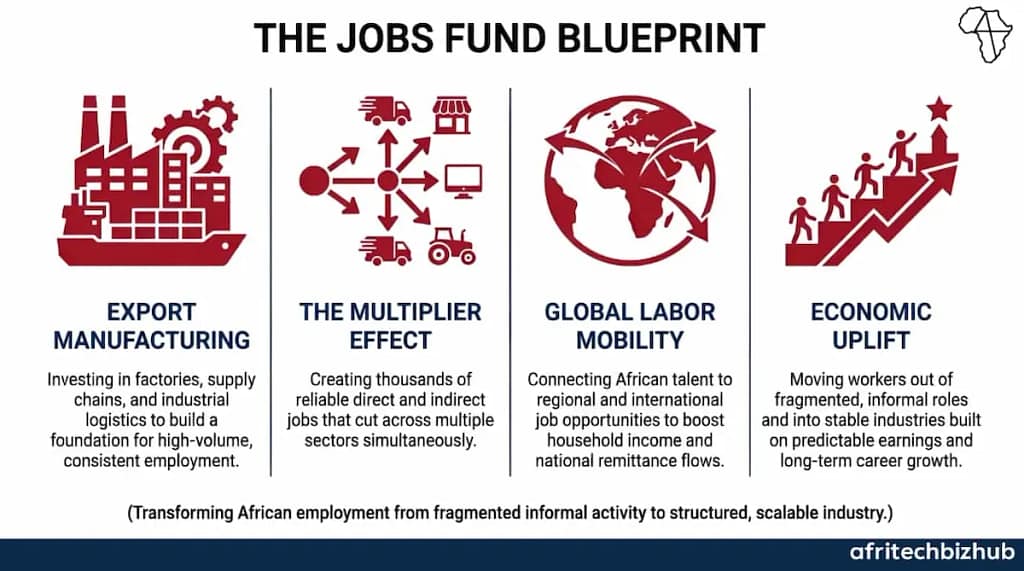
The fund is placing its bet on sectors where employment scales beyond individual enterprises and into wider economic ecosystems.
Export manufacturing sits at the centre of that thesis.
Factory floors create jobs, but industrial activity also generates demand across logistics, warehousing, transport networks, maintenance services, and supply chains.
Labour mobility provides a second growth channel.
Large sections of Africa’s workforce remain disconnected from labour demand beyond domestic borders despite persistent skills shortages across international markets.
Connecting workers to those opportunities expands income access while increasing remittance flows into African economies.
The strategy ultimately seeks to push employment away from fragmented survival activity and towards sectors with greater stability and earning potential.
Can African Employment Rise Through Job Creation?
Demographics continue to dominate the employment discussion.
Africa adds millions of new labour-market entrants annually, while formal employment creation struggles to keep pace.
Economic growth alone has not solved that imbalance. In many markets, output has expanded faster than opportunity.
That reality explains the growing attention on export manufacturing and labour-intensive industries.
Large industrial sectors absorb workers across multiple layers of the economy, from production lines to transport corridors and business services.
Labour mobility expands that equation further by linking workers to demand where shortages already exist.
Employment pressure eases when industries hire at scale, not when economies simply grow on paper.
Is Job Creation Driven by African Jobs Fund?
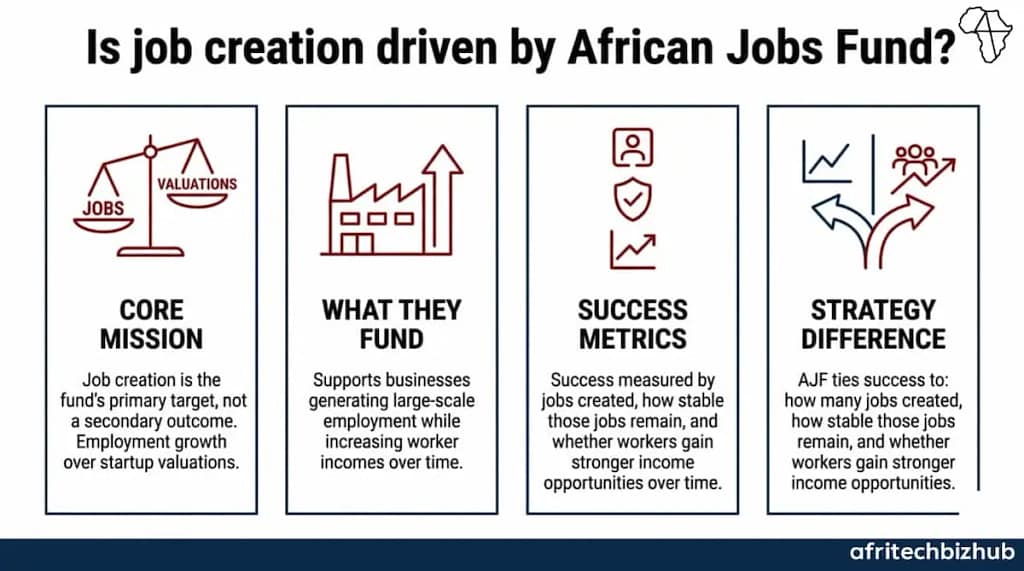
Employment growth is not presented as a by-product of investment.
It is the investment objective itself.
According to the Africa Jobs Fund, capital deployment will focus on businesses capable of generating large-scale employment while improving worker incomes over time.
That emphasis reflects a broader institutional shift.
Development finance institutions, labour-market programmes, and economic policymakers increasingly evaluate investment through employment outcomes rather than capital formation alone.
The underlying concern is becoming harder to ignore.
Growth that fails to create jobs eventually weakens consumption, limits productivity gains, and intensifies social pressure.
The fund positions itself directly within that debate.
Why is Jobs Fund Targeting African industries?
Industrial sectors remain one of the few proven pathways to large-scale employment expansion.
Manufacturing rarely creates jobs in isolation.
It supports transport operators, logistics providers, packaging businesses, warehousing networks, maintenance firms, and service companies that emerge around production activity.
That multiplier effect explains why export-oriented industries continue attracting attention from employment-focused investors.
The future of Africa jobs is unlikely to be decided by headline GDP growth rates.
It will be determined by whether economies can expand industries capable of employing workers consistently and at scale.
The continent’s labour challenge is becoming a race between demographic growth and productive job creation.
That race is accelerating.


Recent Comments