


Last updated: May 30, 2026
Featured Summary:
- AI Tutor platforms are expanding science learning access across West Africa through mobile-first education tools.
- WhatsApp AI increasingly supports low-friction learning access where smartphones remain the primary digital device.
- Edtech Africa platforms are positioning AI learning as a response to teacher shortages and uneven science education access.
- AI-powered assessments are changing how students receive feedback and personalised learning support.
Science education across West Africa faces a capacity challenge.
Student demand continues rising, while teacher availability, classroom resources, and laboratory access remain uneven across many education systems.
AI Tutor platforms are increasingly being deployed into that gap, using WhatsApp AI and other mobile-first channels to expand science learning, assessment support, and personalised educational assistance at scale.
The question is shifting from whether digital learning can support classrooms to how much of the learning burden technology can realistically absorb.
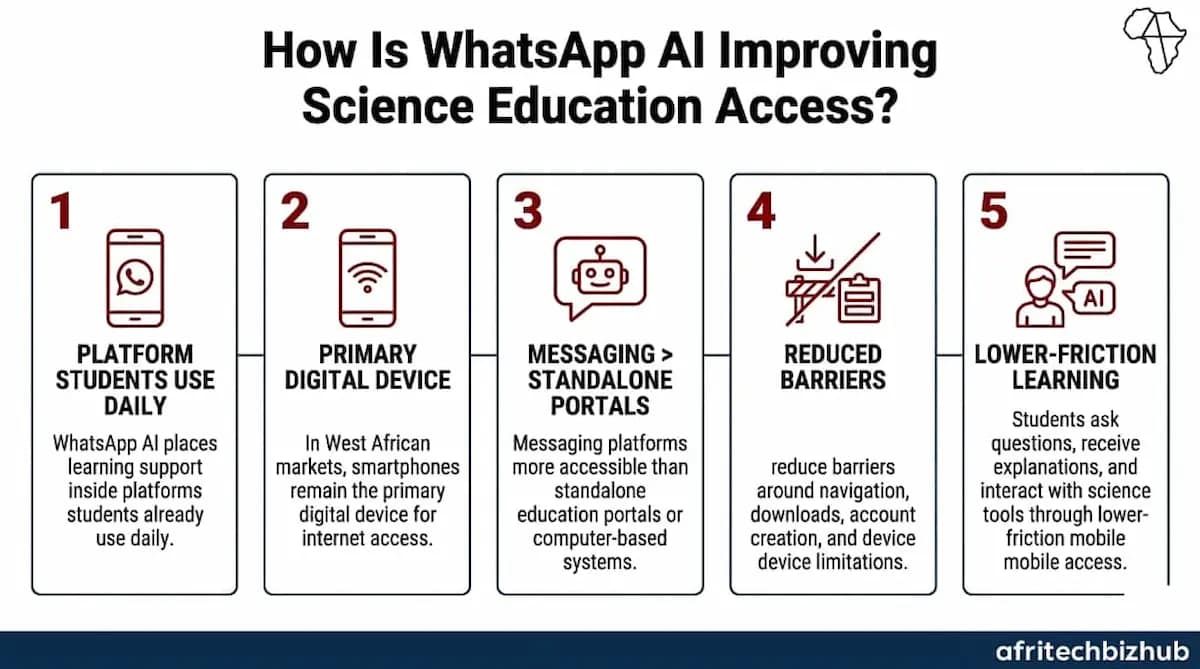
How Is WhatsApp AI Improving Science Education Access?
The expansion of WhatsApp AI into education reflects a simple reality about digital access across West Africa.
Smartphones remain the primary gateway to the internet for millions of students, making messaging platforms one of the most accessible entry points for digital learning.
That advantage is helping AI Tutor systems move closer to students by reducing many of the barriers that have historically limited participation in online education.
Embedded learning support inside familiar messaging environments places educational assistance within reach of more learners without requiring separate digital ecosystems.
The result is not merely wider access to educational content.
It is a lower-friction pathway into science learning where connectivity, device limitations, and digital literacy constraints continue to shape outcomes.
Why Is AI Learning Expanding Rapidly Across West Africa?
Pressure inside education systems is creating favourable conditions for AI learning adoption.
Across several West African countries, demand for science education continues expanding while teacher availability, classroom capacity, and access to updated learning materials remain inconsistent.
The growth of AI learning also reflects broader changes in digital behaviour.
Rising smartphone ownership, expanding internet access, and growing familiarity with digital services have created a larger audience for education technology.
What began as a supplementary learning tool is increasingly becoming part of how students access revision support, science explanations, and educational assistance outside traditional classroom hours.
Can Edtech Africa Solve Teacher Shortages Effectively?
The teacher shortage challenge has become one of the central questions facing Edtech Africa.
UNESCO has highlighted the role digital technologies and artificial intelligence can play in supporting learning systems while maintaining that technology works most effectively when it complements rather than replaces educators.
That distinction matters because AI Tutor platforms can provide revision support, assessment feedback, and additional learning assistance at scale without requiring equivalent growth in teaching capacity.
Their value increasingly lies in extending the reach of limited teaching resources and supporting students between classroom sessions.
In regions where science educators remain scarce, that support can strengthen learning continuity and improve access to educational assistance.
How Does AI Tutor Personalise Student Science Assessments?
AI Tutor systems are emerging as one of the most significant developments in personalised science assessment across West Africa.
Rather than delivering identical exercises to every learner, AI-powered platforms can analyse performance patterns, identify weaker subject areas, and adapt feedback based on individual progress over time.
The longer-term significance of AI Tutor platforms extends beyond assessment itself.
Science education across West Africa has traditionally been constrained by the availability of teachers, laboratories, and classroom capacity.
AI Tutor systems introduce a different model in which personalised feedback can be delivered at scale through devices students already use daily.
The next phase of competition may not centre on which platform offers digital learning.
It may centre on which systems can demonstrably improve science outcomes while remaining affordable, accessible, and trusted across diverse education markets.


Recent Comments