


Featured Summary:
- Africa Financial Architecture is moving from debate to implementation as AFDB Governors back NAFAD and President Sidi Ould Tah’s Four Cardinal Points vision
- African leaders and institutions are pushing to value natural capital, biodiversity, carbon assets, and ecosystem services more formally within development financing frameworks
- New financing mechanisms including AGFA, green bonds, the Congo Basin Blue Fund, and local-currency capital mobilisation are gaining institutional support
- The real test begins now: converting policy commitments into functioning capital markets, investable projects, and lower financing costs across Africa
Africa’s development financing model is entering a period of adjustment.
For decades, governments were encouraged to improve ratings, attract foreign investment, and wait for global capital to become cheaper.
Yet borrowing costs remained high, natural capital remained undervalued, and trillions of dollars in domestic savings, pension assets, insurance funds, and banking capital remained largely disconnected from development finance.
The most important outcome of the African Development Bank’s 2026 Annual Meetings in Brazzaville was not a funding announcement. It was the growing acceptance that Africa cannot finance its long-term development primarily through external capital.
That recognition is beginning to influence policy.
Governors endorsed President Sidi Ould Tah’s vision for reforming Africa’s financial architecture, while initiatives around NAFAD, natural-capital valuation, green-finance platforms, and domestic resource mobilisation moved further into the implementation phase.
The question is no longer whether Africa possesses wealth. The question is whether African institutions can build the financial architecture capable of converting that wealth into lower borrowing costs, investable infrastructure, and long-term economic transformation.
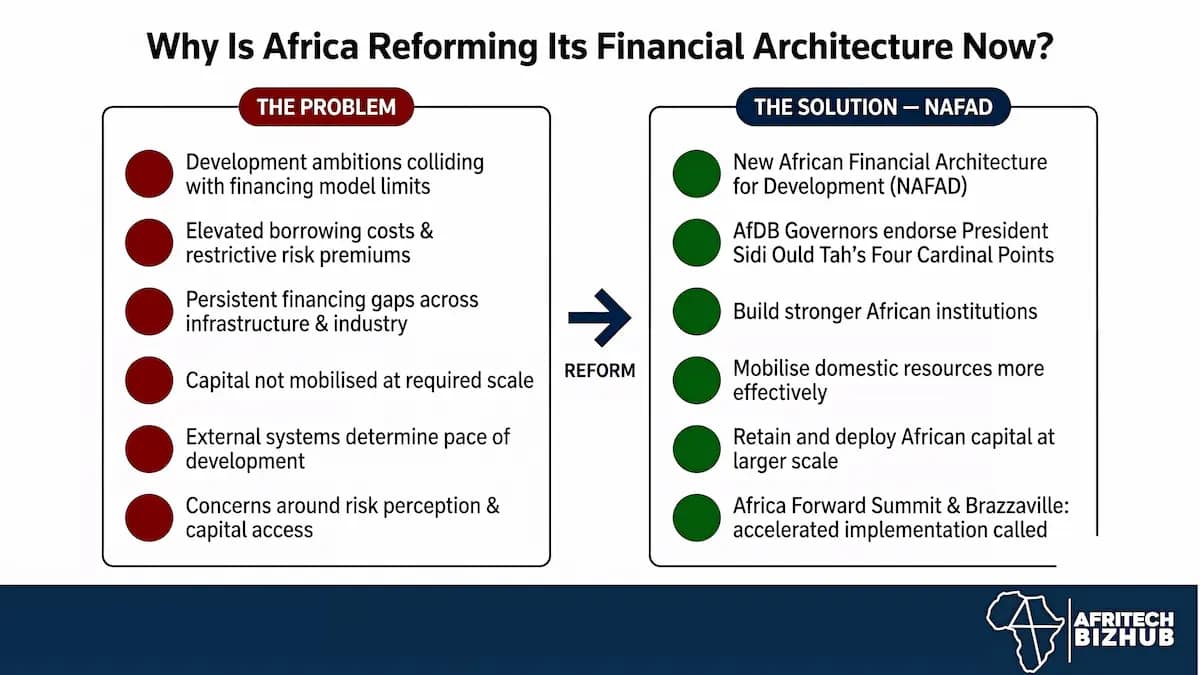
Why Is Africa Financial Architecture Changing Now?
The push to reform Africa Financial Architecture reflects a growing recognition that the continent’s development ambitions are increasingly colliding with the limits of the existing financing model.
Despite decades of engagement with international capital markets, many African economies continue facing elevated borrowing costs, restrictive risk premiums, and persistent financing gaps across infrastructure, industry, and productive sectors.
Capital remains available globally, and substantial capital exists within Africa itself. The problem is that neither is being mobilised at the scale required to finance the continent’s development ambitions.
That reality surfaced repeatedly during recent discussions among African leaders and financial institutions.
At the Africa Forward Summit in Kenya, concerns around risk perception, capital access, and the cost of development financing featured prominently in conversations about Africa’s economic future.
The same themes carried into Brazzaville, where African Development Bank Governors endorsed President Sidi Ould Tah’s Four Cardinal Points vision and called for accelerated implementation of the New African Financial Architecture for Development (NAFAD).
The message was clear: Africa can no longer rely exclusively on external financial systems to determine the pace of its development.
The objective is not to replace international capital. It is to build stronger African institutions, mobilise domestic resources more effectively, and create financing mechanisms capable of retaining and deploying African capital at a much larger scale.
What Did AFDB Governors Actually Approve?
The endorsement delivered in Brazzaville went beyond support for a new leadership agenda.
Governors effectively gave the African Development Bank a mandate to accelerate reforms aimed at mobilising larger pools of capital for African development through the New African Financial Architecture for Development (NAFAD).
The significance lies less in the language of the resolution and more in what it acknowledges: existing financing structures are not delivering capital at the scale, cost, or speed required to meet the continent’s development ambitions.
The endorsement also provided political backing for President Sidi Ould Tah’s Four Cardinal Points vision, signalling that Governors want the Bank to play a more active role in reshaping how development capital is mobilised across Africa.
In practical terms, the meeting signalled a new phase for Africa Financial Architecture, with stronger emphasis on domestic resource mobilisation, regional financial integration, and greater value creation from Africa’s own assets.
Ould Tah argued that Africa must mobilise more domestic capital, guard against fragmentation, and transform more of its raw materials into higher-value products capable of generating growth and jobs.
Brazzaville also revealed how that vision may begin taking shape.
Discussions around the proposed Africa Green Finance Architecture (AGFA) pointed to the creation of a green development-finance platform involving 13 African multilateral financial institutions.
Shelter Afrique announced plans to issue local-currency green bonds across African capital markets and is working with the African Development Bank and property developers to establish a Green Fund for Urban Development.
The initiatives are designed to address Africa’s persistent financing gaps while supporting sustainable infrastructure, housing, and climate-related investment.
The message emerging from the meetings was increasingly practical.
Institutions are no longer discussing financial reform solely as a policy objective. They are beginning to build the financing vehicles intended to support it.
Can Africa Natural Capital Become a Source of Development Finance?
African institutions increasingly believe natural capital must become a financing asset rather than simply an export asset.
That shift was visible throughout the discussions in Brazzaville, where policymakers, economists, and development-finance leaders argued that forests, biodiversity, carbon assets, water systems, and critical minerals should play a larger role in strengthening sovereign balance sheets and expanding development finance.
The African Development Bank’s 2026 African Economic Outlook estimates Africa’s natural capital at roughly $6 trillion, reinforcing the scale of assets that remain only partially reflected in the continent’s economic and financial systems.
The deeper issue extends beyond natural resources alone.
Africa possesses substantial financial capital in the form of pension funds, insurance assets, banking capital, and institutional savings, yet much of that capital remains defensive or underutilised relative to the continent’s development needs.
This is where the debate increasingly intersects with Africa Financial Architecture. The challenge is no longer proving that Africa possesses wealth.
The challenge is creating financing structures capable of converting both natural capital and financial capital into infrastructure investment, industrial expansion, and long-term economic growth.
The global economy is becoming increasingly competitive in its pursuit of strategic resources.
Brazzaville signalled that African institutions want a larger share of the financial value generated by those resources to remain within Africa itself.
The broader objective is not simply to extract more value from natural assets, but to ensure that more of that value strengthens African balance sheets, supports productive investment, and finances long-term development.
Why Will Implementation Be Harder Than Policy Announcements?
The difficult part is no longer identifying the problem.
African policymakers, development institutions, and financial leaders increasingly agree that the continent must mobilise more of its own capital, place greater value on its natural assets, and build stronger financing mechanisms around them. Brazzaville demonstrated a growing consensus.
The harder challenge is translating that consensus into functioning capital markets, investable projects, regulatory reforms, and institutions capable of deploying capital at scale.
The cost of delay is becoming increasingly visible.
The African Development Bank estimates that Africa requires between $130 billion and $170 billion in infrastructure investment each year, while financing gaps continue to constrain development across energy, transport, water, housing, and industrial sectors.
At the same time, African institutions are warning that the continent faces a broader development financing gap measured in the hundreds of billions of dollars annually.
These are not simply funding shortages. They represent delayed infrastructure, weaker productivity, slower industrialisation, and missed opportunities for economic growth.
This is why implementation matters more than declarations.
Valuing natural capital, mobilising pension assets, launching green-finance platforms, and advancing Africa Financial Architecture can create new sources of development finance, but only if they are supported by stronger project preparation, clearer regulation, credit-enhancement mechanisms, and institutions capable of moving capital from balance sheets into productive investment.
Brazzaville may have marked the moment Africa agreed on the direction of travel.
The next phase is proving that these reforms can convert policy ambition into investable projects, productive assets, and long-term growth.
The continent is already paying the cost of delay.
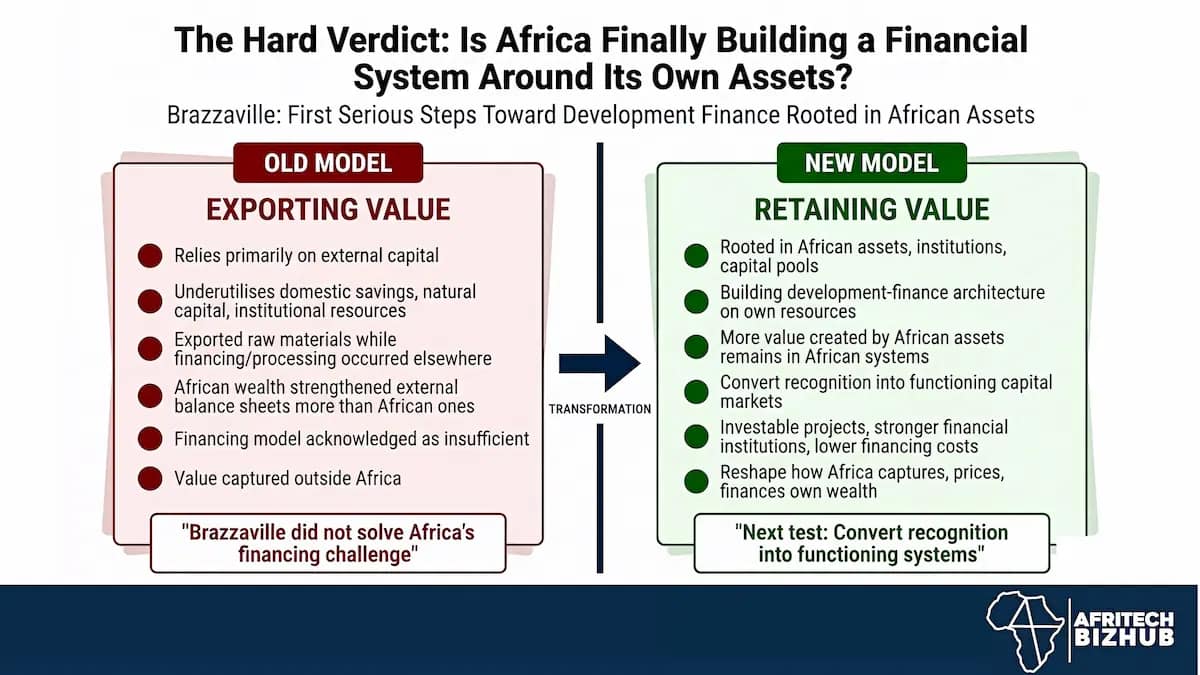
The Hard Verdict: Is Africa Financial Architecture Finally Being Built Around African Assets?
Brazzaville suggests Africa is taking the first serious steps toward building an Africa Financial Architecture rooted more firmly in its own assets, institutions, and capital pools.
The most important outcome of the African Development Bank’s 2026 Annual Meetings was not a funding announcement or a new financing vehicle.
It was the growing acceptance that Africa’s development ambitions cannot be financed indefinitely through a model that relies primarily on external capital while underutilising domestic savings, natural capital, and institutional resources.
The challenge ahead is not simply valuing natural resources or mobilising more capital.
It is ensuring that more of the value created by African assets remains within African financial systems.
For decades, African economies exported raw materials while much of the financing, processing, and value capture occurred elsewhere.
The same pattern has often existed in finance, where African wealth generated returns that strengthened external balance sheets more effectively than African ones.
Brazzaville did not solve Africa’s financing challenge. It did something more important. It acknowledged that the continent’s existing financing model is insufficient.
The next test is whether African institutions can convert that recognition into functioning capital markets, investable projects, stronger financial institutions, and lower financing costs.
If they succeed, the implications will extend far beyond development finance. They will reshape how Africa captures, prices, and finances its own wealth.


Recent Comments