


Featured Summary:
- Fintech infrastructure is emerging as the real growth bottleneck as African payment firms expand across multiple markets.
- KYC compliance increasingly determines which financial technology companies secure banking partnerships and regulatory approval.
- Cross-border payments remain one of the largest unresolved gaps in Africa’s digital economy despite rapid fintech growth.
- Banking API infrastructure is reducing launch timelines as firms compete for a larger share of the global payments market.
Africa’s fintech sector is no longer constrained by customer demand.
It is constrained by infrastructure.
Digital payments continue expanding across the continent, mobile-money adoption remains strong, and financial technology investment has reshaped how consumers and businesses move money.
The harder challenge now sits underneath the applications themselves.
Compliance systems, banking connectivity, settlement infrastructure, and cross-border payments capabilities increasingly determine which fintech companies scale beyond local markets.
Sterllo’s infrastructure strategy sits inside that larger transition as financial firms compete for position in an increasingly connected payments economy.
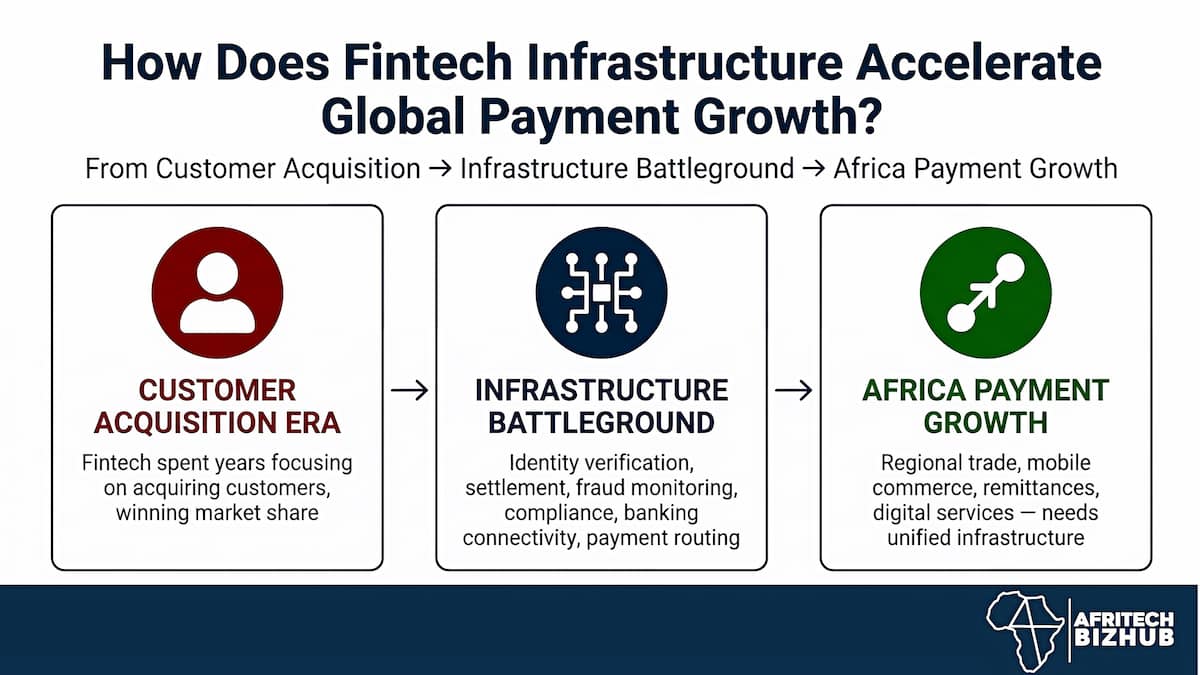
How Does Fintech Infrastructure Accelerate Global Payment Growth?
The fintech industry spent years focusing on customer acquisition.
Increasingly, fintech infrastructure has become the larger competitive battleground.
Every digital payment depends on systems operating behind the transaction itself.
Identity verification, settlement logic, fraud monitoring, compliance controls, banking connectivity, and payment routing determine whether a transaction succeeds or fails. Customers rarely see those systems.
Investors increasingly do.
As transaction volumes rise, weak infrastructure becomes expensive.
Failed settlements, delayed processing, compliance gaps, and fragmented banking relationships create operational pressure that eventually limits expansion.
Many fintech firms discover that entering a new market is easier than maintaining performance after entry.
This matters for Africa because payment growth is increasingly tied to regional trade, mobile commerce, remittances, and digital services.
The continent’s digital economy cannot scale efficiently on fragmented infrastructure while transaction demand continues rising.
Sterllo’s focus on fintech infrastructure reflects a broader industry recognition that growth increasingly depends on what happens beneath the customer interface.
Why Is KYC Compliance Essential For Scaling Fintechs in Africa?
KYC compliance is no longer operating as a regulatory checklist.
It is becoming part of fintech market access.
Across African markets, regulators continue strengthening oversight around digital payments, customer onboarding, anti-money laundering controls, and transaction monitoring.
Expansion now requires more than acquiring users.
It requires proving that those users can be verified and monitored within regulatory frameworks.
The misconception inside parts of the fintech industry is that compliance slows growth.
The opposite is increasingly true.
Weak compliance infrastructure delays partnerships, increases regulatory scrutiny, and raises operational risk.
Investors, banking partners, and regulators increasingly examine KYC compliance readiness alongside growth metrics.
User growth attracts attention. Regulatory durability attracts capital.
As fintech companies expand across borders, KYC compliance becomes a strategic capability rather than an operational obligation.
The firms that scale successfully are often the firms that can satisfy regulatory requirements repeatedly across multiple jurisdictions.
How Do Cross-Border Payments Drive Fintech Expansion Worldwide?
Cross-border payments remain one of the most valuable opportunities inside financial technology because global commerce continues operating across fragmented payment systems.
Businesses increasingly sell internationally.
Remote work has expanded global income flows.
African startups increasingly serve customers outside their home markets.
Yet moving money across borders often remains slower and more expensive than domestic transactions.
That friction creates opportunity.
Fintech firms are investing heavily in infrastructure that reduces settlement delays, improves transaction visibility, lowers foreign-exchange complexity, and simplifies payment flows between markets.
The firms controlling payment connectivity increasingly occupy strategic positions within the financial ecosystem.
For Africa, cross-border payments extend beyond fintech competition.
Regional trade ambitions, AfCFTA implementation, diaspora remittances, digital exports, and intra-African commerce all depend on more efficient payment infrastructure.
Africa’s payment challenge is no longer a lack of digital wallets.
It is the continued fragmentation between them.
What Makes A Banking API Critical For Fast Launches?
Speed has become one of the most valuable assets in financial technology.
The longer it takes to launch a financial product, the greater the risk that competitors capture market share first.
A Banking API allows fintech firms to connect directly to existing banking capabilities without building every component independently.
Payment processing, account services, transaction monitoring, compliance functions, and settlement capabilities can be integrated through a single infrastructure layer.
According to the official documentation from Galileo Financial Technologies, Banking API infrastructure helps fintech companies reduce development complexity and accelerate deployment by providing access to established financial services capabilities rather than requiring firms to build those systems from scratch.
This is becoming increasingly relevant across African markets where startups and financial institutions face pressure to launch products faster while maintaining regulatory standards.
Sterllo’s infrastructure model aligns with this broader industry movement toward API-driven financial services.
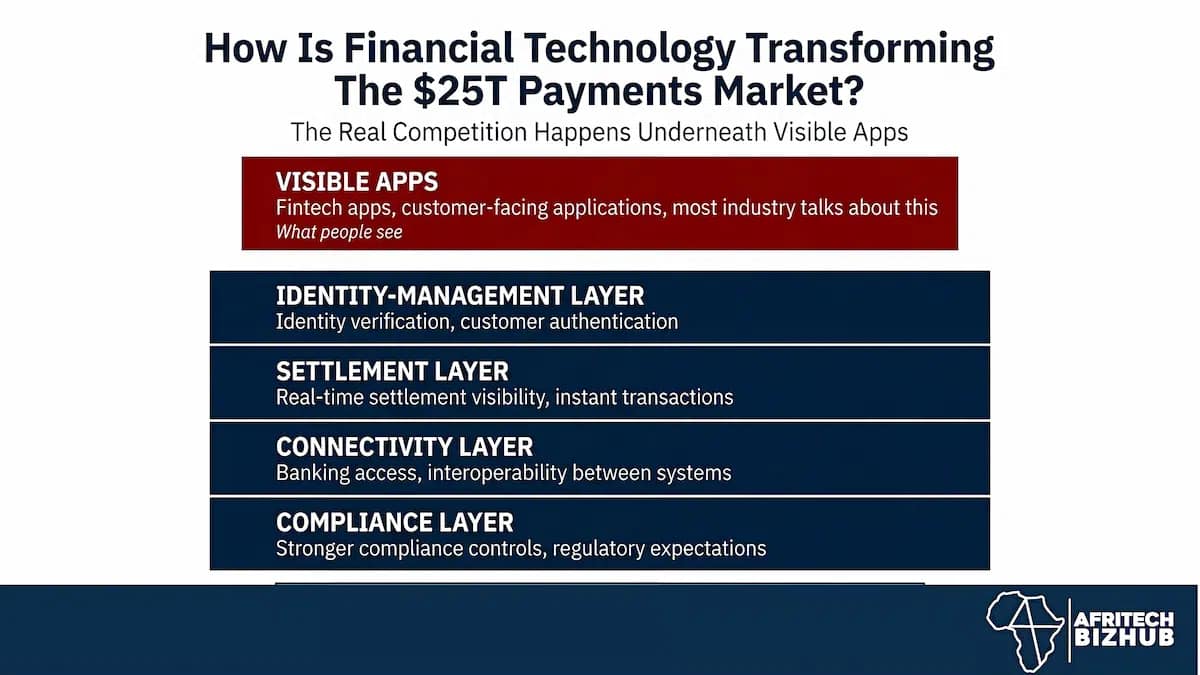
How Is Financial Technology Transforming The $25T Payments Market?
Financial technology is restructuring how payment infrastructure operates across the global economy. Consumers increasingly expect instant transactions.
Businesses expect real-time settlement visibility.
Regulators expect stronger compliance controls.
Financial institutions expect interoperability between systems.
Those demands are forcing payment infrastructure to evolve simultaneously across compliance, connectivity, settlement, and identity-management layers.
The deeper transformation is not simply transaction growth.
It is the growing importance of the infrastructure that supports those transactions.
As payment volumes expand, infrastructure providers increasingly occupy strategic positions within the financial ecosystem.
That creates a significant question for Africa.
The continent’s digital economy depends on who controls the infrastructure connecting payments, compliance, banking access, and settlement across markets.
The next generation of fintech winners may not be the companies building the most visible applications.
They may be the companies building the infrastructure every application depends on.
Most of the industry is still talking about fintech apps.
The real competition is increasingly happening underneath them.


Recent Comments