


Featured Summary:
- Africa Aviation is becoming a cooperation problem, not a financing problem
- African airlines still operate only 19% of the continent’s flights despite repeated reform efforts
- Unlocking $7 billion for aircraft and infrastructure will not automatically create an integrated aviation market
- The next battle in African aviation is likely to be fought in policy and regulation, not balance sheets
Africa Aviation may be trying to solve the wrong problem.
The African Development Bank’s proposed $7 billion aviation platform is built around financing, risk-sharing, and fleet modernisation.
Yet Africa’s biggest aviation constraint increasingly appears to be neither capital nor aircraft. It is fragmentation.
Airlines can raise financing, lease aircraft, and expand fleets, but those investments produce limited returns inside a market still divided by regulatory barriers, bilateral restrictions, and uneven implementation of open-skies commitments.
The deeper challenge is that Africa does not operate as a single aviation market. Until that changes, financing may improve the industry without fundamentally transforming it.
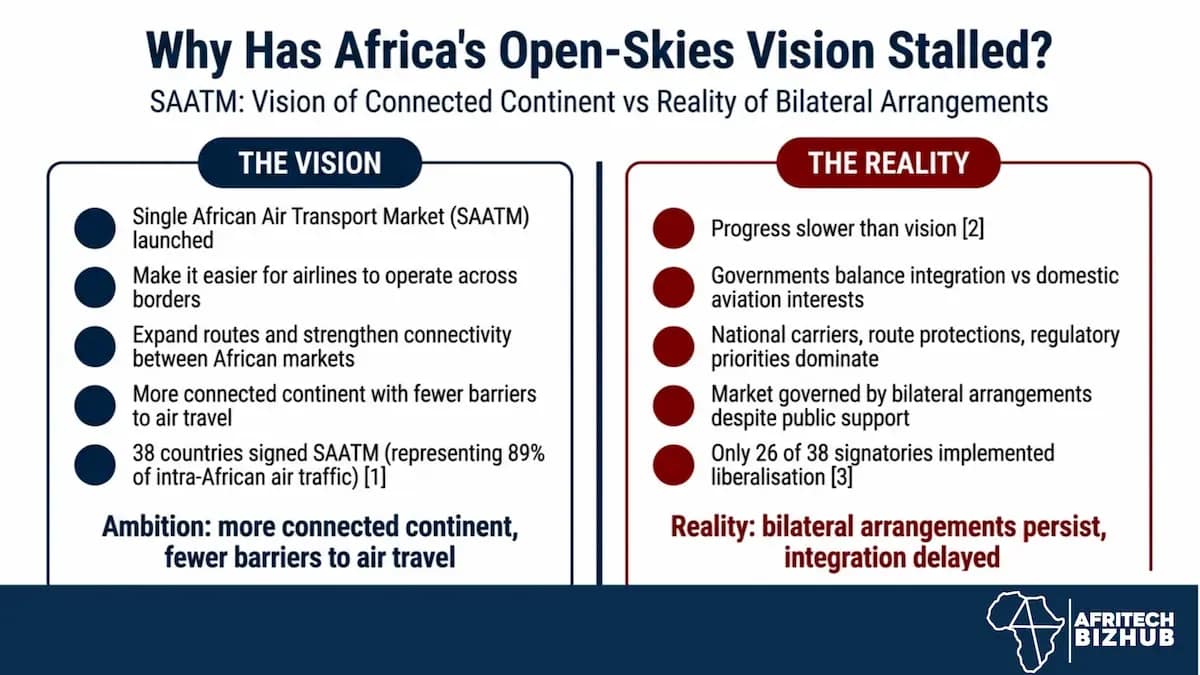
Why Is Africa Aviation Receiving New Financing Attention?
Financing is receiving attention because parts of Africa’s aviation sector remain expensive to build, upgrade, and operate.
Airlines face some of the world’s highest aircraft-leasing costs, while airports, cargo facilities, maintenance infrastructure, and logistics networks continue requiring long-term capital.
This is the gap the African Development Bank is attempting to address through its proposed $7 billion Integrated Aviation Transformation Program.
By combining guarantees, risk-sharing mechanisms, and private-sector capital, the Bank hopes to reduce financing costs that have historically limited fleet modernisation and infrastructure investment across African markets.
The challenge is that financing addresses only one layer of the problem.
Capital can help airlines acquire aircraft and improve infrastructure. Whether those assets operate efficiently across the continent is a different question entirely.
Why Does Africa Still Depend on Foreign Airlines?
Africa’s aviation challenge extends beyond fleet size.
The continent remains one of the most fragmented aviation markets in the world, with airlines often finding it easier to connect passengers through Europe or the Middle East than through neighbouring African countries.
This fragmentation creates an unusual outcome.
Africa accounts for a growing share of global population and trade, yet foreign carriers continue to capture a significant portion of long-haul and intercontinental traffic.
African airlines frequently face restrictions, bilateral agreements, and market barriers that limit their ability to expand seamlessly across the continent.
The result is a market where connectivity often lags demand.
Passengers, businesses, and supply chains may require an integrated aviation network, but the market itself continues to operate through a patchwork of national systems.
For Africa Aviation, the challenge increasingly appears to be market integration rather than market potential.
Can More Financing Solve Africa’s Aviation Problems?
The answer depends on which problem is being solved.
Aviation does not operate like a standalone infrastructure project where capital is deployed once and results follow automatically.
Airlines, airports, cargo networks, regulators, and route agreements all depend on one another.
Progress in one area does not necessarily translate into progress across the system.
This is where the real test of the African Development Bank’s aviation strategy may emerge.
A stronger balance sheet can support investment. New aircraft can expand capacity. Better infrastructure can improve efficiency.
But aviation ultimately derives its value from movement across markets. If connectivity remains constrained, the benefits of financing may prove smaller than expected.
The next challenge is not raising capital. It is ensuring that capital can move through a market capable of operating at continental scale.
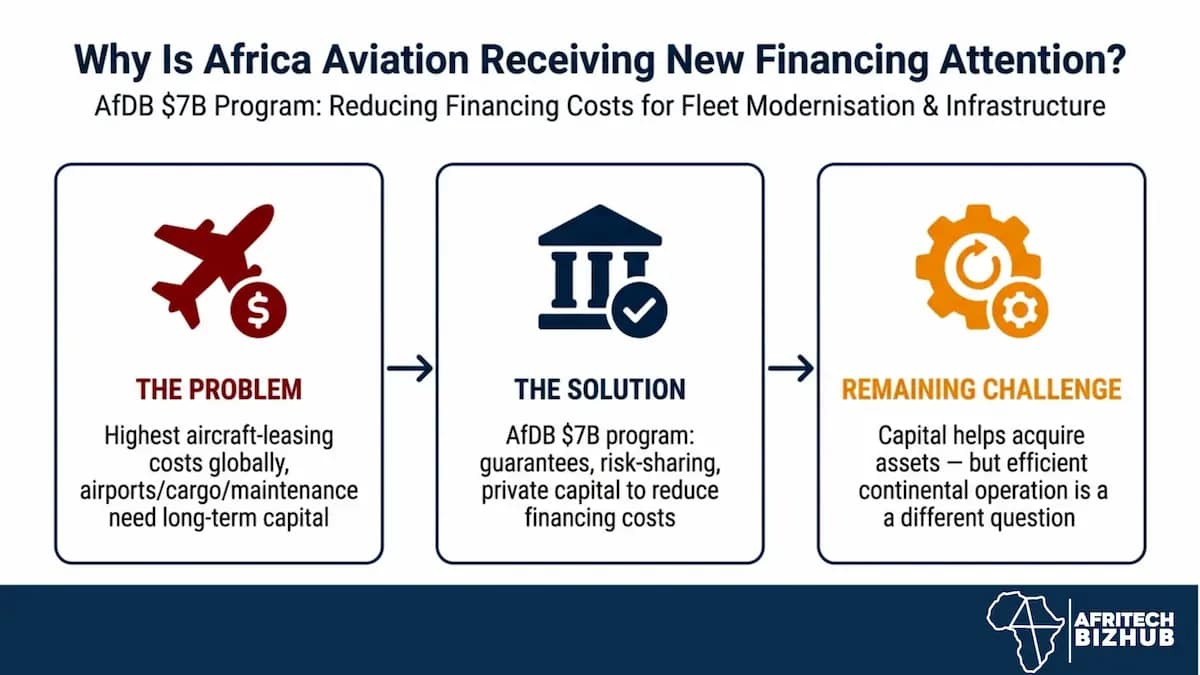
Why Has Africa’s Open-Skies Vision Stalled?
Africa’s aviation integration agenda is not new.
The Single African Air Transport Market was launched to make it easier for airlines to operate across borders, expand routes, and strengthen connectivity between African markets.
The ambition was straightforward: a more connected continent supported by fewer barriers to air travel.
Progress has been slower than the vision.
Many governments continue to balance integration goals against domestic aviation interests, national carriers, route protections, and regulatory priorities.
The result is a market that often remains governed by bilateral arrangements even as leaders publicly support deeper integration.
This is where the contradiction becomes visible.
Capital can modernise fleets and improve infrastructure, but integration ultimately depends on policy decisions.
Until more countries move from endorsement to implementation, Africa Aviation may continue to operate below its potential despite growing investment and institutional support.
Has Market Integration Become Africa Aviation’s Real Test?
The direction appears increasingly clear.
Africa’s aviation sector is no longer defined primarily by a shortage of financing.
The larger question is whether governments can translate years of aviation agreements, integration commitments, and open-skies ambitions into a market that operates more seamlessly across borders.
This is what makes the African Development Bank’s aviation strategy significant.
The proposed financing can support investment, modernisation, and expansion.
What it cannot do is implement integration. That responsibility remains with policymakers, regulators, and governments.
The next phase of Africa Aviation will be shaped less by access to capital and more by the willingness to remove barriers that continue to divide the market.
Financing can accelerate progress. Integration will determine its scale.


Recent Comments