


Featured Summary:
- Online markets are creating new opportunities for women entrepreneurs to expand beyond local economies.
- Digital entrepreneurship is increasingly viewed as a growth engine for jobs, trade, and broader Africa development.
- Online markets are creating new opportunities for women entrepreneurs to expand beyond local economies.
- Women in tech remain underrepresented despite growing demand for digital skills and technology-driven businesses.
Africa produces some of the world’s highest rates of female entrepreneurship, yet many women entrepreneurs remain excluded from the fastest-growing parts of the digital economy.
That gap has become a growing concern for policymakers as digital commerce, online services, mobile payments, and technology-driven businesses expand across the continent.
In response, ECA Africa has launched a regional initiative designed to strengthen digital entrepreneurship among women entrepreneurs in Burkina Faso, Ethiopia, Namibia, and the Republic of the Congo.
The programme combines digital-skills development, financial-management training, policy support, and access to online markets as part of a wider effort to support inclusive Africa development.
How Can Women Entrepreneurs Access ECA Africa Support?
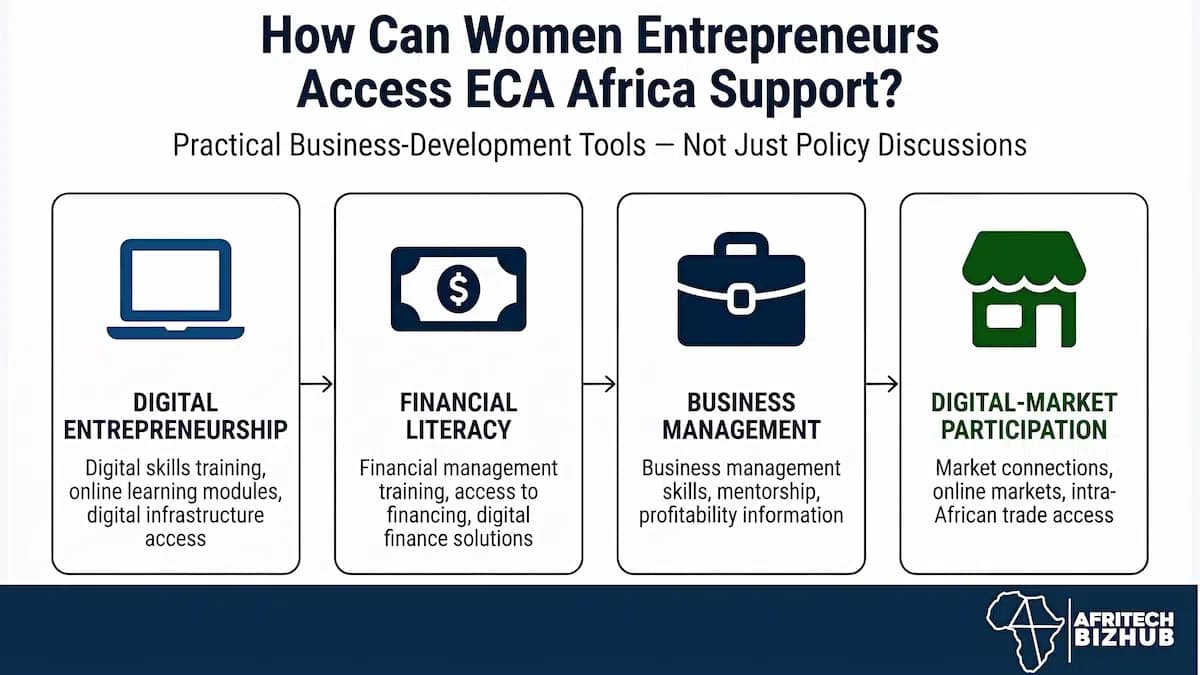
The new ECA Africa initiative is designed to support women entrepreneurs through practical business-development tools rather than broad policy discussions alone.
According to the programme framework, participants will receive support in digital entrepreneurship, financial literacy, business management, and digital-market participation.
The initiative also works with policymakers to improve the environment in which women-led businesses operate.
That matters because one of the largest barriers facing women entrepreneurs is not the lack of business ambition.
It is the gap between ambition and access.
Many entrepreneurs can identify opportunities.
Far fewer can access the digital infrastructure, training, financing, and market connections required to pursue them.
ECA Africa’s approach reflects a growing recognition that entrepreneurship programmes achieve limited results when they focus exclusively on training while ignoring the wider systems that determine whether businesses can grow.
Why Is Digital Entrepreneurship Vital For Africa Development?
Digital entrepreneurship is increasingly becoming part of Africa’s economic infrastructure.
Across the continent, businesses are using digital tools to reach customers, process payments, market products, manage operations, and participate in regional commerce.
As connectivity expands, entrepreneurship is becoming less dependent on physical location and more dependent on digital access.
For Africa development, this transition carries significant implications.
Digital businesses can create employment, expand market participation, improve productivity, and generate new income streams without requiring the same capital intensity as many traditional industries.
The risk for Africa is not technological stagnation.
It is unequal participation.
A digital economy that concentrates opportunities within narrow segments of society ultimately limits its own growth potential.
Digital entrepreneurship is no longer a technology discussion.
It is increasingly an economic-development discussion.
How Will ECA Africa Expand Opportunities For Women In Tech?
Women in tech continue facing barriers that extend beyond technical skills alone.
Access to financing, professional networks, mentorship opportunities, digital infrastructure, and leadership pathways remains uneven across many African markets.
Those constraints affect who builds businesses, who accesses technology opportunities, and who participates in digital economic growth.
ECA Africa’s initiative seeks to address those barriers through a combination of entrepreneur training and policy engagement.
More than 1,000 women entrepreneurs are expected to benefit directly from digital and financial-capacity-building programmes under the initiative.
The programme acknowledges a reality that many development strategies have struggled to address effectively. Encouraging women in tech is not enough.
Creating the conditions that allow them to compete and scale is the harder challenge.
Africa’s digital economy does not suffer from a shortage of entrepreneurial talent. It suffers from uneven access to opportunity.
Can Online Markets Help Women Entrepreneurs Scale Faster?
Online markets are becoming one of the most powerful growth tools available to women entrepreneurs.
Digital platforms allow businesses to reach customers beyond local communities, reduce dependence on physical retail networks, and participate more directly in regional and international commerce.
For many small businesses, digital visibility now influences growth as much as physical presence.
According to the official announcement from the United Nations Economic Commission for Africa, the initiative seeks to strengthen digital entrepreneurship by improving access to digital skills, financial-management capabilities, and online markets while supporting policy reforms that help women entrepreneurs participate more effectively in the digital economy.
Online markets are not a guaranteed path to success. Logistics constraints, internet affordability, payment systems, and regulatory barriers still shape outcomes.
But businesses increasingly struggle to scale without digital-market access.
The next generation of successful African businesses is likely to compete for digital visibility as aggressively as they compete for customers.
What Impact Will Digital Entrepreneurship Have On Africa Development?
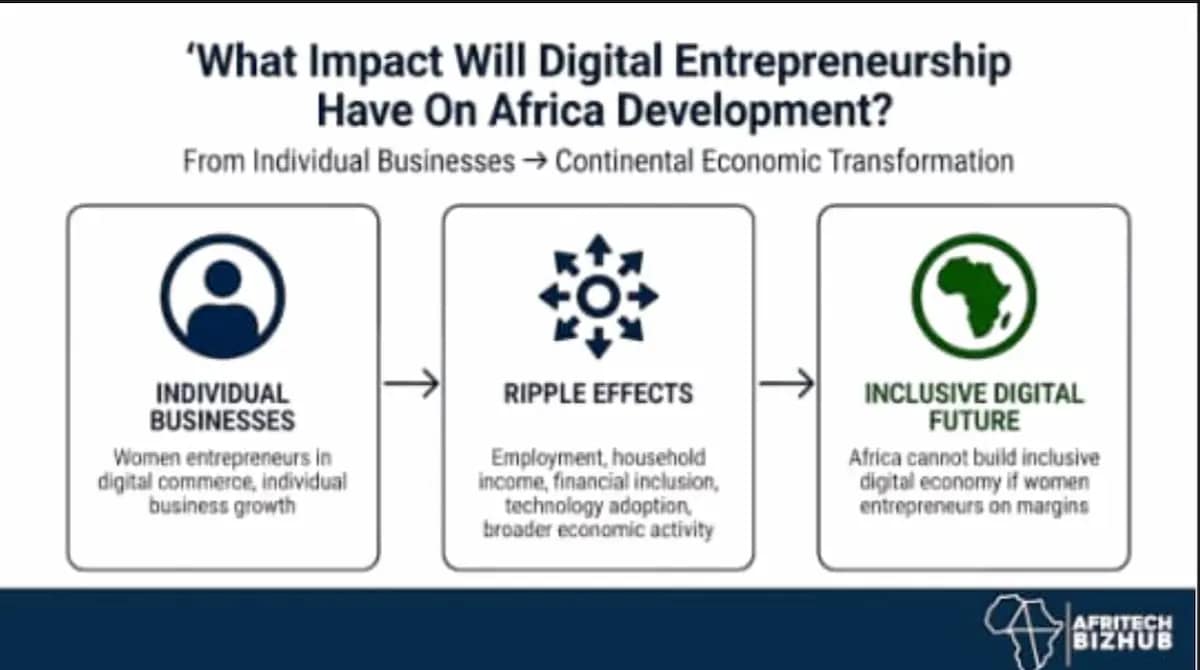
The long-term significance of digital entrepreneurship extends far beyond individual businesses.
As more women entrepreneurs participate in digital commerce, the effects spread into employment, household income, financial inclusion, technology adoption, and broader economic activity.
Stronger participation also increases the diversity of businesses contributing to Africa’s digital economy.
This is where the ECA Africa initiative connects to a larger continental question.
Africa development strategies increasingly focus on digital transformation, digital trade, innovation ecosystems, and technology adoption.
Yet those ambitions become difficult to achieve if large segments of potential entrepreneurs remain underrepresented in the sectors generating digital growth.
The future of Africa’s digital economy will not be determined solely by the technologies that emerge.
It will be shaped by who gains access to the opportunities those technologies create.
Africa cannot build an inclusive digital future while millions of potential women entrepreneurs remain on the margins of it.


Recent Comments