


Featured Summary:
- NALA Fintech has secured up to $50 million to expand stablecoin-powered payment infrastructure across international markets.
- Stablecoin payments are attracting growing attention as businesses seek faster and cheaper cross-border settlement.
- Fintech funding is increasingly moving toward payment infrastructure, liquidity management, and transaction efficiency.
- Global payments competition is shifting toward firms that control settlement networks and cross-border connectivity.
The next battle in financial technology is not being fought over digital wallets or mobile apps.
It is being fought over the infrastructure that moves money across borders.
Global businesses are demanding faster settlement, lower transaction costs, and greater liquidity efficiency as international commerce becomes increasingly digital.
That demand is reshaping investment flows across the fintech sector.
NALA Fintech’s new financing facility arrives at the centre of that transition.
The Tanzanian-founded company is expanding stablecoin-powered payment infrastructure as payment providers race to modernise how money moves between Africa, Europe, North America, and other emerging markets.
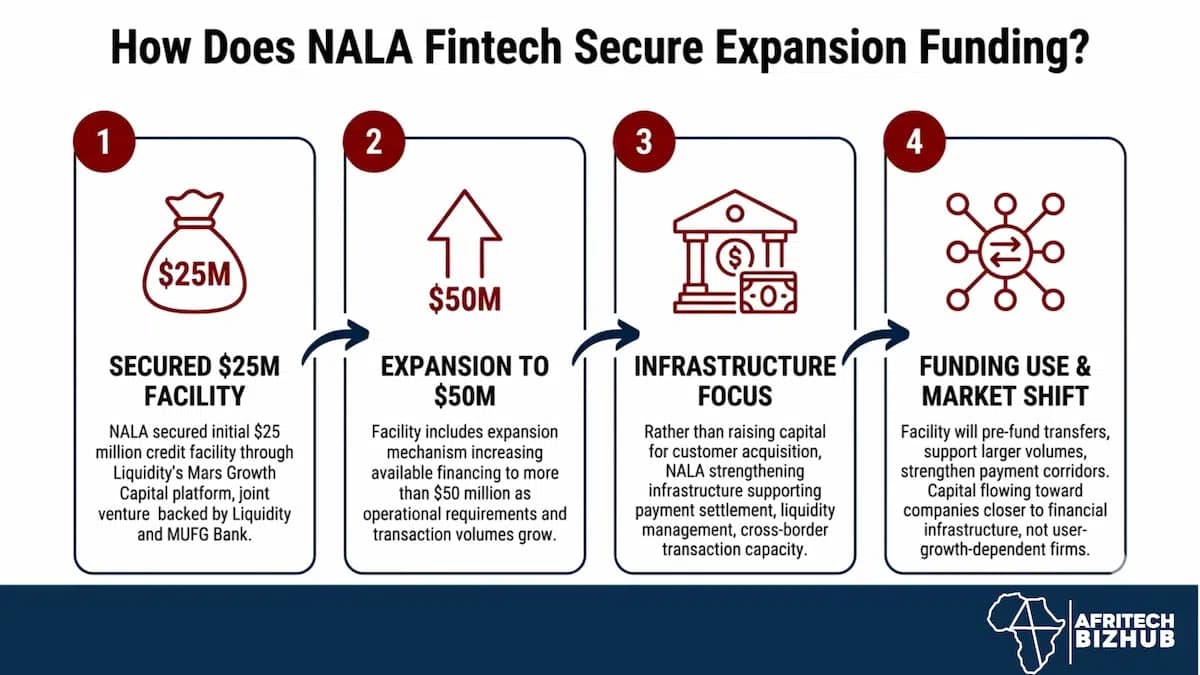
How Does NALA Fintech Secure Expansion Funding?
NALA Fintech has secured an initial $25 million credit facility through Liquidity’s Mars Growth Capital platform, a joint venture backed by Liquidity and MUFG Bank.
The facility includes an expansion mechanism that can increase available financing to more than $50 million as operational requirements and transaction volumes grow.
The structure reflects a different phase of fintech growth.
Rather than raising capital primarily for customer acquisition, NALA is strengthening the infrastructure supporting payment settlement, liquidity management, and cross-border transaction capacity.
The company said the facility will help pre-fund transfers, support larger transaction volumes, and strengthen payment corridors connecting multiple international markets.
Investors are becoming increasingly selective across fintech.
Capital is flowing toward companies operating closer to financial infrastructure rather than firms dependent solely on user growth.
Are Stablecoin Payments Driving Global Growth?
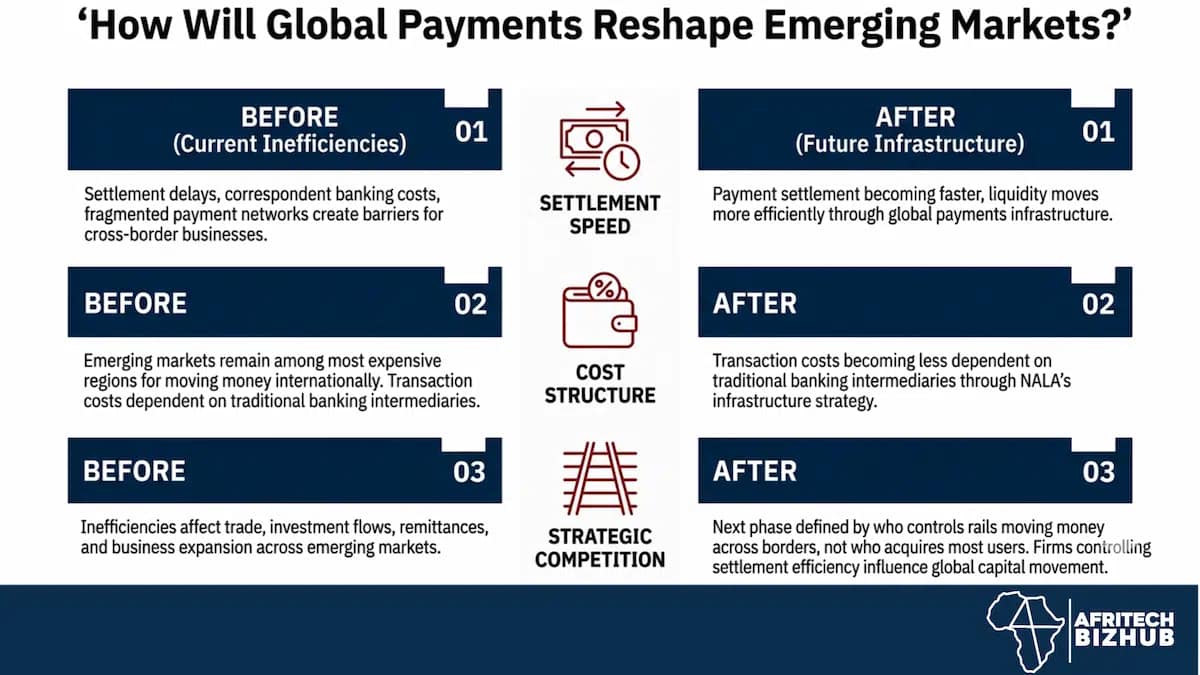
Stablecoin payments are attracting attention because they address one of the most expensive frictions in global finance: cross-border settlement.
Traditional international payments often move through multiple intermediary institutions, creating delays, higher costs, and liquidity pressures for businesses operating across jurisdictions.
Stablecoin-based settlement systems offer a potential alternative by enabling faster movement of value between payment networks.
The opportunity extends beyond cryptocurrency markets.
Businesses, payment processors, and financial institutions are increasingly evaluating how digital settlement infrastructure can improve transaction efficiency across international trade and commerce.
As transaction volumes expand across digital economies, demand for faster payment rails continues rising.
For NALA Fintech, stablecoin payments represent a settlement solution rather than a speculative asset strategy.
The company is positioning itself around the infrastructure layer supporting global transactions rather than the volatility often associated with digital asset markets.
Why Is Fintech Funding Powering NALA Growth?
The direction of fintech funding is changing.
Investors are increasingly backing infrastructure businesses capable of generating transaction volume, improving settlement efficiency, and supporting enterprise-scale payment activity.
The market is rewarding companies solving structural payment problems rather than simply chasing user growth.
NALA Fintech sits directly within that trend.
The company previously raised a $40 million Series A round and has now secured additional financing focused on scaling payment infrastructure.
The objective is not simply expansion.
It is operational capacity.
That strategy aligns with a broader industry push toward modernising cross-border payments.
The Bank for International Settlements has repeatedly identified cross-border payments as slower, more expensive, and less transparent than domestic payments, highlighting the need for infrastructure improvements across global financial systems.
The companies attracting capital are increasingly those building solutions around that challenge.


Recent Comments