

Featured Summary:
- Nigeria Critical Minerals move deeper into U.S. supply-chain plans
- U.S. investment could extend from mining into processing and infrastructure
- Africa is pushing to keep more mineral value through local processing
- New projects will show how much investment stays in Nigeria
The United States and China extended their trade truce by two months this week, with rare earths still among the issues under negotiation.
China accounts for up to 70% of global rare-earth mining and more than 85% of refining and production.
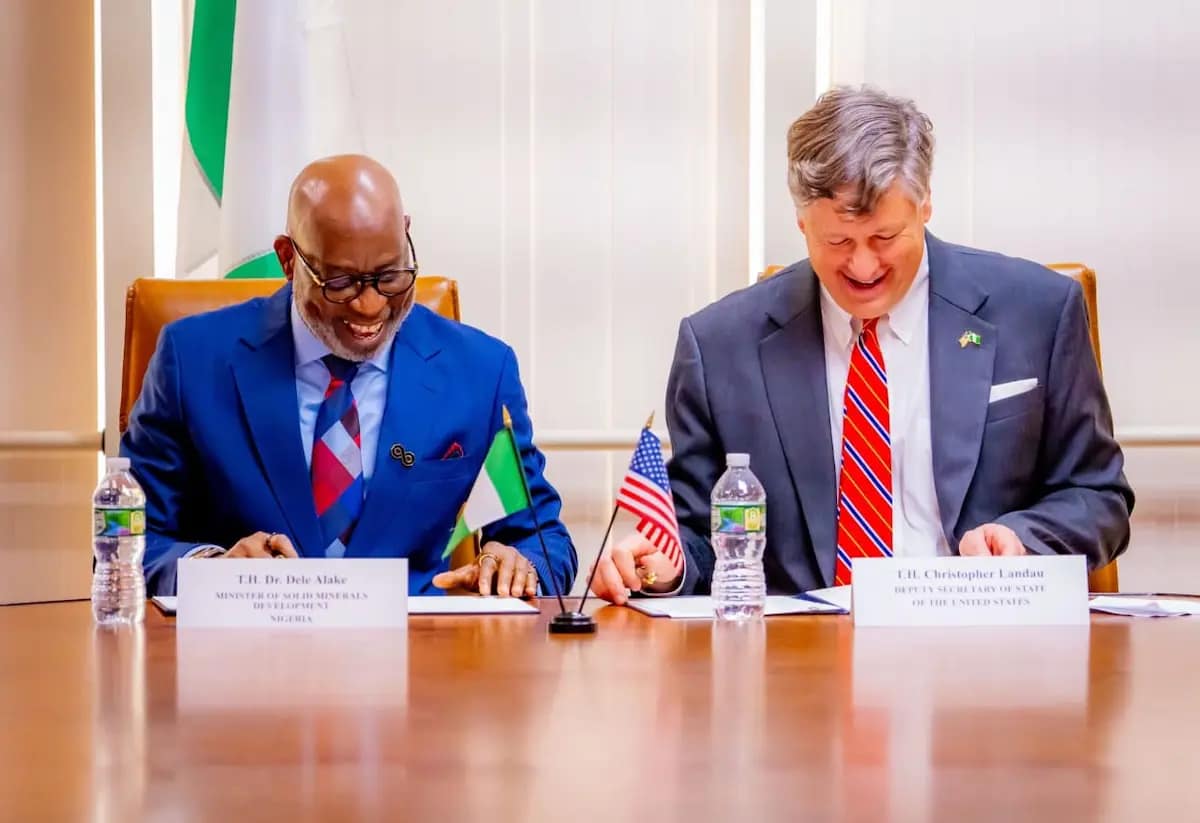
At UNGA, Nigeria signed a mineral-investment framework with the United States covering resources Abuja values at $700 billion.
The framework covers exploration, processing and infrastructure, while Nigeria wants more of its minerals processed locally before they are exported.
China’s Mineral Dominance Keeps Alternative Supply in Focus
The Democratic Republic of Congo has identified manganese, copper-cobalt, gold and lithium projects for potential U.S. investment.
The list gives American investors specific mining opportunities to consider as the two governments develop their minerals partnership.
The U.S. Development Finance Corporation is providing $553 million for the Lobito Atlantic Railway, connecting Congo’s mining region to Angola’s Atlantic coast.
Washington has also signed a minerals marketing partnership with Congolese state miner Gecamines covering copper and cobalt.
The framework signed with Nigeria during UNGA covers exploration, processing and infrastructure. Individual projects and investment amounts have yet to be announced.
Nigeria’s Mineral Market Is Already Moving Beyond Extraction
Nigeria says its mining sector attracted more than $2.6 billion in foreign direct investment between 2023 and May 2026.
Part of that money has gone into lithium processing, including a $600 million plant near the Kaduna-Niger border and a $200 million refinery outside Abuja. Additional facilities have been developed in Nasarawa.
The terms for new mining investment have also changed. Companies seeking licences are required to submit plans for processing minerals in Nigeria rather than shipping everything abroad in raw form.
Equipment, power costs and the movement of profits are among the areas covered by incentives offered to investors.
Chinese companies entered this market before the latest U.S. agreement. Beijing and Abuja agreed in 2024 to expand cooperation in mineral development, including Chinese-backed plants producing for Nigerian and export markets.
Some of the processing capacity now taking shape therefore predates Washington’s framework.
The opening for U.S. investors is not limited to digging new mines. Nigeria is seeking capital for the plants, power and infrastructure around mineral production, while individual American projects under the new framework remain to be negotiated.
Africa Wants Processing Capital Alongside Mining Investment
The African Development Bank estimates that Africa holds about 30% of global reserves of the most critical minerals. It puts their mine-site value at roughly $29.5 trillion, with about $8.6 trillion yet to be developed.
FEDA, Afreximbank’s development investment arm, committed $300 million to the Africa Minerals and Metals Processing Platform in November 2025.
A2MP has 12 mineral assets and four processing hubs across nine countries, including projects involving rare earths and battery materials.
Governments and financial institutions meeting at an AfDB ministerial forum in July backed more refining and manufacturing within Africa.
Regional supply chains and investment in industries around mineral production were also part of the agenda.
The U.S.-Nigeria framework includes processing, infrastructure and technical capacity, areas already attracting support from African financial institutions.
No American projects under the agreement have yet established how much of that investment will take place in Nigeria.
Nigeria’s Mineral Deal Moves From Diplomacy to Capital
As individual projects reach financing, investors, costs and locations become identifiable. Construction then provides the first evidence of where U.S. money is actually being deployed in Nigeria’s mineral industry.
Existing foreign-backed plants give those projects a commercial benchmark inside Nigeria. U.S. investment can be measured against facilities already under development rather than against the size of the country’s resource estimates.
The first projects to break ground will establish whether Washington’s search for mineral supply produces another source of mining capital or expands Nigeria’s industrial base around the minerals it extracts.


Recent Comments