


Last updated: May 17, 2026
Featured Summary:
- Africa immigration systems are holding back regional movement as visa controls and labor restrictions tighten across major economies.
- While AfCFTA pushes trade integration, immigration barriers are blocking faster labor mobility and business growth.
- Despite progress with e-Visas, work permits, residency rules, and labor restrictions remain fragmented across Africa.
Africa immigration systems are increasingly out of step with the continent’s rapid economic integration.
While AfCFTA is driving trade, digital commerce, and regional business growth, border restrictions, visa controls, and labor-market barriers continue to limit mobility.
Despite political commitments to African unity, Africans still face significant hurdles in moving freely across neighboring markets, with visa restrictions and work permit controls blocking the flow of talent and business expansion.
As the continent’s trade integration accelerates, its immigration systems remain a major bottleneck.
Why Do African Countries Still Restrict Visa-Free Travel?
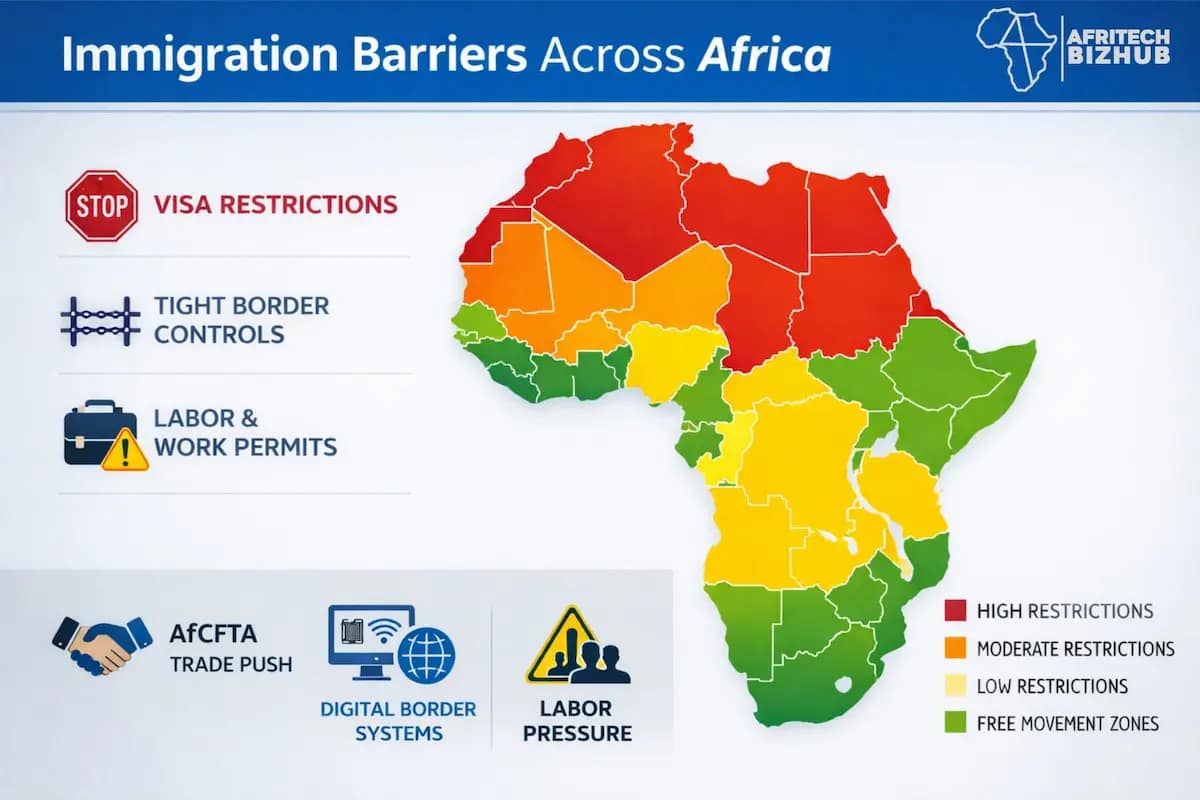
African governments continue backing continental integration politically while tightening border enforcement operationally.
Immigration policy across parts of the Sahel, Central Africa, and East Africa is moving closer to national security structures as governments respond to insurgency risks, trafficking networks, irregular migration, and border instability.
Border enforcement, intelligence coordination, labor-market pressure, and residency verification increasingly operate inside the same political system across several African states.
Economic pressure is hardening immigration systems further across major African economies.
Governments facing rising unemployment are tightening work permits, labor verification systems, and residency controls to protect domestic labor markets from growing social pressure.
South Africa increasingly sits at the center of that tension as immigration collides directly with unemployment, labor politics, and urban economic strain.
Similar pressure is quietly spreading across other African markets as regional trade expands faster than labor mobility.
What Happened to the African Passport?
The African passport became one of the African Union’s strongest integration symbols under Agenda 2063, but the project stalled long before continental mobility became operational reality.
The passport remains largely restricted to diplomats and officials while governments continue resisting broader free-movement protocols that weaken border discretion and labor controls. Political symbolism moved faster than implementation.
African startups, logistics firms, and digital businesses are already expanding across borders faster than immigration systems can process skilled movement efficiently.
Technology firms increasingly hire across multiple African markets while residency systems remain built for slower domestic labor structures.
Africa’s business systems are integrating faster than its immigration architecture, and governments are losing the ability to manage that contradiction quietly.
Why Is It Easier to Travel Across Europe Than Across Africa?
Europe made labor mobility part of its economic structure early. Africa kept border control at the center of integration.
That difference still shapes movement across the continent today.
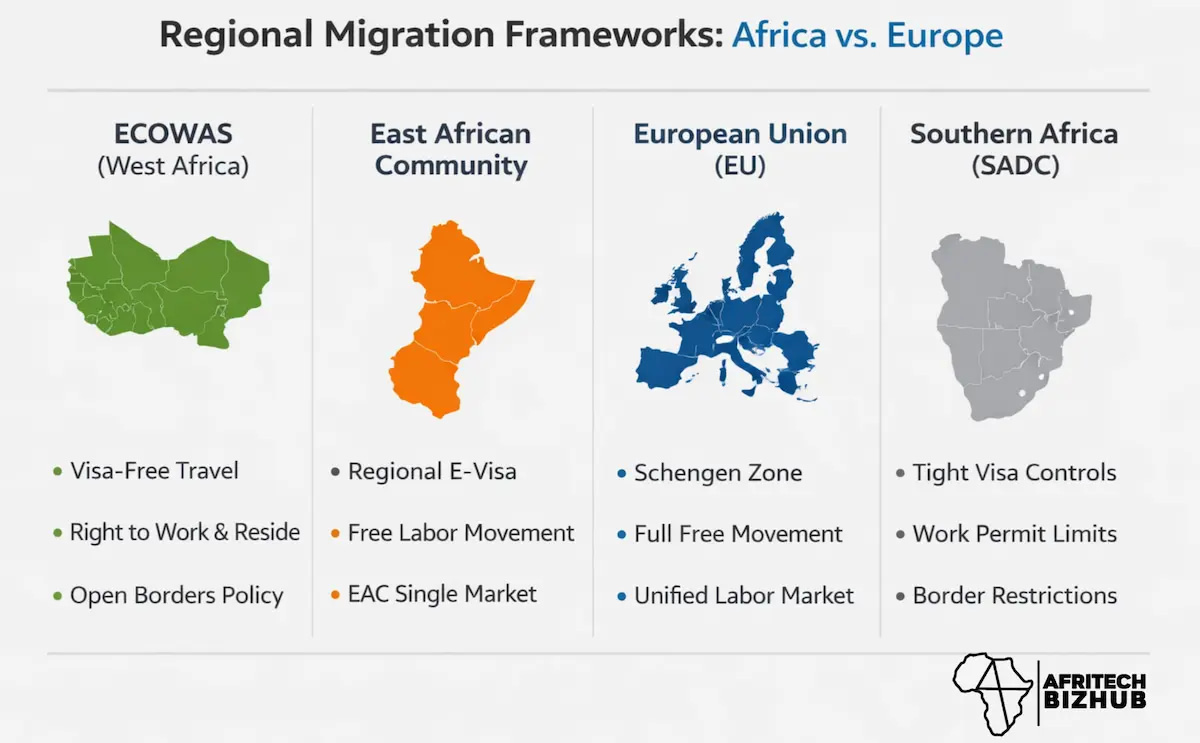
ECOWAS remains Africa’s strongest free-movement framework supporting labor mobility and regional trade across West Africa, while the East African Community has moved further on coordinated visas and business mobility involving Kenya, Rwanda, and Uganda.
Southern Africa remains more restrictive as labor-market protection and border enforcement continue dominating immigration policy across several SADC economies.
Africa already operates through multiple migration systems moving at different speeds instead of one coordinated continental mobility structure.
Most African migration already happens inside Africa according to the International Organization for Migration, yet many immigration systems across the continent still treat African mobility as a security issue before treating it as an economic reality.
Trade integration is accelerating across Africa while mobility coordination continues falling behind it.
Why Is Africa Immigration Systems Coming Under Growing Pressure?
Africa immigration systems are tightening just as the continent moves deeper into industrial expansion, logistics integration, regional finance, aviation growth, and digital commerce.
Governments want larger investment flows, manufacturing growth, stronger regional trade systems, and integrated supply chains, but labor mobility remains politically explosive across several major economies.
Work permits, foreign hiring approvals, and labor verification systems are becoming stricter as governments respond to unemployment pressure and domestic political tension.
At the same time, Africa’s next growth cycle depends heavily on engineers, logistics operators, technical specialists, researchers, digital workers, and executives moving across borders efficiently.
Climate-linked displacement is also beginning to reshape long-term migration pressure across parts of the Sahel, East Africa, and Southern Africa as environmental stress alters movement patterns across multiple regions.
AfCFTA is integrating African trade faster than immigration systems are adjusting to the economic reality forming around them.


Recent Comments