


Last updated: May 16, 2026
China builds more of Africa’s infrastructure, but US capital holds deeper influence over the sectors shaping the continent’s future.
Featured Summary:
- US vs China investment in Africa remains tilted toward Beijing, with China leading by scale through infrastructure and state-backed finance.
- China still dominates Africa’s ports, rail, roads, and industrial buildout.
- US capital remains stronger in Africa’s tech, finance, and digital economy.
- China builds more of Africa’s hard assets, but US capital shapes more of its strategic future.
China finances more of Africa’s roads, railways, ports, and industrial corridors than the United States, giving Beijing the dominant hand in the continent’s physical infrastructure buildout.
But infrastructure is only part of the contest. US capital remains more deeply embedded in the strategic sectors that shape long-term influence, technology, finance, digital infrastructure, and high-value private markets.
The rivalry extends well beyond investment. Africa has become a central arena in the wider contest for global influence.
US vs China Investment in Africa: Who is Leading in 2026?
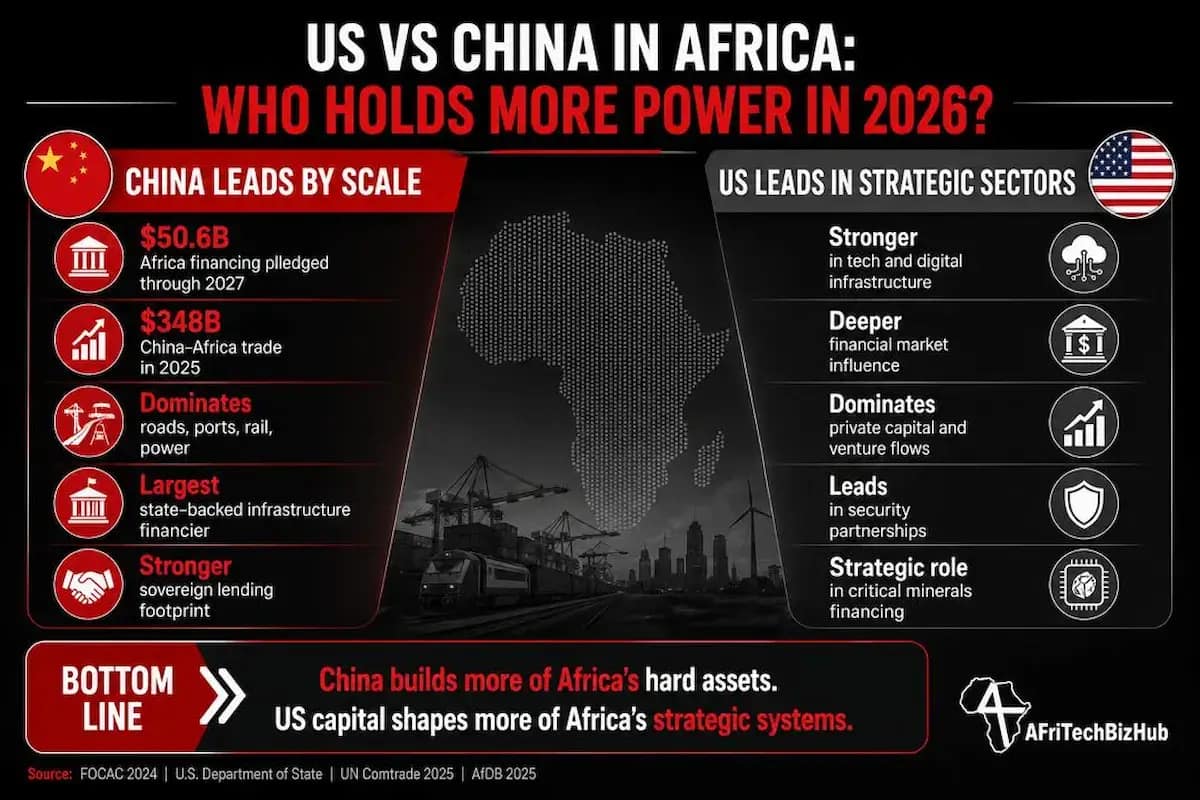
China remains ahead of the United States in Africa’s capital deployment race in 2026, retaining the dominant position in large-scale infrastructure and sovereign-backed financing.
Beijing entered the year with a fresh $50.6 billion Africa financing package through 2027, reinforcing its lead in the roads, ports, railways, and power projects that continue to shape the continent’s physical economy.
Africa’s broader commercial relationship also tilts decisively toward China. China–Africa trade reached roughly $348 billion in 2025, far above the $83.4 billion in U.S.–Africa goods trade recorded over the same period.
Washington remains influential, but its Africa footprint is concentrated more heavily in technology, finance, digital infrastructure, critical minerals, and strategic security partnerships.
The division is clear: China leads Africa by scale, while the United States remains strongest in the strategic sectors that shape long-term power.
Why China Invests More in Africa Infrastructure While the US Focuses on Tech
China invests more in Africa’s infrastructure because Beijing remains the most aggressive major external provider of state-backed capital at the scale Africa’s infrastructure deficit demands.
While Western lenders and private markets remain more selective, Chinese policy banks and contractors continue financing roads, ports, rail, and power projects many others will not underwrite.
That has made China the dominant external builder of Africa’s physical infrastructure.
The financing is strategic, not charitable. China’s infrastructure push supports broader access to African commodities, trade corridors, and long-term supply chains tied to industrial demand at home.
Washington has chosen a different lane.
Rather than compete directly in sovereign-backed infrastructure finance, US capital remains concentrated in the sectors where America retains structural advantage, technology, digital infrastructure, private capital, and security-linked strategic partnerships.
The division of influence in US vs China Investment in Africa is clear: China builds more of Africa’s hard infrastructure, while the US retains greater influence across the continent’s strategic digital, financial, and security systems.
Which African Countries Receive the Most China and US Investment?
China and the United States do not deploy capital evenly across Africa.
US vs China Investment in Africa remains concentrated in the continent’s largest and most strategic economies, including Nigeria, South Africa, Egypt, Kenya, Angola, and the Democratic Republic of Congo, where market scale, mineral access, trade corridors, and geopolitical relevance justify heavier capital allocation.
Foreign capital follows leverage, not geography.
That concentration reflects how both powers structure their Africa strategy.
Beijing’s latest Forum on China–Africa Cooperation (FOCAC) package pledged roughly $50.7 billion in financing and support for Africa through 2027, reinforcing its role as the continent’s largest state-backed external financier.
Washington, by contrast, continues to operate under its broader $55 billion Africa commitment framework launched through the 2022–2025 U.S.–Africa Leaders Summit agenda, with capital spread across digital infrastructure, trade, energy, health, and strategic partnerships rather than direct sovereign-backed infrastructure lending.
The pattern in US vs China investment in Africa is clear: both powers concentrate capital in the continent’s largest and most strategic economies, where scale, influence, and long-term leverage are highest.
How US vs China Investment in Africa Is Shaping Trade and Economic Power
US and Chinese investment in Africa now reaches far beyond capital flows.
It shapes how the continent’s minerals, energy, and strategic resources move through global supply chains.
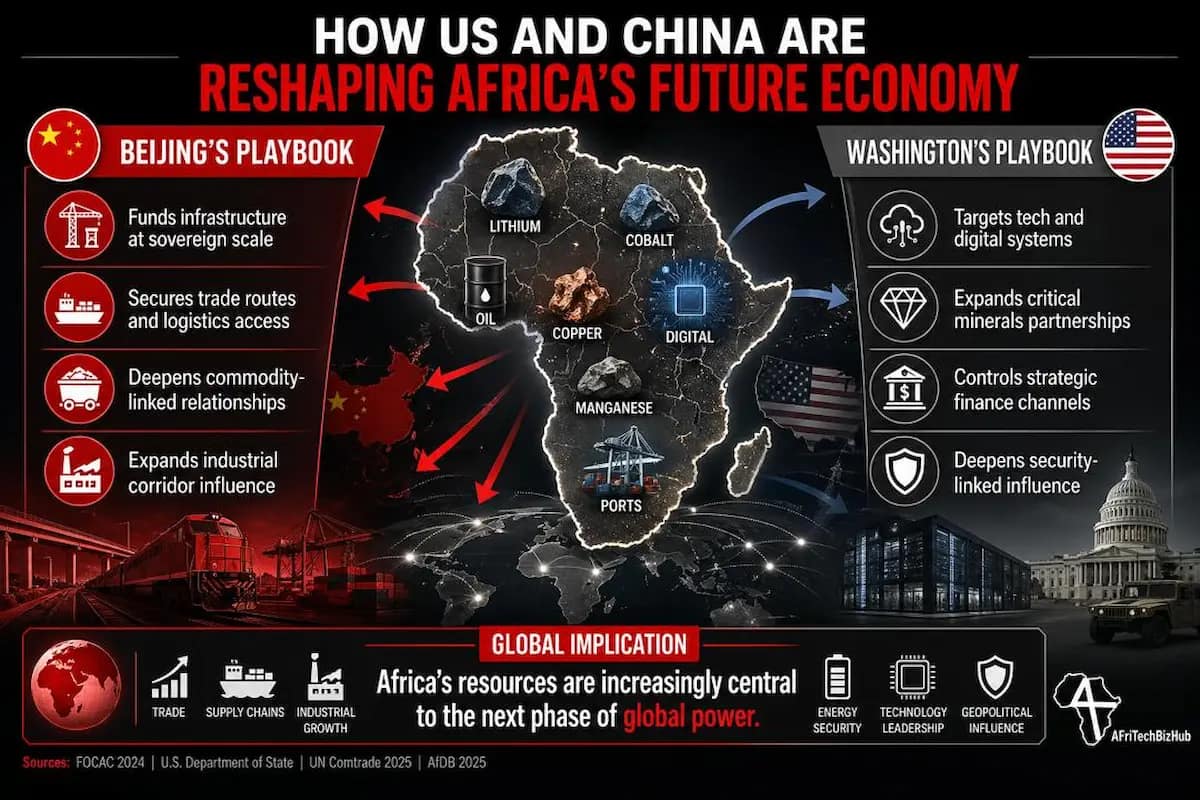
With Africa holding major reserves of cobalt, lithium, copper, manganese, platinum, and critical energy resources, both powers are positioning around the assets most vital to industrial production, energy security, and future technologies.
Beijing uses infrastructure finance to strengthen trade routes and commodity access.
Washington targets critical minerals, digital systems, finance, and security-linked sectors tied to long-term strategic leverage.
The conclusion is clear: Africa’s resources are no longer peripheral to global power. They are increasingly central to it.


Recent Comments