


Featured Summary:
- South Africa Wi-Fi networks gained access to new 6GHz wireless spectrum, but adoption is slower than expected.
- Network congestion continues to reduce performance in homes, businesses, campuses, and urban environments.
- Many users still rely on aging routers that cannot fully exploit next-gen Wi-Fi technologies.
- The primary challenge is now infrastructure and device upgrades, not spectrum access alone.
South Africa has taken a major step toward faster wireless connectivity by opening part of the 6GHz band for Wi-Fi services.
The decision increases available wireless spectrum, which should improve capacity and reduce congestion.
Yet better spectrum alone does not guarantee improved internet experiences.
Across South Africa and other African countries, next-generation Wi-Fi adoption continues slower than anticipated.
The technology exists, but infrastructure transitions, device upgrades, and economic factors are slowing the benefits of faster wireless networks.
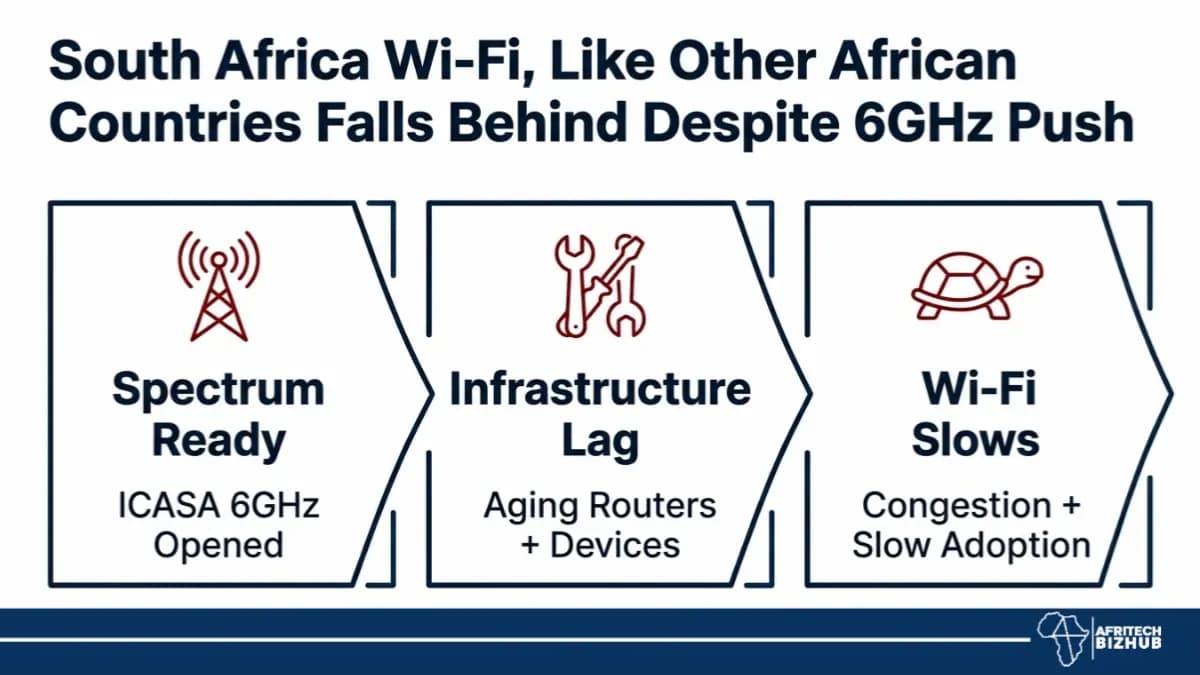
Why is South Africa Wi-Fi Still Lagging?
Spectrum reform addresses only one aspect of network performance.
Users still need compatible devices, modern routers, and reliable broadband connections to fully benefit from the 6GHz expansion.
Many households and businesses operate equipment designed for older Wi-Fi standards.
Even with fiber connections, outdated hardware creates a gap between what networks can deliver and what users experience.
Observed patterns across Africa show that regulatory changes often outpace infrastructure adoption, leaving user experience behind.
The challenge is similar in other African countries.
Expanding spectrum is necessary but not sufficient to improve internet performance at scale.
How Does Network Congestion Slow Wi-Fi Adoption in Africa?
Network congestion occurs when too many devices share limited wireless capacity.
Homes, offices, schools, campuses, and public spaces increasingly rely on multiple connected devices simultaneously.
As smartphones, laptops, televisions, cameras, and smart appliances compete for bandwidth, speeds drop and latency increases.
Expanding spectrum can mitigate congestion, which is why regulators focus on bands like the 6GHz allocation.
Yet older equipment and crowded frequencies maintain practical limits on performance.
Across African networks, congestion continues to constrain adoption of next-generation Wi-Fi despite regulatory spectrum expansions.
What Role ICASA Spectrum Plays Wi-Fi Rollout?
ICASA’s release of the 5925–6425 MHz portion of the 6GHz band gives South Africa additional spectrum to support Wi-Fi 6E and future wireless technologies.
Observed implementation shows that more spectrum enables higher simultaneous connections, lower latency, and reduced interference.
Regulatory frameworks like ICASA’s are critical to expanding digital infrastructure and promoting connectivity across urban and rural areas.
The regulator’s spectrum release provides the foundation for next-generation Wi-Fi adoption, but actual benefits depend on device and network readiness.
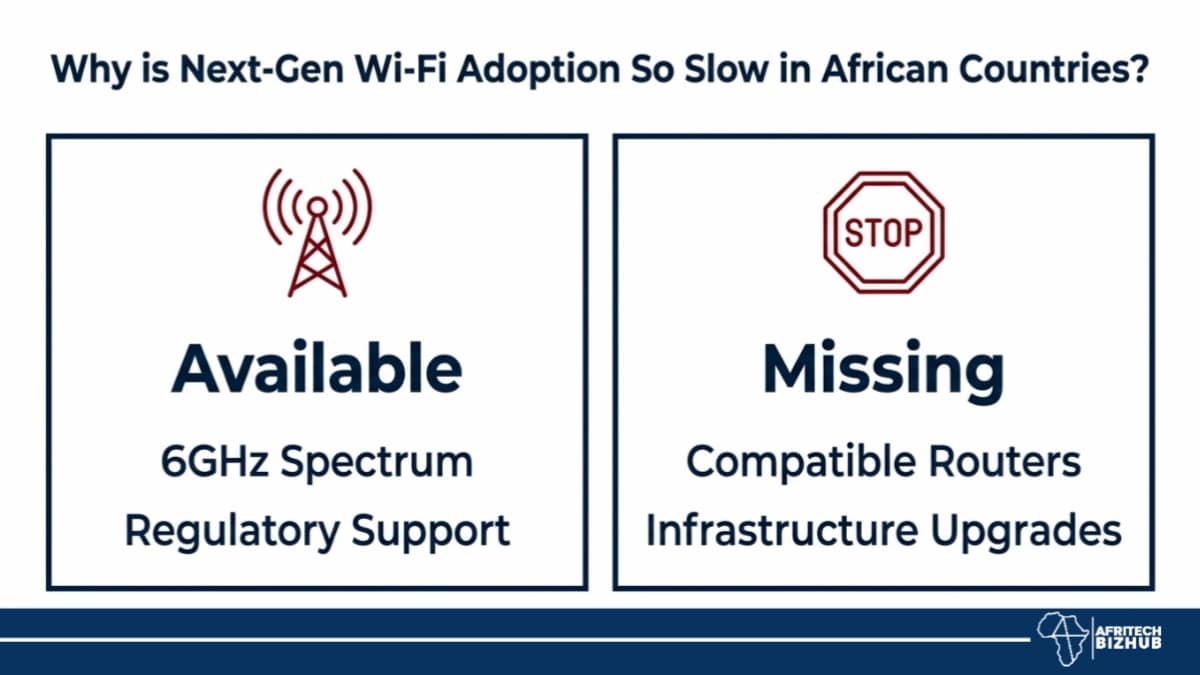
Why is Next-gen Wi-Fi Adoption So Slow in African Countries?
The main obstacle is economics.
Consumers must purchase compatible routers, businesses must upgrade network equipment, ISPs must invest in infrastructure, and manufacturers must make devices affordable.
Observed patterns across Africa indicate that adoption rates remain constrained despite spectrum availability.
Faster spectrum creates opportunity, but uptake depends on device availability, infrastructure upgrades, and market economics.
South Africa’s 6GHz rollout illustrates a continental lesson: spectrum allocation alone is not enough.
Widespread next-generation Wi-Fi adoption requires coordinated investment in devices, networks, and user access.
Countries that upgrade fastest will capture the full potential of next-gen connectivity first.


Recent Comments