

Featured Summary:
- Namibia China is evolving from investment-led cooperation toward industrial capability.
- Oil, gas, technology and renewable energy are becoming part of one long-term economic strategy.
- Technology transfer is becoming as valuable as foreign capital.
- The partnership will ultimately be judged by the industries and skills it leaves behind.
The relationship between Namibia and China is entering a different phase.
Earlier cooperation centred on trade, infrastructure and investment, but recent agreements increasingly combine energy development with technology transfer, local value addition and industrial cooperation.
The conversation is shifting from financing projects to building productive capacity that can support long-term economic growth.
That distinction matters because investment alone does not guarantee economic transformation.
Sustainable development depends on whether countries acquire the technology, engineering expertise and industrial capability needed to create value long after projects have been completed.
The Namibia China partnership is increasingly becoming a practical test of that approach as both countries expand cooperation across energy, mining and advanced manufacturing.
How Will Namibia China Partnership Transform Economic Cooperation?
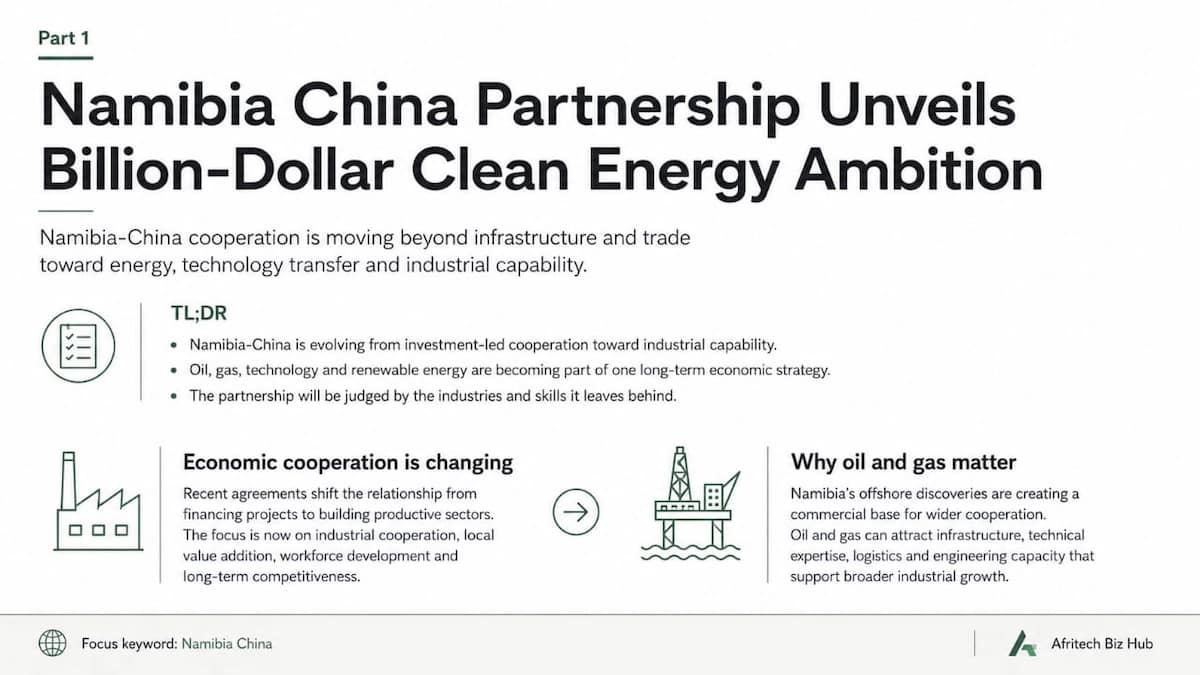
The Namibia China partnership is moving beyond financing individual projects towards strengthening productive sectors that can generate long-term economic growth.
Recent agreements place greater emphasis on industrial cooperation, local processing, technology transfer and workforce development instead of focusing solely on infrastructure investment.
That evolution reflects a broader strategy in which capital becomes a catalyst for expanding Namibia’s productive economy rather than an end in itself.
The partnership now covers sectors capable of creating long-term industrial capacity, including mining, oil and gas, green energy, digital technology and advanced manufacturing.
Both governments have also agreed to deepen cooperation through an economic partnership framework that supports trade, investment and industrial development.
Economic Cooperation is therefore becoming increasingly centred on building industries that create employment, expand domestic production and strengthen Namibia’s long-term competitiveness.
Why is Namibia China Boosting the Oil and Gas Industry?
The Oil and Gas industry has become the commercial foundation supporting broader industrial cooperation because it offers Namibia one of its strongest opportunities to expand exports, attract investment and finance economic diversification.
Major offshore discoveries have positioned the country among Africa’s most promising future oil producers, encouraging international partners to invest in infrastructure, technical expertise and supporting industries that extend beyond resource extraction.
Energy development also creates opportunities for engineering services, logistics, manufacturing and specialised technical employment that strengthen the wider economy.
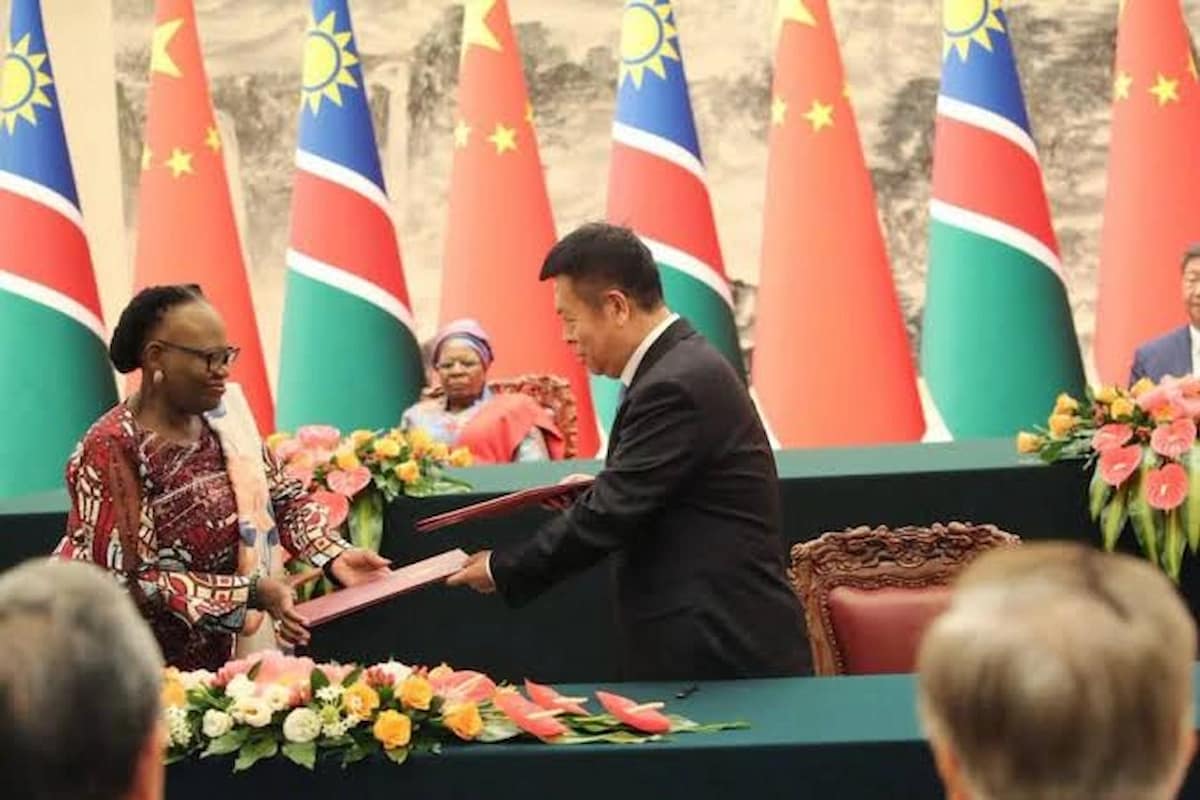
During the recent state visit, China and Namibia identified energy cooperation as a strategic priority alongside mining, infrastructure and industrial development.
The Oil and Gas industry is therefore providing the commercial platform upon which broader industrial cooperation between Namibia and China is being built.
How Does the Technology Transfer Agreement Benefit Namibia China?
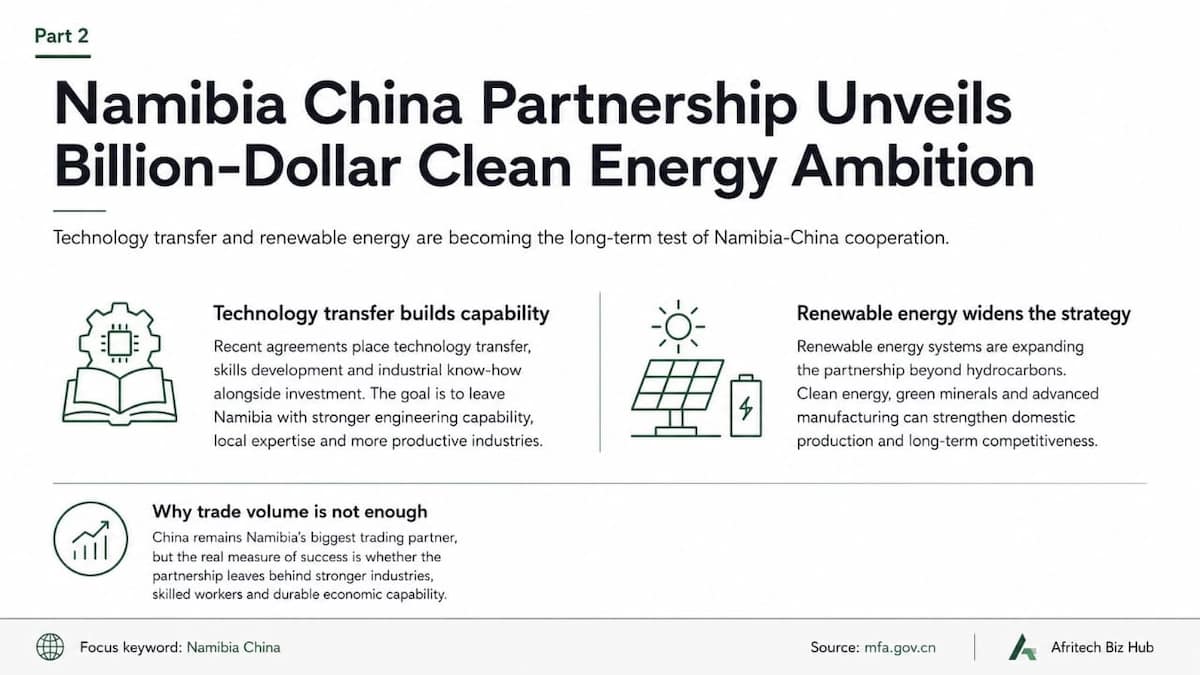
The greatest long-term value within the Namibia China partnership comes from Technology Transfer Agreement commitments that extend knowledge alongside investment.
The joint statements and commercial agreements signed during the state visit place technology transfer, local skills development and industrial capacity building alongside investment in green minerals, clean energy and manufacturing.
That approach allows infrastructure projects to leave behind technical capability that remains valuable long after construction is completed.
Engineering expertise, vocational training and manufacturing knowledge strengthen Namibia’s ability to participate more actively across future value chains instead of depending primarily on imported technology.
As local companies and workers gain greater technical capability, future projects can rely more heavily on domestic expertise while supporting wider industrial expansion.
Technology transfer therefore allows foreign investment to build productive industries that continue creating economic value after individual projects have ended.
Can Namibia China Accelerate Renewable Energy Systems Growth?
Renewable Energy systems are moving Namibia China cooperation beyond traditional resource trade into a wider industrial strategy.
Namibia’s solar potential, green hydrogen ambitions and critical mineral reserves give the country a stronger position in clean energy value chains, while China’s renewable technology base, manufacturing capacity and infrastructure experience create room for cooperation in energy systems, industrial production and technology deployment.
The opportunity is no longer limited to extracting resources.
It is increasingly tied to how Namibia can use energy partnerships to build productive capacity.
The joint statement published by the Permanent Mission of the People’s Republic of China to the UN places energy, critical minerals, industrial cooperation, agriculture, logistics and technology transfer inside the wider Namibia China partnership.
It also supports Chinese enterprises investing in Namibia and participating in projects that strengthen local development.
That institutional backing gives Renewable Energy systems a broader economic role: they can support cleaner power, industrial growth, value addition and long-term competitiveness if investment moves beyond project announcements into domestic production and skills transfer.
Who is Namibia’s Biggest Trading Partner?
China remains Namibia’s largest trading partner, particularly through imports of uranium and other mineral exports, but the significance of the relationship now extends beyond trade volumes alone.
Commercial ties increasingly reflect a broader strategy centred on industrial development, technology cooperation and productive investment that seeks to strengthen Namibia’s long-term economic capability rather than simply increase bilateral trade.
Trade measures the scale of commercial relationships, but productive capability determines their lasting economic value.
The future of the Namibia China partnership will therefore be judged less by investment announcements or export figures than by whether it leaves Namibia with stronger industries, skilled workers, advanced technology and a more productive economy capable of generating sustainable growth for decades to come.


Recent Comments