

Featured Summary:
- The Namibia-China partnership is shifting attention from raw mineral exports to domestic industrial capacity.
- Chinese investment is being judged by its contribution to processing, manufacturing, and skills development.
- Value addition allows resource-rich economies to retain more export earnings and create skilled employment.
- Long-term cooperation will depend on factories, technology transfer, and stronger regional supply chains.
Africa’s resource strategy is no longer centered on the volume of minerals shipped abroad.
Governments now want foreign investment to leave behind processing plants, manufacturing capacity, technology, and skilled employment. .
The Namibia-China partnership reflects that shift as Windhoek asks Chinese investors to support industries capable of converting uranium, lithium, copper, and other resources into higher-value exports.
Namibia’s position places resource ownership at the center of industrial policy rather than treating extraction as the final measure of investment success.
Why Is Extraction of Raw Materials Facing New Pressure?
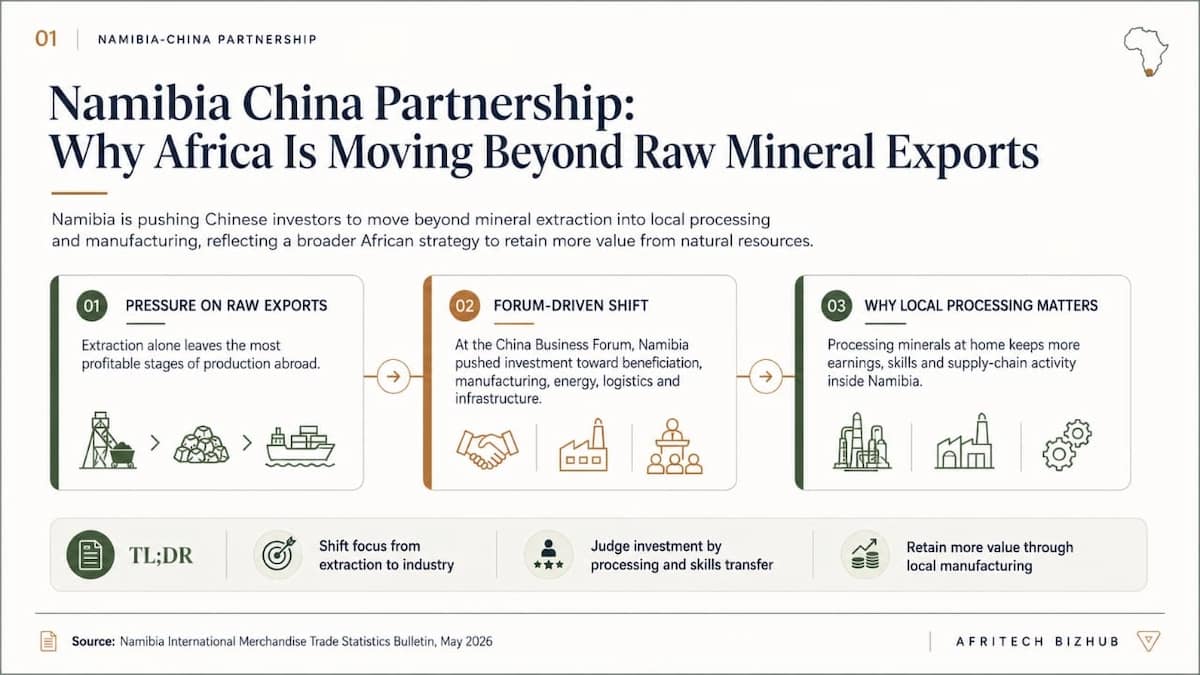
Raw mineral exports leave the most profitable stages of production outside the countries where the resources are mined.
Refining, component production, and manufacturing usually generate stronger margins, technical employment, and wider supply-chain activity than extraction alone.
Resource-rich governments are therefore questioning investment models that raise export volumes without creating enough domestic industry or reducing unemployment.
The pressure reflects a wider demand for economic returns that extend beyond royalties and tax receipts.
Under the Namibia-China Partnership, mineral wealth can support processing facilities, engineering services, industrial suppliers, and technical training inside Namibia.
Retaining more stages of production would strengthen export earnings, reduce dependence on unprocessed commodities, and connect natural resources more directly to national industrialization.
How Is China Business Forum Driving Namibia’s Economic Shift?
The China Business Forum gave Namibia a platform to negotiate investment around industrial outcomes rather than mining capital alone.
Namibia used the engagement to present opportunities across mineral beneficiation, manufacturing, agriculture, energy, logistics, and infrastructure, while making clear that foreign investors must contribute to domestic production.
The discussion placed value creation at the center of future commercial cooperation.
This changes the basis on which investment proposals are assessed.
A mining project may bring capital and export revenue, but an industrial partnership also requires local suppliers, trained workers, processing technology, and access to international markets.
The forum therefore supports a transition from individual extraction projects to connected value chains capable of strengthening industrial capacity and long-term economic growth.
Why Does Namibia-China Partnership Demand Local Processing?
Namibia’s demand for local processing rests on the gap between mineral wealth and domestic economic transformation.
Exporting unprocessed resources gives overseas refiners and manufacturers control over the higher-value stages of production, while Namibia receives a smaller share of the final product’s commercial value.
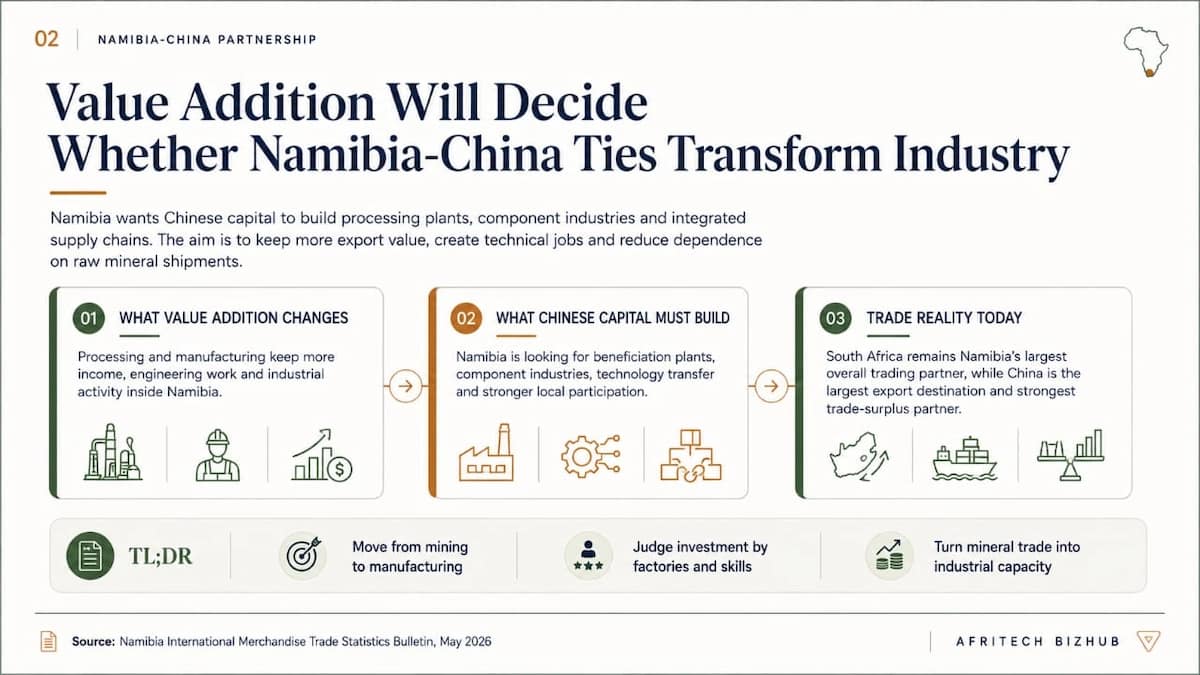
Processing minerals before export would allow more income, technical capability, and industrial activity to remain within the country.
The Namibia-China Partnership offers a route to close that gap because Chinese companies already possess experience in mining, refining, equipment production, and large-scale manufacturing.
Namibia wants that relationship to support beneficiation plants, component industries, and technical skills rather than stop at extraction.
A wider industrial role would diversify exports, strengthen technology transfer, and place Namibia inside higher-value mineral supply chains.
Will Chinese Investors Transform Namibia Through Value Addition?
Chinese capital can alter Namibia’s industrial structure only when investment links mines to factories, suppliers, and skilled workers.
Processing plants would create demand for engineering, transport, energy, maintenance, and business services, while component manufacturing could connect Namibia to regional and international markets.
The quality of investment will therefore depend on how much production capacity remains after minerals leave the mine.
Official trade data still shows the importance of mineral commodities to Namibia’s export performance, which makes local value addition central to the next stage of the Namibia-China Partnership.
Industrial progress will require reliable energy, transport infrastructure, clear investment rules, and agreements that support technology transfer and local participation.
Chinese investors that build integrated supply chains could help Namibia develop regional processing and manufacturing hubs rather than remain primarily a supplier of raw materials.
Who is Namibia’s Biggest Trading Partner?
South Africa remains Namibia’s largest overall trading partner when imports and exports are considered together, while China holds a particularly strong position as an export market.
In May 2026, China was Namibia’s largest export destination and its strongest trade-surplus partner, supported largely by mineral shipments.
The distinction matters because a country can lead as an export buyer without being the largest partner across total bilateral trade.
Trade volume alone, however, does not determine how much economic value Namibia retains.
The Namibia-China Partnership will carry greater long-term weight if mineral exports lead to processing, manufacturing, and technology-based industries inside Namibia.
Industrial cooperation could convert a strong commodity relationship into manufacturing exports, regional competitiveness and a more resilient economy capable of generating value beyond the extraction cycle.


Recent Comments