


Featured Summary:
- Internet access Africa represents one of the world’s largest remaining digital infrastructure opportunities.
- Connectivity now supports trade, finance, education, public services and enterprise growth.
- African AI requires reliable networks, computing capacity, local data and skilled workers.
- Countries combining coverage, affordability, skills and effective policy hold the strongest digital positions.
Africa’s connectivity deficit now carries the economics of a major infrastructure market.
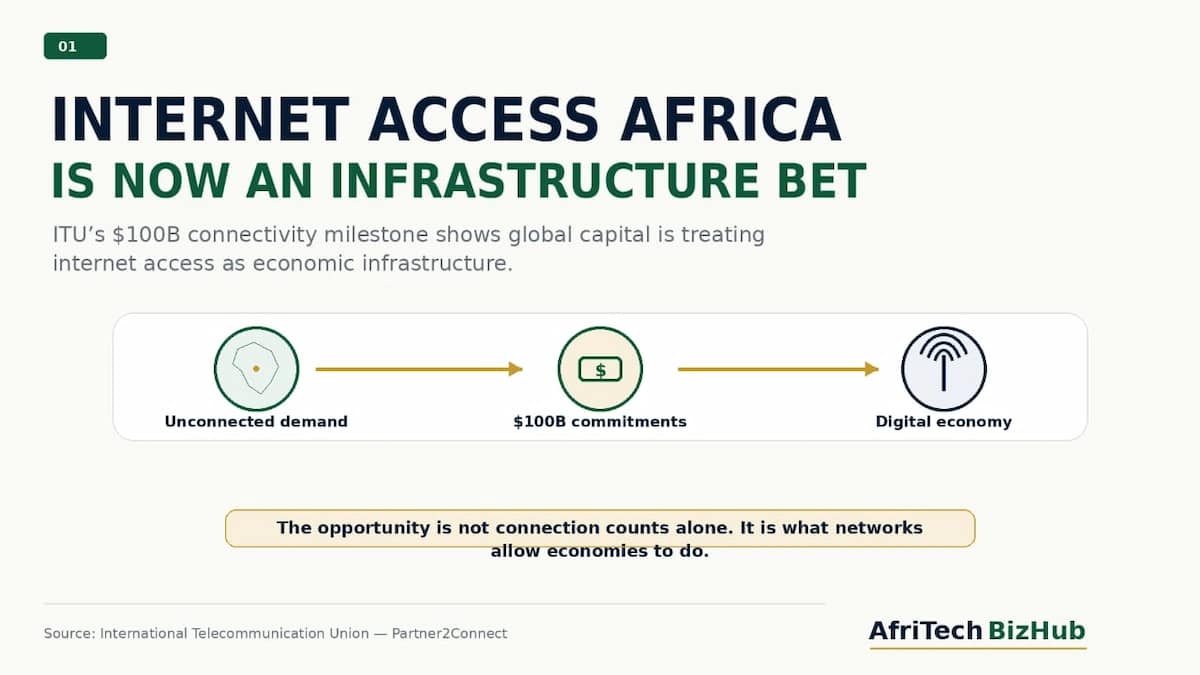
The International Telecommunication Union’s Partner2Connect coalition has reported more than $100 billion in worldwide commitments to universal and meaningful connectivity, although the funding is not reserved exclusively for Africa.
The continent remains central to the investment case because hundreds of millions of people, businesses and communities remain outside the digital economy.
Internet access Africa therefore sits at the centre of a wider contest for telecommunications growth, cloud infrastructure, artificial intelligence and digital commerce.
How Will Universal Internet Access Transform Africa’s Digital Future?
The economic value of universal access lies in what networks allow economies to do, not in connection figures alone.
Reliable and affordable internet lowers the cost of receiving payments, reaching customers, accessing information and delivering public services.
It also gives smaller businesses the digital tools once available mainly to large companies in major cities.
Connectivity therefore functions as economic infrastructure alongside electricity, roads and financial systems.
Internet access Africa-wide would widen participation in digital finance, online education, remote employment and technology-enabled healthcare.
Its effect will depend on whether households can afford devices and data, whether businesses receive reliable service and whether rural communities gain coverage comparable with urban centres.
Countries that address those constraints can translate network investment into stronger productivity, enterprise growth and financial inclusion rather than treating internet coverage as an isolated development target.
Why Is Digital Economy Participation Expanding Faster Across Africa?
Africa’s digital economy now rests on shared digital systems rather than a small collection of urban technology companies.
Mobile payments, digital identification, online marketplaces and government platforms allow consumers and businesses to participate without relying on traditional physical infrastructure.
This has widened the economic role of connectivity from communication to transactions, employment, service delivery and business formation.
The strongest gains will come where networks connect with trusted payment systems, usable digital identities, secure data exchange and practical digital skills.
E-commerce requires reliable payments and delivery systems, while remote work depends on affordable broadband and employable talent.
Technology investment follows the same pattern because investors need both market demand and institutions capable of supporting digital businesses.
Participation therefore rises fastest where connectivity operates as part of a complete digital ecosystem.
How Will African AI Boost Inclusion and Innovation?
AI adoption will be limited by the weakest layer beneath the software.
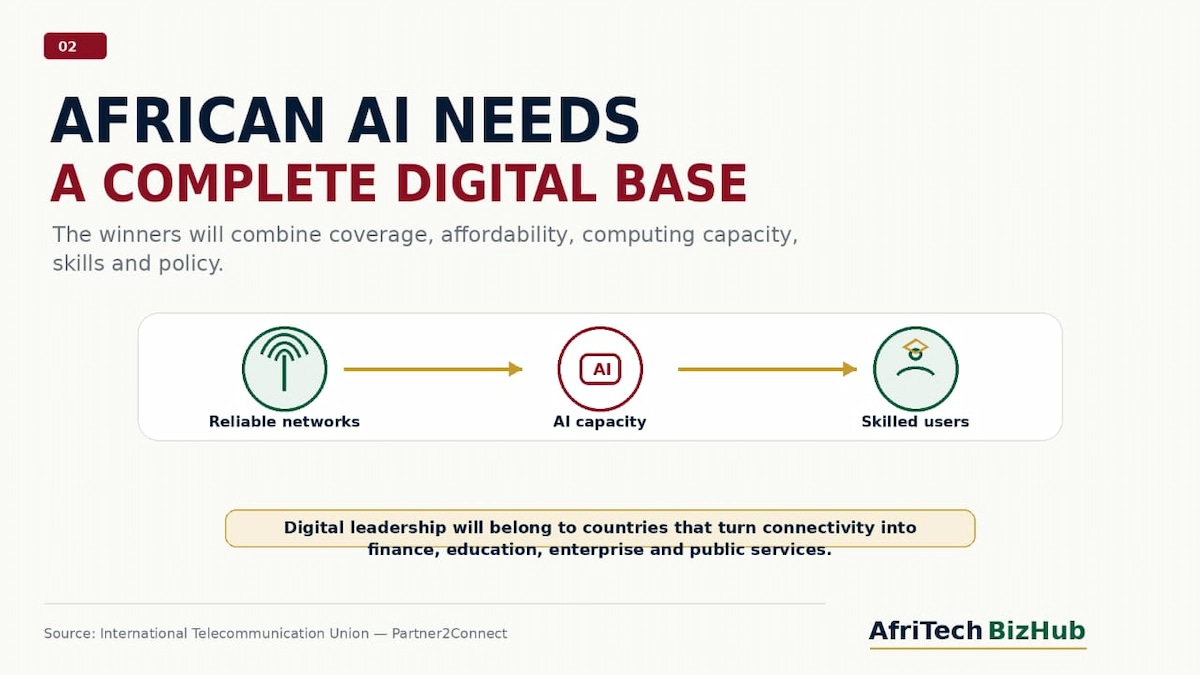
Reliable broadband, computing capacity, dependable electricity, relevant local data and skilled talent determine whether organization’s can deploy artificial intelligence at scale.
Without those foundations, advanced systems remain concentrated among large companies and well-connected urban institutions, leaving smaller enterprises and underserved communities outside the productivity gains.
Stronger infrastructure would allow African AI applications to address practical constraints across healthcare, agriculture, education and public administration.
Medical systems can support diagnosis, farmers can receive location-specific information, learning platforms can adapt materials to individual needs and governments can process services more efficiently.
Africa’s long-term AI position will therefore depend on its ability to build local capacity, strengthen digital infrastructure and adopt technology in ways that reflect the continent’s economic and social priorities.
Why Is Internet Access Africa Gaining Unprecedented Global Support?
Global capital is following the scale of Africa’s unmet digital demand.
The ITU’s Partner2Connect coalition has mobilized more than $100 billion in global commitments for infrastructure, affordability, skills and digital transformation, while Africa still records the world’s lowest regional internet-use rate.
The milestone does not represent a dedicated $100 billion fund for Africa, but it shows how governments, technology companies and development institutions now treat connectivity as a strategic investment priority rather than development assistance alone.
Internet access Africa offers long-term opportunities across mobile networks, fiber corridors, data centers, subsea cables and satellite systems.
Investment will favor markets with predictable regulation, lower infrastructure costs, regional connectivity and enough consumer demand to support commercial returns.
Governments that create those conditions can attract international capital while strengthening the networks required for digital finance, cloud services, AI and cross-border trade.
What Country in Africa Has the Best Internet?
Morocco and Mauritius rank among Africa’s strongest overall connectivity markets, while South Africa leads in the scale of its technology, cloud and data-center ecosystem.
Mauritius performs strongly in network coverage, household adoption and affordability, while Morocco combines broad connectivity with continued investment in digital infrastructure.
South Africa’s larger commercial market gives it wider influence across enterprise technology, digital services and regional infrastructure.
Kenya and Rwanda also stand out, although their strengths extend beyond network speed.
Kenya has built one of Africa’s most advanced digital finance and technology ecosystems, while Rwanda has used policy, digital government and institutional coordination to strengthen its digital position.
No single country leads across every measure.
Long-term digital leadership will depend on the ability to combine infrastructure, affordability, skills, cybersecurity and effective regulation with an economy capable of converting connectivity into innovation, investment and digital exports.


Recent Comments