

Featured Summary:
- Egypt is building more manufacturing capacity around the Suez corridor as it pushes toward the top of Africa’s GDP ranking
- More than $3 billion of new metals, tire and chemical projects are concentrated around Sokhna alone
- The canal gives those factories direct access to a trade route carrying about 12% of global seaborne commerce
- The buildout could give Egypt a stronger export base before 2030, provided the projects move from announcements into sustained production
Industrial investment is gathering around the Suez Canal as Egypt builds more manufacturing capacity into its growth plans.
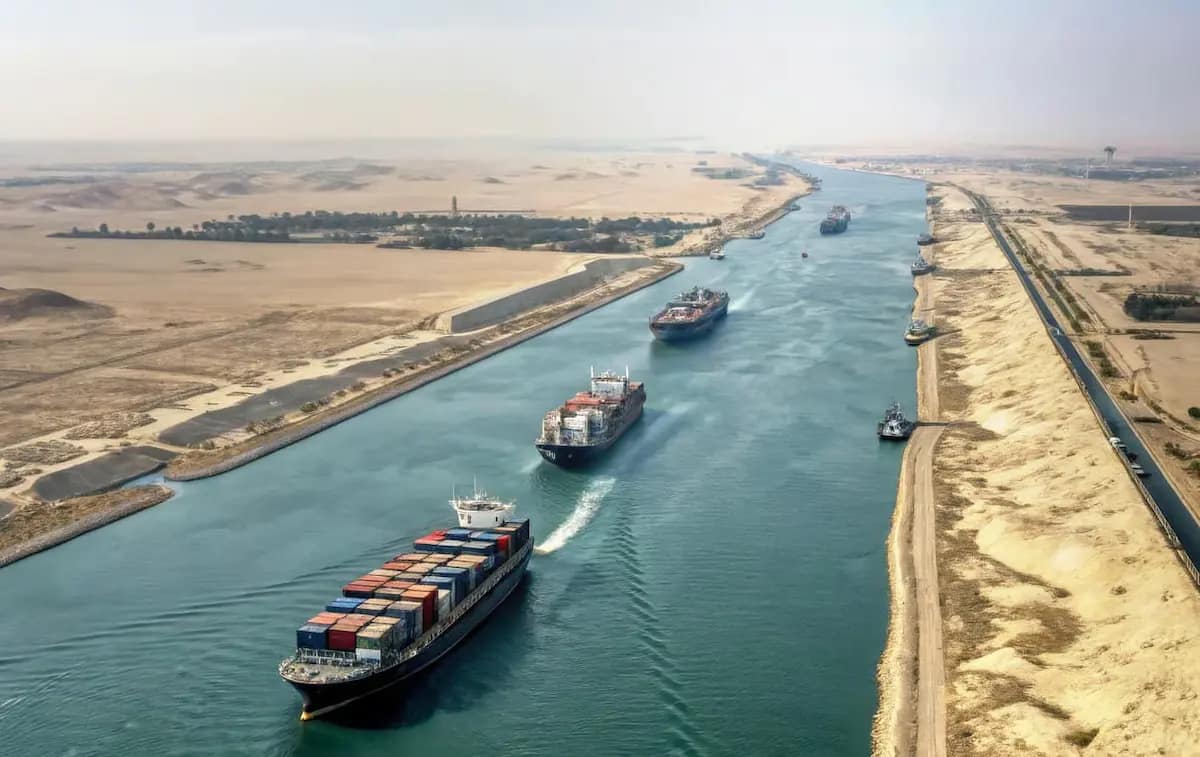
About 12% of global seaborne trade passes through the canal, placing Sokhna, Port Said and other nearby industrial zones on shipping routes linking Europe, Asia and the Middle East.
New factories are being developed beside ports and logistics infrastructure, allowing manufacturers to produce and export from the same corridor.
For Egypt, that expands the economic role of Suez beyond transit fees and shipping revenue. More of the value generated around the canal can now come from goods made in Egypt and sold abroad.
The buildout provides a clearer view of how manufacturing could add to Egypt’s output through the rest of the decade.
Billions of Dollars Are Moving Into Manufacturing Around Suez
China’s Xin Feng is putting $1.65 billion into a nine-factory metals complex at Sokhna, with production planned across steel coils, automotive components and machinery parts. The project is expected to create more than 8,000 direct jobs.
Sailun Group is adding a $1 billion tire plant nearby, with the first phase due to begin production in 2026 and full capacity expected to exceed 10 million tires a year.
Befar Group has committed $500 million to chlor-alkali production, while a separate solar-manufacturing project backed by Chinese, Emirati, Egyptian and Bahraini investors is valued at about $210 million.
The projects bring heavy manufacturing into the same corridor as port and logistics infrastructure, creating a larger export base around Suez.
The capacity being added across steel, automotive inputs, chemicals and energy equipment can serve domestic industry while opening more output to overseas markets.
Sokhna Is Becoming Egypt’s Main Industrial Gateway
New container capacity at Sokhna is being added beside the manufacturing zone, allowing nearby factories to move goods directly onto Red Sea shipping routes.
The range of projects around the port now extends beyond metals and automotive production into chemicals, solar equipment, glass, electronics and textiles.
Qantara West is adding another layer to the corridor. A Turkish investor committed $175 million to a packaging plant in January 2026, taking cumulative investment in the zone to about $1.53 billion across 52 projects.
Chinese companies remain among the largest foreign investors, while recent agreements with South Korea cover shipbuilding, power infrastructure and clean-energy projects.
The corridor is increasingly being built as one production-and-export system rather than a collection of separate industrial sites.
Suez Gives Egypt an Export Advantage South Africa Cannot Reproduce
South Africa still has the stronger corporate and financial base, but factories around Suez are being built beside one of the main shipping routes between Europe and Asia.
That location cuts the distance between production sites and international ports and can reduce the time needed to move goods into overseas markets.
Suppliers and manufacturers can also operate closer to the same transport network as new plants begin production.
The advantage is not guaranteed to translate into faster growth. Red Sea disruptions have already reduced canal traffic, and the IMF continues to press Cairo to reduce the state’s role in the economy and leave more room for private investment.
The projects now under construction will matter more once they begin producing at scale and draw in private capital beyond the initial investment phase.
Suez Canal Is Becoming More Valuable on Land Than at Sea
The Suez corridor is no longer being developed only around the movement of ships. A larger share of the investment now going into the area is tied to what can be produced, assembled and exported from the industrial zones around it.
That changes the role the canal can play in Egypt’s economy. Shipping revenue remains important, but manufacturing around Suez adds output that is created inside the country before goods enter international trade.
The immediate test is whether the current wave of projects moves into sustained production at the scale investors have announced.
If it does, the corridor will carry more weight in Egypt’s manufacturing base and give the country another source of export earnings alongside its traditional canal revenues.
That would make Suez part of the economic capacity supporting Egypt’s rise in Africa’s GDP ranking, rather than simply the trade route running through it.


Recent Comments