

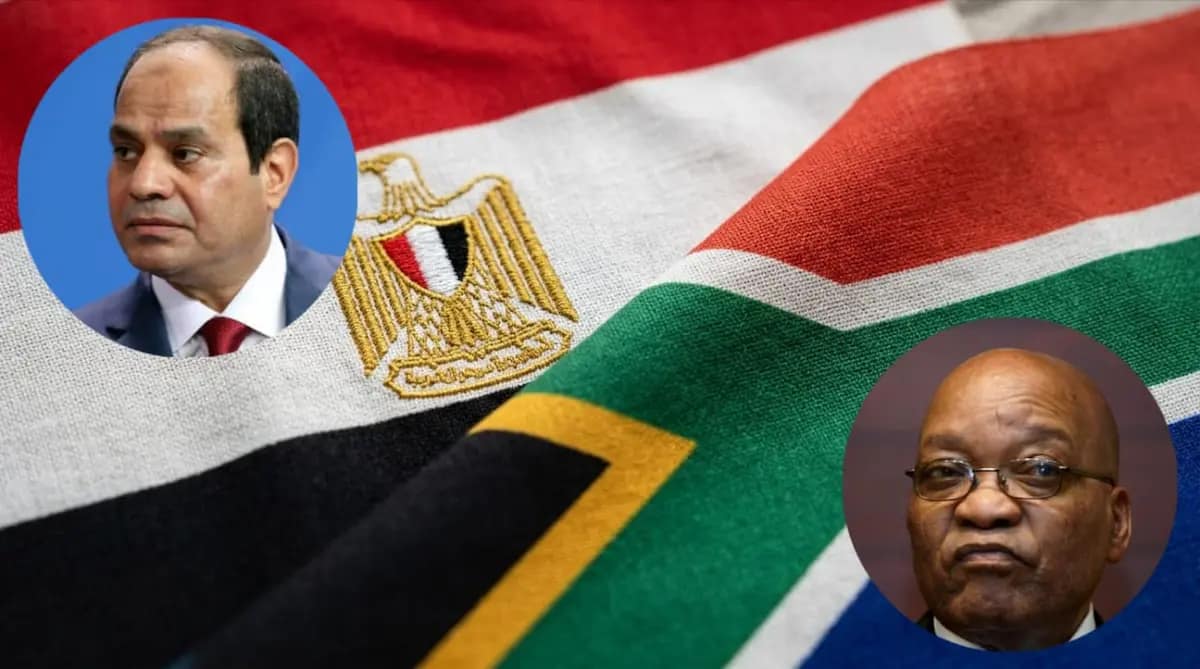
Featured Summary:
- South Africa remains Africa’s largest economy in 2026
- Its lead is narrowing as growth stays weak
- Egypt is closing the gap faster than expected
- IMF projections show Egypt moving ahead in 2029 and extending the lead in 2030
South Africa remains Africa’s largest economy in 2026, with nominal GDP of about $480 billion, compared with roughly $430 billion for Egypt, according to the IMF’s April World Economic Outlook.
South Africa is expected to grow by about 1% this year. Egypt is projected at 4.2%, putting the two economies on very different paths through the rest of the decade.
South Africa still has the larger financial system, a more established corporate sector and a broader industrial base. Those assets have helped keep its economy ahead despite years of weak growth.
Egypt is expanding faster as investment, construction and manufacturing add to output. Current IMF projections put it ahead of South Africa in 2029, with the gap widening in 2030.
South Africa still leads in 2026. Keeping that position now depends on whether growth improves before Egypt closes the remaining gap.
Why South Africa Is Still Africa’s Largest Economy
Finance, real estate and business services produced R296 billion in the second quarter of 2026, according to Statistics South Africa.
Manufacturing contributed R126 billion and mining R51 billion, measured at constant 2015 prices.
The figures show why South Africa’s economy cannot be reduced to mining. Finance remains a larger source of output, while manufacturing, trade, transport and business services add weight across the rest of the economy.
The Johannesburg Stock Exchange strengthens that position. It had more than 263 listed companies and market capitalisation of R24.73 trillion in June, keeping it ahead of other African exchanges by size and liquidity.
South African companies can raise equity and debt in a domestic market with far greater depth than most of the continent.
Manufacturing also remains important to exports. Vehicle and automotive-component exports reached R291 billion in 2025, equal to 15.6% of national exports.
South Africa produced 618,077 vehicles that year, more than half of Africa’s total production, while automotive activity accounted for 23.8% of manufacturing output.
Mining, chemicals, metals, food processing, retail, telecommunications and professional services broaden the base further.
Banks, insurers, suppliers and logistics companies operate around those industries, reinforcing the scale already built into the economy.
That base has kept South Africa ahead even as growth slowed. The pressure now comes from how little that base is expanding.
South Africa’s Lead Is Being Tested by Slow Growth
The IMF expects South Africa’s real GDP growth to reach 1.8% by 2030, compared with 4.7% for sub-Saharan Africa. Unemployment rose to 33.6% in the second quarter, leaving 8.5 million people without work.
Freight volumes remain well below government targets. About 160 million tonnes moved by rail in the latest financial year, while Pretoria is targeting 250 million tonnes by 2029.
More cargo has shifted to roads as rail capacity weakened, raising transport costs for miners, manufacturers and agricultural exporters.
Electricity supply has recovered from the worst of the power crisis, helped by better Eskom performance and more private generation. Investment is now moving into transmission, storage and new capacity.
Rail reform is also moving into implementation. Eleven private operators have been approved to enter the national freight network, with services expected from April 2027. Together, they plan to add as much as 24 million tonnes of annual freight capacity.
The recovery has not yet translated into stronger business demand. South Africa’s private sector contracted in September at its fastest pace since December, with new orders falling sharply and cost pressures increasing.
South Africa has started fixing some of the constraints that held back output. The growth rate still leaves its lead exposed.
Egypt Is Closing the Gap—and Could Move Ahead in 2029
Growth averaged 5.3% between July and December 2025, compared with 3.9% in the same period a year earlier.
Manufacturing benefited from better access to imported inputs and foreign currency, while tourism and telecommunications remained strong.
Egypt also received about $15 billion in foreign direct investment in 2025, more than any other African economy.
Energy, infrastructure and industrial projects took a large share of the inflows, with new factories continuing to cluster around the Suez Canal Economic Zone.
Policy changes have helped draw private capital back into the economy. A more flexible exchange rate was followed by tighter fiscal and monetary policy and a renewed programme of state-asset sales.
By May, roughly 20 further transactions were being prepared, alongside plans to bring private management into 11 airports.
The IMF has continued to press Cairo to reduce the state’s role and accelerate reforms that have moved more slowly than planned.
Manufacturers around Ain Sokhna and East Port Said also sit beside one of the main shipping corridors linking Asia, Europe and the Middle East.
Egypt accounted for almost all announced investment in special economic zones across COMESA between 2015 and 2024.
On the IMF’s present path, those gains take Egypt past South Africa in nominal dollar GDP in 2029.
Currency movements could still bring that date forward or push it back, since changes in the pound or rand alter the dollar value of national output.
Inflation and heavy financing needs remain constraints, while the government has yet to complete much of its planned withdrawal from commercial activity.
Even so, Egypt is expected to continue expanding at a markedly faster rate than South Africa.
Nigeria is not yet as close. Stronger real growth has been offset in dollar terms by the naira’s depreciation, keeping its economy below both countries in the current projections.
South Africa’s Position Now Depends on Growth
South Africa enters the rest of the decade with some of its biggest constraints beginning to ease, but the economic payoff is still limited.
Improvements in electricity supply and freight capacity will matter only if they are followed by stronger private investment, higher production and better job creation.
That is now the central test for an economy that has spent years relying on advantages built earlier.
The institutions, companies and industrial capacity are already in place; what has been missing is a stronger rate of expansion.
Egypt is moving through the same period with faster growth and a heavier flow of investment into industry and infrastructure, giving it more room to close the remaining gap.
South Africa’s position at the top is therefore no longer protected by size alone. The next few years will show whether its reforms can produce enough growth to keep that position intact.


Recent Comments