


Featured Summary:
- Ecobank Nature Bond Africa is helping channel capital toward sustainable agriculture, biodiversity protection, and climate-resilient projects.
- Investment into clean energy is increasingly moving through structured financial instruments rather than traditional donor funding.
- Green bonds are expanding access to long-term capital for environmental and sustainability-linked projects.
- Farm credit financing is becoming an important link between green finance and agricultural productivity.
Africa’s green transition increasingly faces a financing challenge rather than an ambition challenge.
Governments, businesses, and development institutions broadly agree on the need for climate resilience, clean energy expansion, sustainable agriculture, and environmental protection.
The larger question has become how those activities are financed at scale.
Ecobank Nature Bond Africa reflects a growing effort to move environmental finance beyond grants and development programmes into capital markets.
The significance extends beyond a single financial product.
It signals an attempt to make sustainability investable and connect environmental outcomes to long-term investment capital.
As African financial institutions search for scalable climate-finance solutions, Ecobank Nature Bond Africa represents a test of whether environmental assets can attract mainstream investment rather than rely primarily on development funding.
How Is Ecobank Driving Nature Bonds Growth?
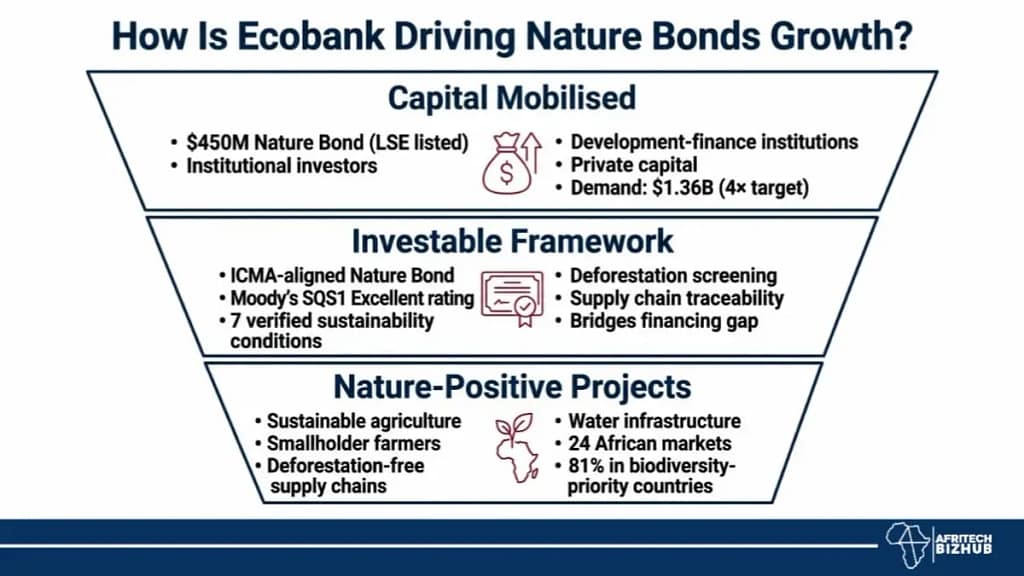
Ecobank is driving Nature Bonds growth by creating financial structures capable of directing investment toward projects that generate both environmental and economic value.
The Nature Bond program seeks to mobilize capital for activities linked to sustainable agriculture, biodiversity protection, ecosystem restoration, climate resilience, and nature-positive economic development.
The strategy addresses a long-standing financing gap.
Many environmental projects struggle to attract private investment because returns are often perceived as uncertain, fragmented, or difficult to measure.
Nature Bonds attempts to bridge that gap by packaging environmental initiatives into investable frameworks that appeal to institutional investors, development-finance institutions, and private capital.
The significance extends beyond Ecobank itself.
Nature Bonds reflect a broader shift in how environmental assets are being viewed.
Activities once treated primarily as sustainability objectives are increasingly being evaluated as investable economic opportunities.
How Is Ecobank Driving Nature Bonds Growth?
Ecobank is driving Nature Bonds growth by creating financial structures capable of directing investment toward projects that generate both environmental and economic value.
The Nature Bond program seeks to mobilize capital for activities linked to sustainable agriculture, biodiversity protection, ecosystem restoration, climate resilience, and nature-positive economic development.
The strategy addresses a long-standing financing gap.
Many environmental projects struggle to attract private investment because returns are often perceived as uncertain, fragmented, or difficult to measure.
Nature Bonds attempts to bridge that gap by packaging environmental initiatives into investable frameworks that appeal to institutional investors, development-finance institutions, and private capital.
The significance extends beyond Ecobank itself.
Nature Bonds reflect a broader shift in how environmental assets are being viewed.
Activities once treated primarily as sustainability objectives are increasingly being evaluated as investable economic opportunities.
What Drives Investment Into Clean Energy Africa?
Investment into clean energy in Africa is being driven by a combination of rising energy demand, improving project economics, policy support, and growing investor interest in climate-related assets.
Across the continent, governments and businesses continue searching for solutions capable of expanding energy access while reducing infrastructure constraints that limit economic growth.
The timing is important. Global investors are increasingly allocating capital toward climate-transition projects, renewable energy infrastructure, and sustainability-linked investments.
Development-finance institutions are simultaneously helping reduce investment risk through guarantees, blended-finance structures, and co-financing arrangements.
Clean energy is therefore attracting attention not simply because it supports environmental goals.
It is attracting capital because investors increasingly view energy access, grid expansion, and renewable infrastructure as long-term economic opportunities capable of generating measurable returns.
Are Green Bonds Transforming African Capital Markets?
Green bonds are transforming African capital markets by expanding the types of projects that can access long-term financing.
Historically, many environmental and sustainability initiatives relied heavily on grants, concessional funding, or public-sector programs.
Green bonds create a mechanism that links environmental projects directly to investors.
The impact extends beyond climate finance.
Green bonds encourage stronger reporting standards, greater transparency, and more rigorous measurement of project outcomes because investors increasingly require evidence that environmental objectives are being achieved.
This represents a structural change within African capital markets.
Sustainability projects are increasingly moving from the margins of finance toward mainstream investment discussions.
Capital markets are gradually broadening to accommodate environmental performance alongside traditional financial metrics.
How Does Farm Credit Financing Boost Farmers?
Farm credit financing improves access to capital needed for production, equipment, inputs, irrigation systems, storage facilities, and productivity-enhancing technologies.
Many agricultural producers continue facing financing constraints that limit their ability to expand output or adopt more resilient farming practices.
Access to credit allows farmers to invest in activities that improve yields, strengthen resilience against climate-related shocks, and increase long-term income potential.
The benefits extend beyond individual farms.
Improved agricultural productivity supports food security, strengthens rural economies, and contributes to broader economic growth.
According to the International Finance Corporation, sustainable agricultural finance plays an increasingly important role in improving resilience, expanding financial inclusion, and supporting long-term agricultural development.
The success of many green-finance initiatives ultimately depends on whether capital reaches productive sectors of the economy.
Farm credit financing remains one of the clearest tests of whether green finance can generate measurable economic outcomes alongside environmental benefits.
Why Is African Green Investment Gaining Momentum?
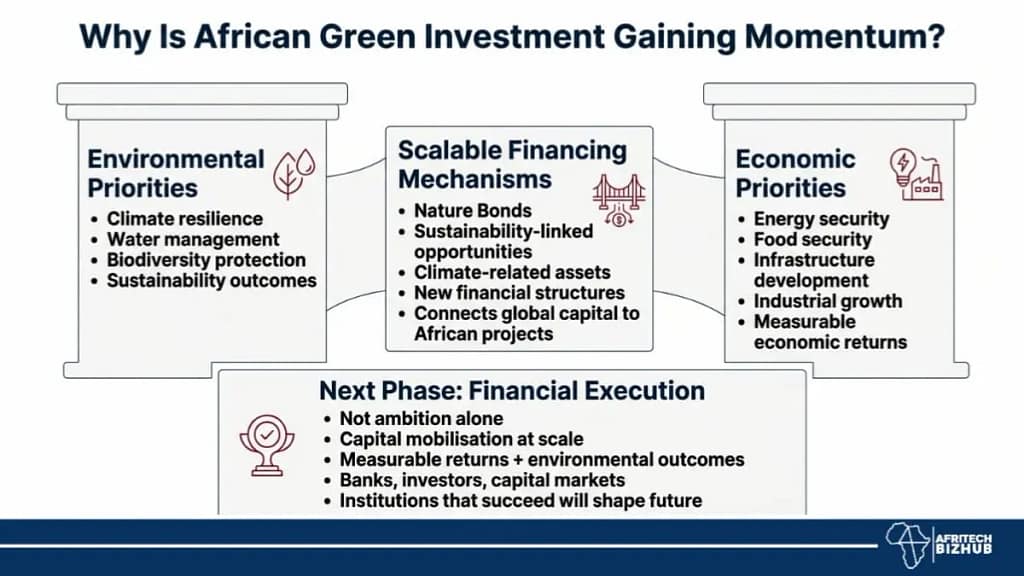
African green investment is gaining momentum because environmental priorities are increasingly aligning with economic priorities.
Energy security, food security, climate resilience, infrastructure development, water management, and industrial growth are becoming part of the same investment conversation.
The shift is also being driven by capital markets themselves.
Global investors are actively searching for climate-related assets, sustainability-linked opportunities, and long-term growth sectors capable of benefiting from the global transition toward lower-carbon economies.
At the same time, African financial institutions are developing new structures capable of connecting that capital with investable projects across the continent.
The deeper reality is that Africa does not suffer from a shortage of sustainability opportunities.
It suffers from a shortage of scalable financing mechanisms.
That is why Ecobank Nature Bond Africa is attracting attention.
The initiative attempts to solve a financing problem rather than an environmental problem.
The next phase of African green finance will not be determined by ambition alone.
It will be determined by whether banks, investors, and capital markets can move sufficient capital into projects capable of generating measurable economic returns alongside environmental outcomes.
Africa’s sustainability challenge is increasingly a capital-allocation challenge.
The institutions that solve the financing problem will shape the future of African green investment long before they solve the climate problem itself.


Recent Comments