


Featured Summary:
- Afreximbank country briefs suggest that trade position and economic role may matter as much as growth, exports, or GDP
- Ghana is increasingly presented as a processing, logistics, and trade-corridor economy rather than simply a commodity producer
- Tunisia is increasingly examined through manufacturing networks, industrial connectivity, and its position between Europe and Africa
- The deeper signal is that African economies are being assessed less by what they produce and more by where they fit inside larger trade and industrial systems
Afreximbank’s latest country briefs reveal a subtle but important shift in how African economies are being examined.
Ghana and Tunisia are not presented simply through growth, exports, production, or investment. Something else appears to be organising the analysis.
The pattern emerges repeatedly throughout both reports. Attention moves beyond economic output and towards position. Beyond production and towards connection. Beyond resources and towards role.
The implication is difficult to miss. The question is no longer only what economies generate. It is increasingly where they fit.

Are Afreximbank Country Briefs Becoming Capital Design Documents?
Most economic reports begin with performance. Growth, inflation, debt, exports, fiscal balances, and production remain the standard reference points for measuring economic progress.
The latest Afreximbank country briefs take a different route.
Ghana and Tunisia are examined through trade corridors, industrial positioning, processing capacity, logistics systems, manufacturing networks, and regional connectivity.
Economic performance remains present throughout both reports. It simply does not appear to be the organising principle of the analysis.
That distinction matters. Capital rarely follows production alone. It follows access, movement, connectivity, and position within larger commercial systems.
The Afreximbank country briefs repeatedly return to those foundations.
Growth can increase without changing an economy’s place in a value chain.
Exports can rise without improving value capture. The deeper question running through both documents is not what countries produce, but where they fit.
Why Does The Ghana Brief Focus More On Movement Than Extraction?
Ghana’s economy remains closely associated with gold, cocoa, oil, minerals, and commodity exports.
Those sectors remain central to the country’s economic profile and feature prominently throughout the brief.
Yet extraction is not the dominant theme. The document repeatedly returns to processing capacity, trade infrastructure, logistics systems, export corridors, and industrial activity.
Tema Port expansion, the Boankra Inland Port project, the Big Push infrastructure programme, and efforts to expand domestic processing appear throughout the analysis.
Production remains important. The infrastructure that moves production receives even greater attention.
That emphasis is revealing. The Ghana brief shows limited interest in commodities as isolated assets.
Its focus remains fixed on what happens after extraction.
Resources move into processing. Goods move through ports and corridors. Exports move into regional markets. Extraction creates output. Value capture happens afterwards.
The recurring question is not what Ghana produces, but how much value it retains before those products leave the economy.
Why Does Tunisia Appear More As A Connector Than A Market?
The Tunisia section of the Afreximbank country briefs follows a different path but arrives at a similar destination.
Manufacturing, exports, industrial diversification, and trade integration feature prominently throughout the analysis.
Yet the report appears less interested in domestic market size than in Tunisia’s position within wider production and trade networks.
That position sits at the centre of the document.
Tunisia remains closely integrated into European manufacturing supply chains through automotive components, industrial exports, and trade links with France, Italy, and Germany.
At the same time, the brief repeatedly highlights regional connectivity through Libya, Algeria, and broader African trade relationships.
Geography becomes part of the economic story.
That emphasis is revealing.
The report spends relatively little time presenting Tunisia as a consumer market.
Instead, it examines the country as a production, transit, and industrial link between regions.
The pattern mirrors the broader logic running through the Afreximbank country briefs.
Importance is increasingly derived from connection, access, and integration rather than economic size alone.
Are African Economies Being Assigned Functional Roles?
A common logic runs through both briefs.
Ghana appears through value chains, processing capacity, logistics corridors, and resource movement.
Tunisia appears through manufacturing networks, industrial connectivity, export capability, and trade linkage.
Different economies. Similar treatment.
The latest Afreximbank country briefs spend less time examining countries in isolation and more time locating them within larger commercial networks.
Trade systems. Industrial systems. Production networks. Regional integration frameworks. Position increasingly matters alongside performance.
The pattern extends beyond these two reports.
Institutions across Africa are placing greater emphasis on regional value chains, industrial corridors, cross-border infrastructure, and trade integration as AfCFTA implementation advances.
The shift becomes difficult to ignore.
Economic performance remains important, but the role an economy performs inside wider systems is becoming increasingly important as well.
The question is no longer only how economies grow. It is how they fit.
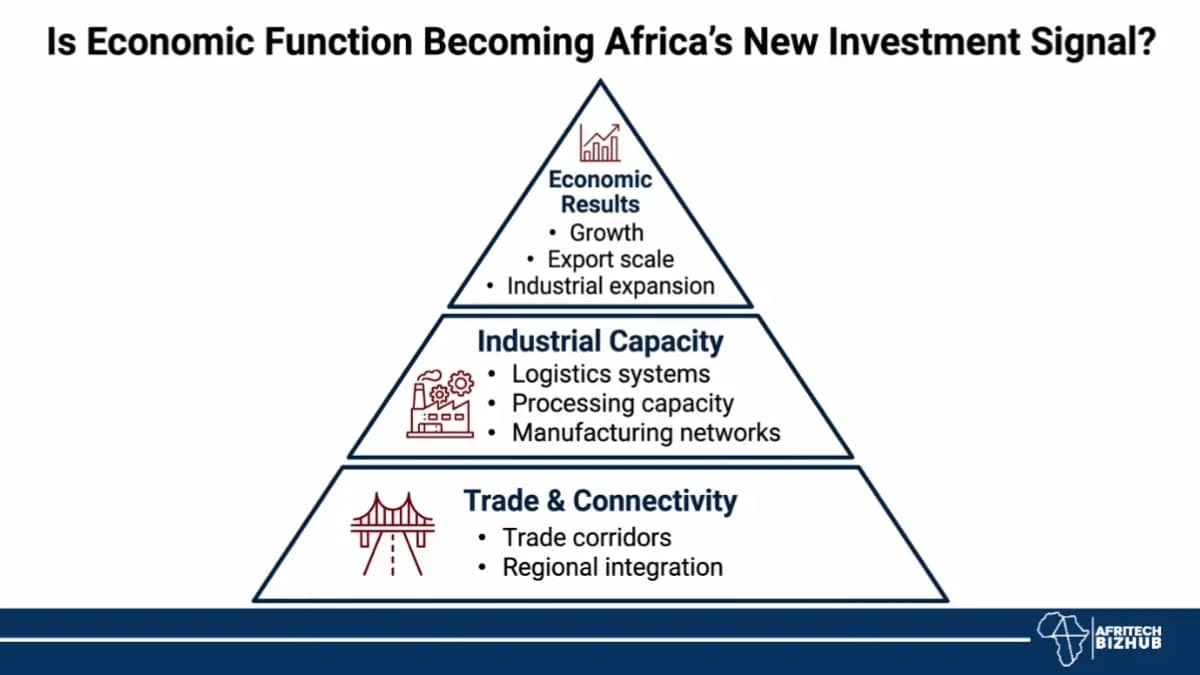
Is Economic Function Becoming Africa’s New Investment Signal?
The most revealing feature of both briefs is not what they say about Ghana or Tunisia individually.
It is what they suggest about how African economies may increasingly be assessed.
Trade corridors appear before trade expansion. Industrial positioning appears before industrial scale. Connectivity appears before growth. The sequence is difficult to ignore.
Governments will continue announcing industrial strategies, export targets, and development plans.
Investors, lenders, and development institutions often look one layer deeper.
Infrastructure, logistics systems, processing capacity, manufacturing networks, and regional integration increasingly determine whether those ambitions become reality.
That shift carries important implications.
Countries that occupy strategic positions within trade, industrial, and investment systems may attract attention disproportionate to their economic size.
The latest Afreximbank country briefs suggest that Africa’s next capital map may be shaped less by what economies produce and more by the role they perform.
Growth remains important. Position is becoming harder to ignore.


Recent Comments