


Featured Summary:
- Ghana has launched a National AI Strategy alongside the One Million Coders Programme to strengthen digital competitiveness.
- AI policy reforms are increasingly being linked to workforce development, governance, and economic growth.
- Coding programs are becoming a central pillar of Ghana’s digital talent pipeline.
- Ghana’s approach reflects a broader African shift toward building AI capability rather than simply adopting AI tools.
The race to participate in the AI economy is increasingly being decided by workforce capacity and institutional preparation rather than technology access alone.
Ghana has moved to position itself within that race through the launch of its National AI Strategy and the rollout of the One Million Coders Programme.
Together, the initiatives signal a shift in policy thinking.
The objective is no longer simply expanding digital access.
It is building the skills, governance frameworks, and innovation capacity required to compete in an economy where artificial intelligence increasingly influences productivity, investment, and economic competitiveness.
What Drives Ghana Africa AI Leadership Strategy?
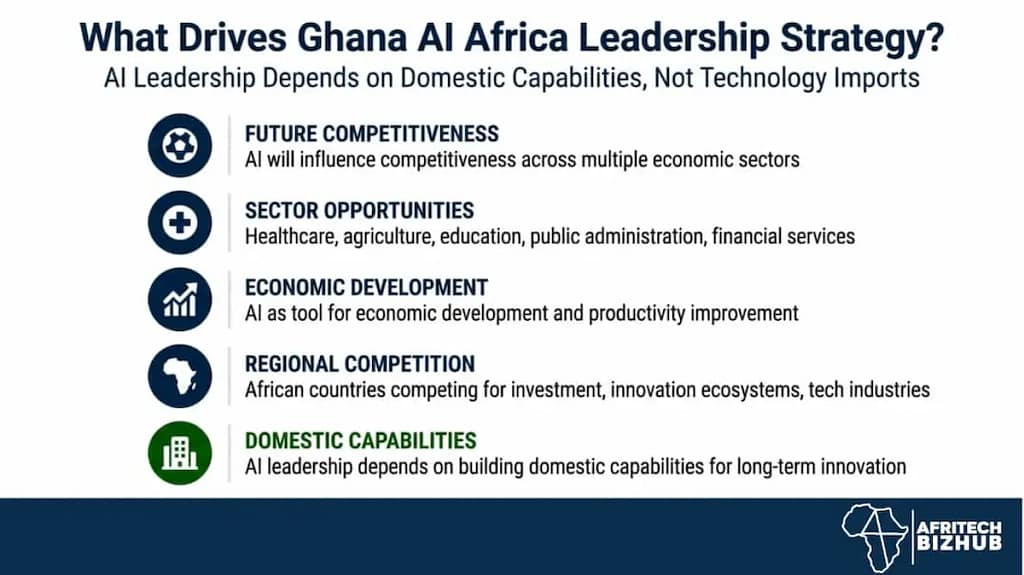
Ghana’s Africa strategy is being driven by a recognition that artificial intelligence will influence future competitiveness across multiple sectors of the economy.
The government’s National AI Strategy identifies opportunities across healthcare, agriculture, education, public administration, and financial services while positioning AI as a tool for economic development and productivity improvement.
The strategy also reflects a broader regional reality.
Countries across Africa are competing to attract investment, develop innovation ecosystems, and build local technology industries.
The competition is no longer centred on who adopts AI first.
It is increasingly centred on who develops the talent, institutions, and governance systems capable of supporting AI at scale.
Ghana’s approach suggests that AI leadership will depend less on technology imports and more on whether countries can build domestic capabilities that support long-term innovation and economic participation.
How is Ghana Shaping AI Policy Reforms?
Ghana is shaping AI policy reforms through a framework that combines innovation objectives with governance considerations.
The National AI Strategy places emphasis on responsible AI adoption, data governance, digital inclusion, institutional coordination, and regulatory readiness.
The significance of that approach extends beyond artificial intelligence itself.
Governments that develop governance frameworks early often create greater certainty for investors, businesses, and public institutions.
The difficult part of AI adoption is rarely acquiring the technology.
The difficult part is creating the institutional capacity required to govern it effectively.
Ghana’s policy direction reflects a recognition that governance readiness is becoming a competitive advantage.
Countries that delay governance often discover that regulatory uncertainty becomes a barrier to innovation rather than a safeguard against risk.
What Powers Ghana Coding Program Digital Skills?
The One Million Coders Programme sits at the centre of Ghana’s digital-skills agenda.
The initiative aims to train large numbers of young people in coding, artificial intelligence, cybersecurity, data analytics, and digital technologies that are increasingly relevant to modern labour markets.
The programme is designed to address a practical challenge facing many African economies.
Demand for digital skills is rising faster than the supply of qualified workers.
By expanding access to technical training, Ghana is attempting to strengthen the pipeline of talent needed to support future technology industries, entrepreneurship, and digital employment opportunities.
The bigger challenge is ensuring those skills translate into productive economic activity rather than simply increasing the supply of trained workers.
According to Ghana’s Ministry of Communication, Digital Technology and Innovations, the National AI Strategy and the One Million Coders Programme form part of a broader effort to build local digital capability and prepare young people for opportunities emerging within the AI economy.
How does Coding Boost Digital Workforce Growth?
Coding boosts digital workforce growth because it creates capabilities that can be applied across multiple industries rather than a single technology sector.
Software development, fintech, cybersecurity, cloud services, AI operations, telecommunications, and digital business services all require workers with technical skills.
The impact is increasingly economic rather than educational.
Countries that develop larger pools of digital talent improve their ability to attract investment, support technology companies, and participate in global digital markets.
Workforce development is therefore becoming a central component of economic strategy rather than simply a training objective.
Countries that fail to build technical talent risk becoming consumers of digital products rather than producers of digital value.
Can AI Economy Transform Africa’s Digital Future?
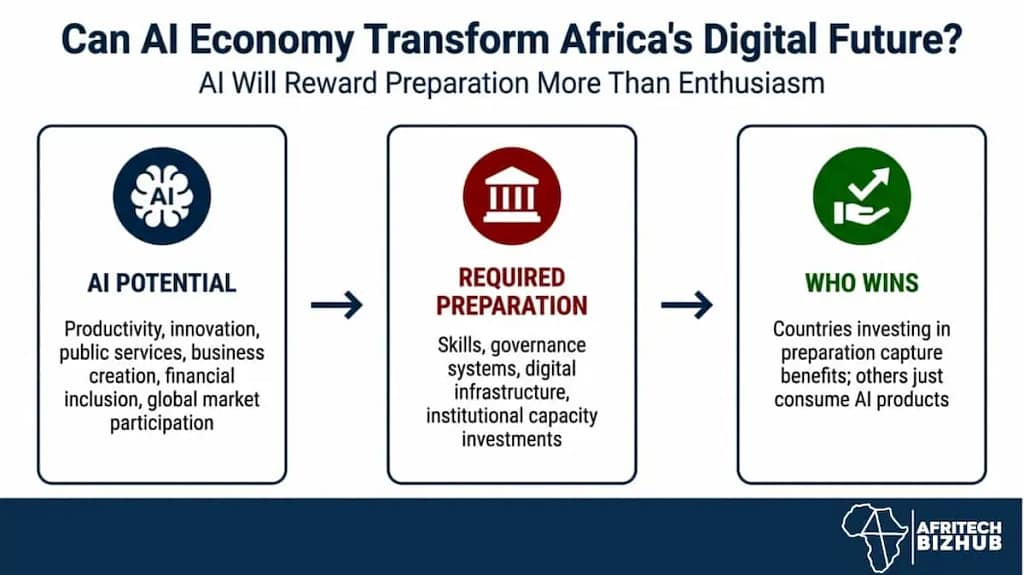
The AI economy has the potential to influence productivity, innovation, public-service delivery, business creation, financial inclusion, and participation in global digital markets.
Artificial intelligence is increasingly becoming part of how economies generate value, improve efficiency, and create new forms of economic activity.
The opportunity, however, will not be distributed evenly.
Countries that invest in skills, governance systems, digital infrastructure, and institutional capacity are likely to capture a larger share of the benefits.
Those that focus only on technology adoption may find themselves consuming AI products while generating limited economic value from them.
That is the judgment increasingly emerging from the global AI race.
The AI economy is unlikely to reward ambition alone.
It will reward preparation, execution, and institutional capacity.
Ghana’s strategy reflects an understanding that digital futures are built through institutions, skills, and policy choices long before technological advantages become visible in economic data.


Recent Comments