

Featured Summary:
- Kenya’s digital rights debate is intensifying as government AI and cyber surveillance plans raise privacy and oversight concerns.
- Cyber surveillance powers require clear legal limits because technical capability cannot become open-ended monitoring authority.
- Digital surveillance could reshape how the state monitors online activity, collects information, and responds to public pressure.
- Government AI now faces a harder accountability test as Kenya weighs security needs against civil freedoms.
Kenya’s government AI debate has moved beyond technology into a harder question of state power.
Systems built to improve security response, public administration, and digital coordination can also expand what authorities are able to see, collect, analyse, and retain.
That is why Kenya’s cyber surveillance debate has triggered a sharper digital rights test.
The issue is no longer whether government can build stronger AI and cyber capability; it is whether legal oversight can keep that capability from becoming open-ended monitoring authority.
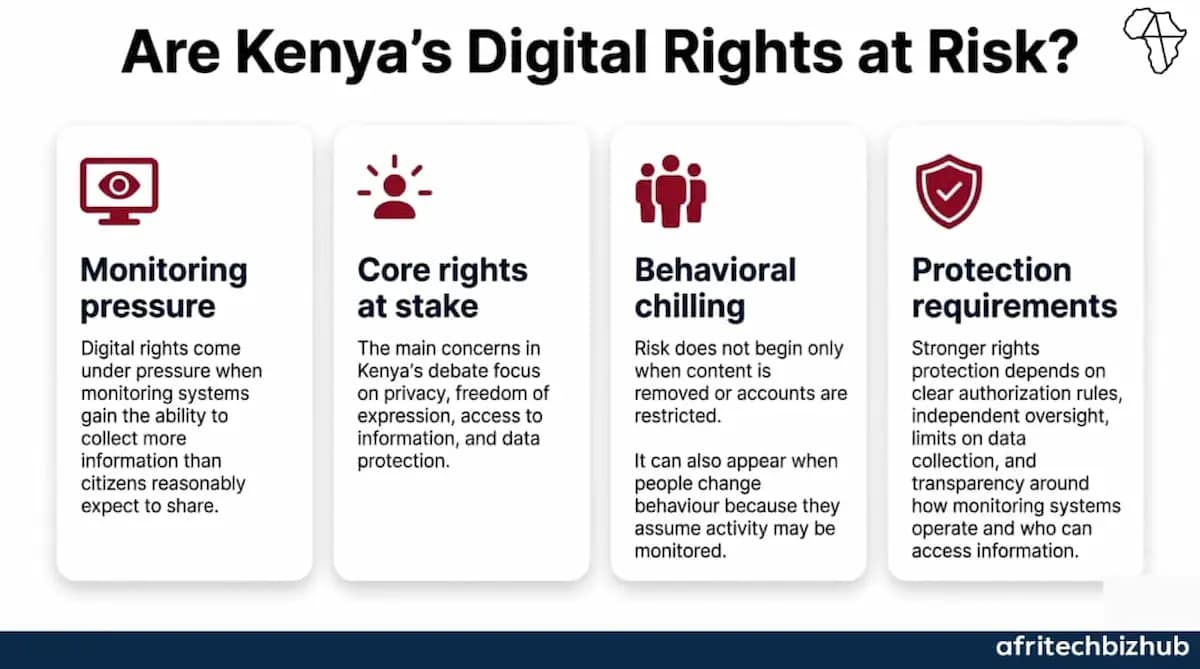
Are Kenya’s Digital Rights at Risk?
Kenya’s digital rights are at risk if government AI and cyber surveillance powers expand faster than legal oversight.
The concern is not technology itself.
The concern is whether monitoring systems can collect, analyse, and retain more information than citizens reasonably expect to share.
The risk extends beyond privacy.
Digital rights weaken when people limit speech, avoid online debate, or change behaviour because they believe activity may be watched.
Kenya’s stronger safeguard must therefore come from clear authorization rules, independent oversight, strict data limits, and transparency over who can access information.
Is Kenya Advancing Cyber Surveillance Systems Now?
Kenya is expanding cyber and AI capability through cybersecurity programmes, government digitisation, and wider technology modernization.
That signals stronger institutional capacity to detect threats, process digital information, and respond faster, but it does not by itself prove an unrestricted surveillance system.
The sharper concern is the gap between capability and authority.
Cybersecurity protects networks and identifies risks; surveillance observes activity and collects information about people or groups.
Public concern grows when the power to monitor expands faster than the rules explaining when it can be used, who approves it, what data is retained, and who provides oversight.
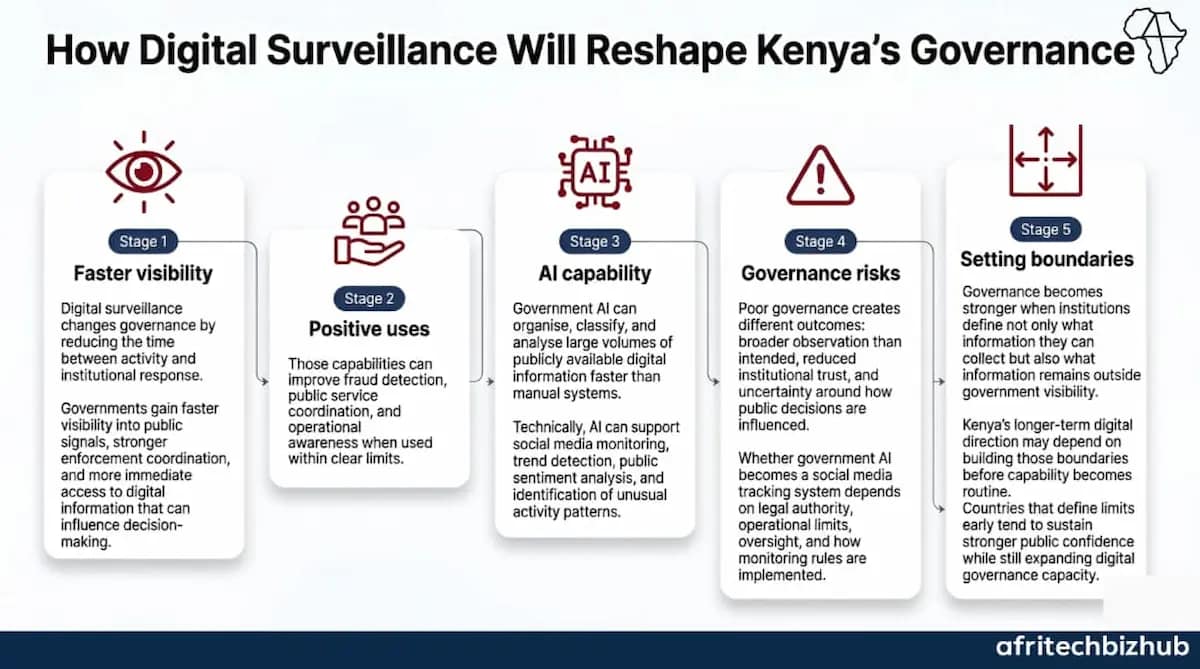
How will Digital Surveillance Reshape Kenya Governance?
Digital surveillance could reshape Kenya governance by giving institutions faster visibility into public activity, security risks, fraud signals, and online behaviour.
That can improve enforcement coordination, public service delivery, and operational response when systems operate under clear legal limits.
The risk is that stronger visibility can also weaken public trust if citizens do not know what is collected, who can access it, and how long it is retained.
Kenya’s governance test is not only whether the state can use digital tools effectively; it is whether oversight can define what government must not see.
Will Government AI Power Social Media Tracking?
Government AI can power social media tracking by helping institutions organise, classify, and analyse large volumes of online activity faster than manual systems.
In Kenya’s case, the concern is not AI capability alone, but whether digital governance tools could support monitoring, sentiment analysis, trend detection, and identification of online behaviour without clear limits.
Whether that becomes legitimate public-interest monitoring or open-ended surveillance depends on legal authority, operational boundaries, independent oversight, and data-retention rules.
Kenya’s harder test is to define those limits before capability becomes routine, because public trust weakens when citizens cannot tell where security monitoring ends and political visibility begins.


Recent Comments