

Featured Summary:
- Africa energy crisis is proving that local refining does not shield consumers from global oil shocks
- Higher oil prices still flow into fuel, transport, food, and household costs across African markets
- Refining improves supply but does not remove energy inflation when crude remains globally priced
- The Hormuz shock exposed a harder reality: infrastructure without pricing power remains vulnerable
Africa produces crude. That does not mean Africa prices energy.
Recent disruption around Iran and the Strait of Hormuz exposed a harder reality beneath the continent’s energy ambitions.
New refining capacity, stronger supply infrastructure, and larger domestic processing do not automatically protect households when crude still trades inside global markets.
Governments can cushion energy costs through subsidies, taxation, exchange-rate policy, and market intervention. They do not set the benchmark that determines what crude costs.
That distinction matters now. Higher global oil prices raise refinery input costs, push fuel prices upward, and spread into transport, food, and industrial activity.
Africa may supply crude to the world. It still largely pays the world’s price to consume energy.
Why Is Africa Energy Still Vulnerable To External Oil Shocks?
Refining capacity reduces dependence on imported fuel. It does not eliminate exposure to imported pricing.
Recent oil-market disruption exposed that constraint more clearly. African economies may refine more locally, but crude remains priced through international benchmarks and traded inside global supply expectations.
When benchmark prices rise, refinery economics move with them.
The assumption that local refining automatically guarantees cheaper fuel confuses production sovereignty with pricing sovereignty.
Refineries still operate inside global crude pricing, financing conditions, and energy-market expectations.
Domestic processing can improve availability and shorten supply chains. It does not automatically disconnect fuel prices from global oil conditions.
That creates the harder constraint for Africa energy strategy. The continent can produce crude, refine crude, and still experience higher fuel prices if the pricing mechanism remains external.
Energy infrastructure changes capacity. It does not automatically change how volatility enters the economy.
The question is no longer whether Africa can refine more oil.
It is whether Africa can absorb global oil shocks without turning external volatility into domestic inflation.
How Are Global Oil Prices Raising Africa Fuel Costs?
The visible price at the pump starts long before fuel reaches a filling station.
Crude is only the first cost. Once global oil prices rise, the increase moves through refining, freight, insurance, financing, storage, distribution, exchange rates, taxes, and retail margins before becoming a consumer fuel price.
That is why local refining does not automatically translate into cheaper energy. Refiners purchase crude at internationally referenced values, process it through energy-intensive operations, and recover operating costs through final product pricing.
The transmission effect extends beyond fuel. Higher energy costs raise transport expenses, increase distribution costs, pressure food prices, compress industrial margins, and weaken household purchasing power.
Consumers do not buy crude directly. They buy the accumulated cost of converting crude into usable energy.
That is where oil shocks become inflation.
The question is no longer whether crude prices rise.
It is how many layers of cost households absorb before energy reaches consumption.
Can Local Refining Protect Africa From Energy Inflation?
Protection and insulation are not the same thing.
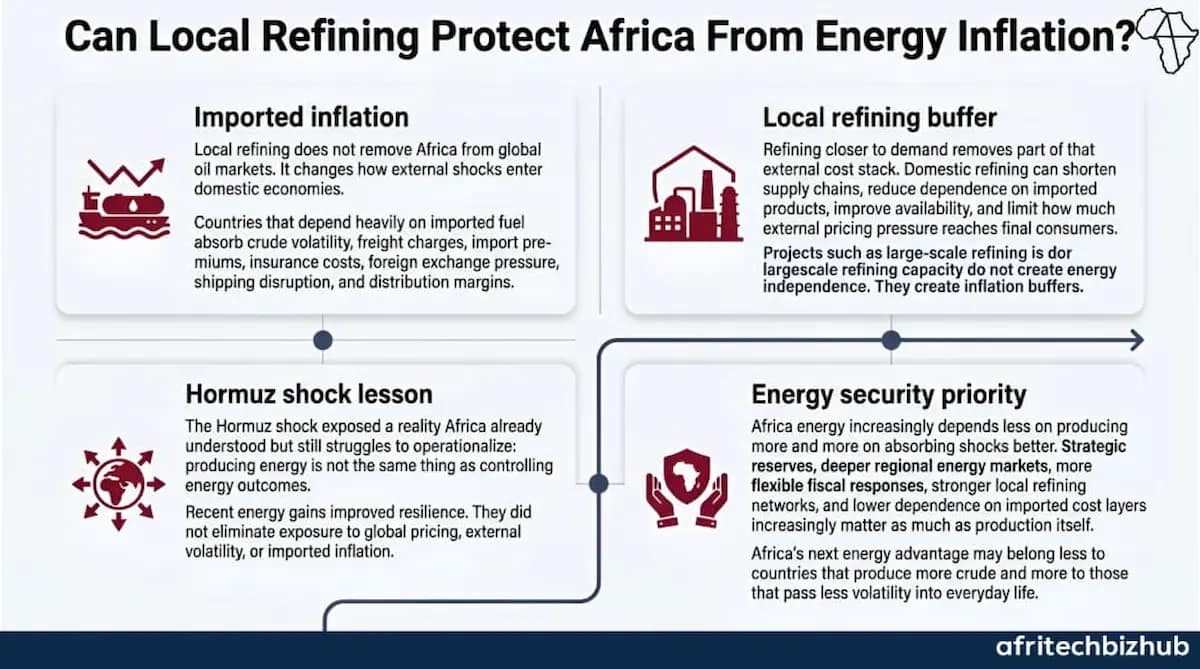
Local refining does not remove Africa from global oil markets. It changes how external shocks enter domestic economies.
Countries that depend heavily on imported fuel absorb crude volatility together with freight charges, import premiums, insurance costs, foreign exchange pressure, shipping disruption, and distribution margins.
Refining closer to demand removes part of that external cost stack.
That distinction matters during periods of oil disruption. Higher crude prices still raise refinery input costs and push fuel prices upward.
But domestic refining can shorten supply chains, reduce dependence on imported products, improve availability, and limit how much external pricing pressure reaches final consumers.
That changes the inflation equation.
Consumers may still pay more during global oil shocks. The difference is that they are not paying for every layer of offshore refining, transport, and import friction at the same time.
This is where infrastructure still matters.
Projects such as large-scale refining capacity do not create energy independence. They create inflation buffers.
The stronger question for Africa is no longer whether refining lowers prices.
It is whether refining reduces the amount of inflation imported during periods of global energy stress.
Why Is Africa Economic Recovery Becoming More Expensive?
Recovery became more expensive the moment growth assumptions collided with external energy pricing.
Many African economies entered the period expecting lower inflation, stronger household spending, improving industrial activity, and gradual stabilization after years of currency pressure and imported cost shocks.
Recovery assumptions increasingly depended on lower cost pressure, stronger demand, and improving business conditions.
The operating environment changed faster than those assumptions.
The IMF warned in April 2026 that new external shocks linked to the Middle East conflict were already raising oil, gas, and fertilizer prices across Sub-Saharan Africa and putting recent economic gains under pressure, with oil-importing economies facing rising living costs and worsening trade balances.
Higher global oil prices do not stop growth. They increase the cost of achieving it. Transport becomes more expensive. Manufacturing absorbs higher input costs. Food distribution weakens. Construction margins tighten. Governments face greater fiscal pressure. Businesses delay expansion. Households spend more protecting consumption and less creating demand.
That creates a different recovery cycle.
Economic activity may continue expanding while becoming more expensive to sustain.
Growth survives, but purchasing power weakens. Investment continues, but margins compress.
This is where energy shocks become development shocks.
The harder lesson is not that Africa lacked ambition.
It is that economic recovery becomes more fragile when external shocks arrive faster than domestic economies can absorb them.
What Does The Hormuz Shock Reveal About Africa Energy Security?
The Hormuz shock exposed a reality Africa already understood but still struggles to operationalize: producing energy is not the same thing as controlling energy outcomes.
Recent energy gains improved resilience. They did not eliminate exposure to global pricing, external volatility, or imported inflation.
Africa energy increasingly depends less on producing more and more on absorbing shocks better.
The lesson is not that Africa should retreat from global markets.
The lesson is that energy systems built around external pricing require stronger buffers when external shocks arrive.
Strategic reserves, deeper regional energy markets, more flexible fiscal responses, stronger local refining networks, and lower dependence on imported cost layers increasingly matter as much as production itself.
Africa is no longer in a position to treat geopolitics as distant.
When external events reshape domestic fuel costs, transport prices, industrial margins, and household purchasing power, geopolitics becomes domestic economics.
Africa’s next energy advantage may belong less to countries that produce more crude and more to those that pass less volatility into everyday life.


Recent Comments