

Last updated: May 16, 2026
Foreign lenders and private capital still finance most of Africa’s renewable energy expansion, with investment concentrated in the continent’s strongest energy markets.
Featured Summary:
- Foreign capital still dominates renewable energy investment in Africa.
- South Africa, Egypt, Morocco, and Kenya continue attracting most large-scale renewable funding.
- Development lenders remain central to Africa’s power-transition financing.
- Africa’s energy transition is expanding faster than local capital can finance it.
Africa’s renewable energy push is accelerating, but much of the capital financing it still comes from outside the continent.
Foreign development banks, climate funds, and private investors continue to underwrite the bulk of large-scale renewable projects across Africa, leaving the continent’s power transition increasingly shaped by external capital even as investment momentum builds.
The result is a two-track reality: renewable energy investment in Africa is expanding, but local financing capacity remains too shallow to drive the transition independently.
Who Is Funding Renewable Energy Investment in Africa?
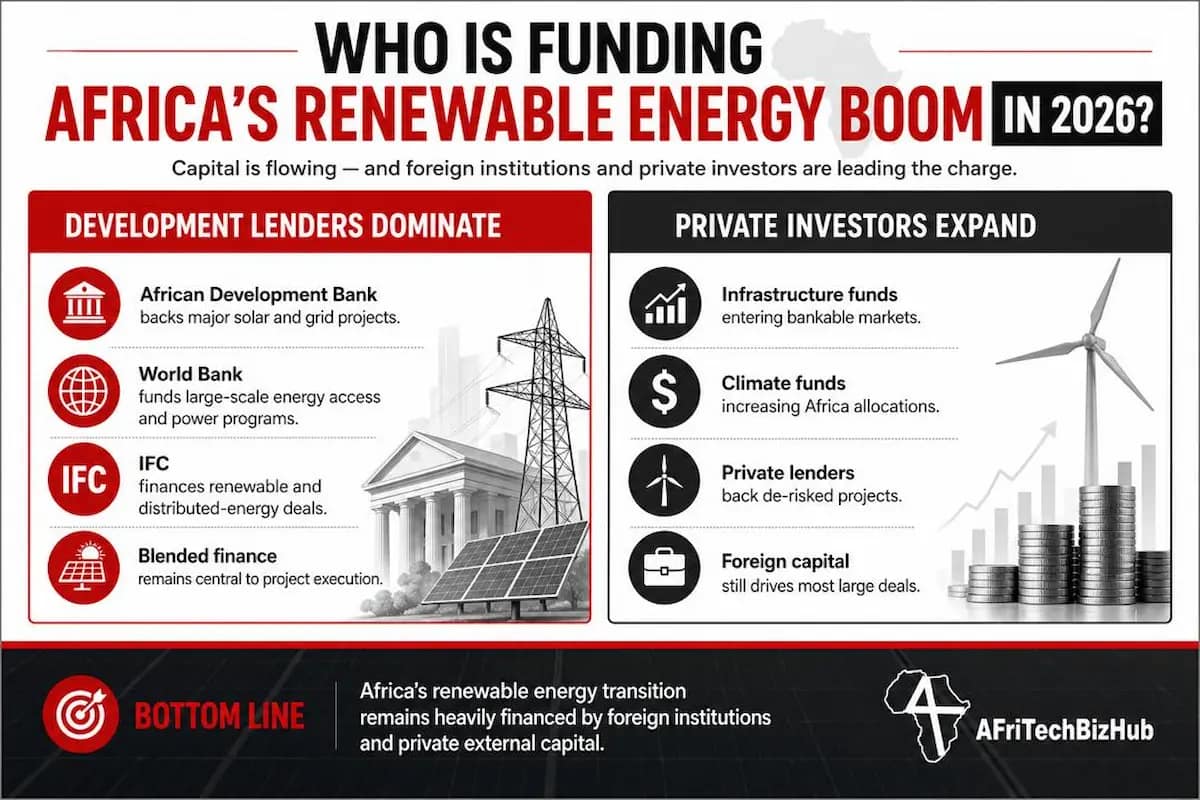
Development finance institutions still fund much of Africa’s renewable energy buildout.
Lenders such as the African Development Bank, World Bank Group, and International Finance Corporation remain central to financing large solar, wind, grid, and distributed energy projects across the continent.
Private investors are participating more actively, but most large deals still depend on development-backed structures to move forward.
In practical terms, Africa’s renewable energy expansion remains financed less by deep local capital markets and more by foreign institutions willing to fund long-term infrastructure risk.
Which Countries Are Attracting Renewable Energy Investment in Africa?
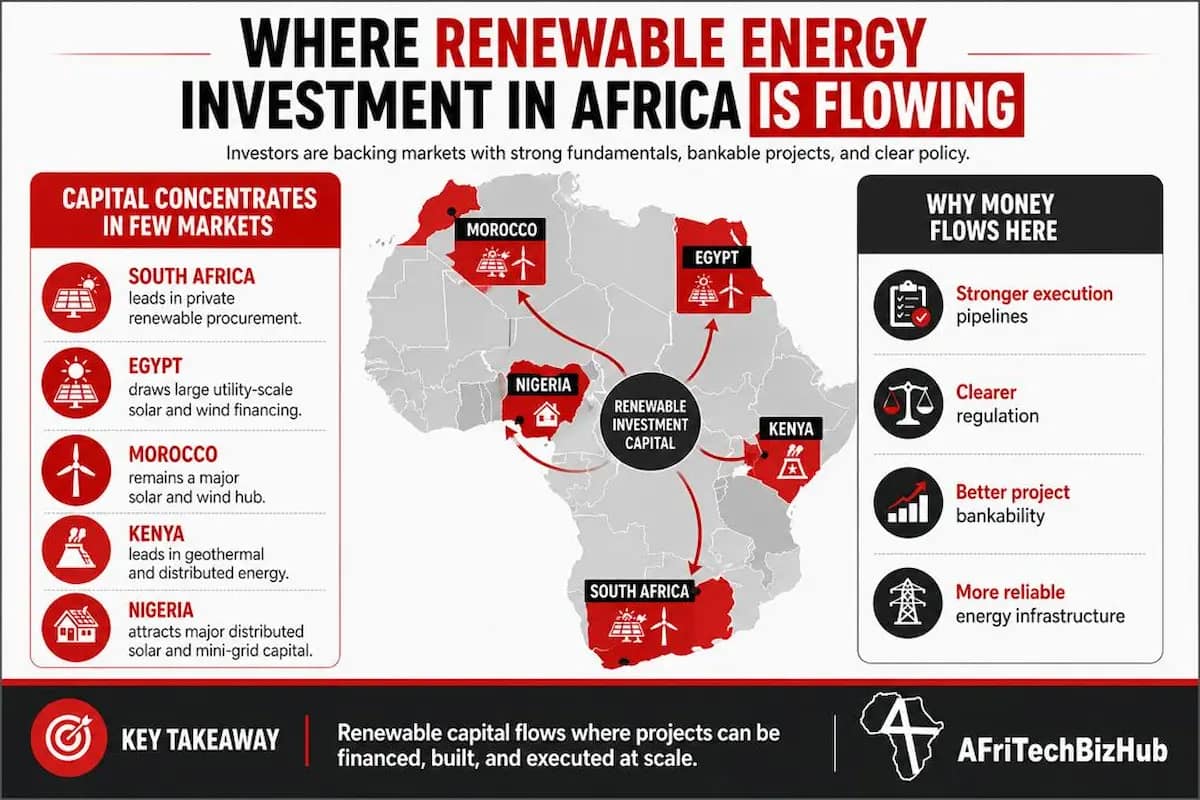
Renewable energy investment in Africa remains concentrated in a small group of bankable power markets.
South Africa, Egypt, Morocco, and Kenya continue drawing most large-scale renewable capital as investors favor countries with stronger execution pipelines, clearer regulation, and more reliable energy infrastructure.
South Africa remains the continent’s deepest private renewable market.
Egypt and Morocco continue attracting utility-scale solar and wind financing tied to broader industrial and export strategies.
Kenya remains a leading destination for geothermal, off-grid, and distributed-energy investment.
Nigeria continues attracting distributed solar and mini-grid capital, though persistent grid constraints still limit broader utility-scale deployment.
Why Africa’s Renewable Energy Sector Still Depends on Foreign Capital
Foreign capital remains central to Africa’s renewable energy buildout because most domestic financial systems still cannot fund large-scale power infrastructure at the depth and duration such projects require.
Across much of the continent, local banks and capital markets remain too shallow to finance utility-scale solar, wind, grid, and storage projects on a sustained basis.
That financing gap keeps external lenders in control of much of the market.
Foreign lenders continue filling that gap, funding projects many local institutions still cannot finance at scale.
Currency volatility and project risk remain major barriers to deeper domestic participation.
How Renewable Energy Investment Is Reshaping Africa’s Power Sector
Renewable energy investment is reshaping Africa’s power sector by pushing electricity access beyond the limits of weak national grids.
In markets such as Nigeria, rising solar adoption is moving more households and businesses off-grid as unreliable public electricity forces consumers toward private energy solutions.
But off-grid growth does not eliminate the need for stronger national power systems.
Africa’s industrial and economic expansion still depends on grid-scale generation, transmission, and reliable public electricity infrastructure that solar backup alone cannot replace.
Renewable energy investment in Africa is helping close access gaps, but without deeper power-sector reform, much of the continent’s electricity shortfall will remain intact.


Recent Comments