


Featured Summary:
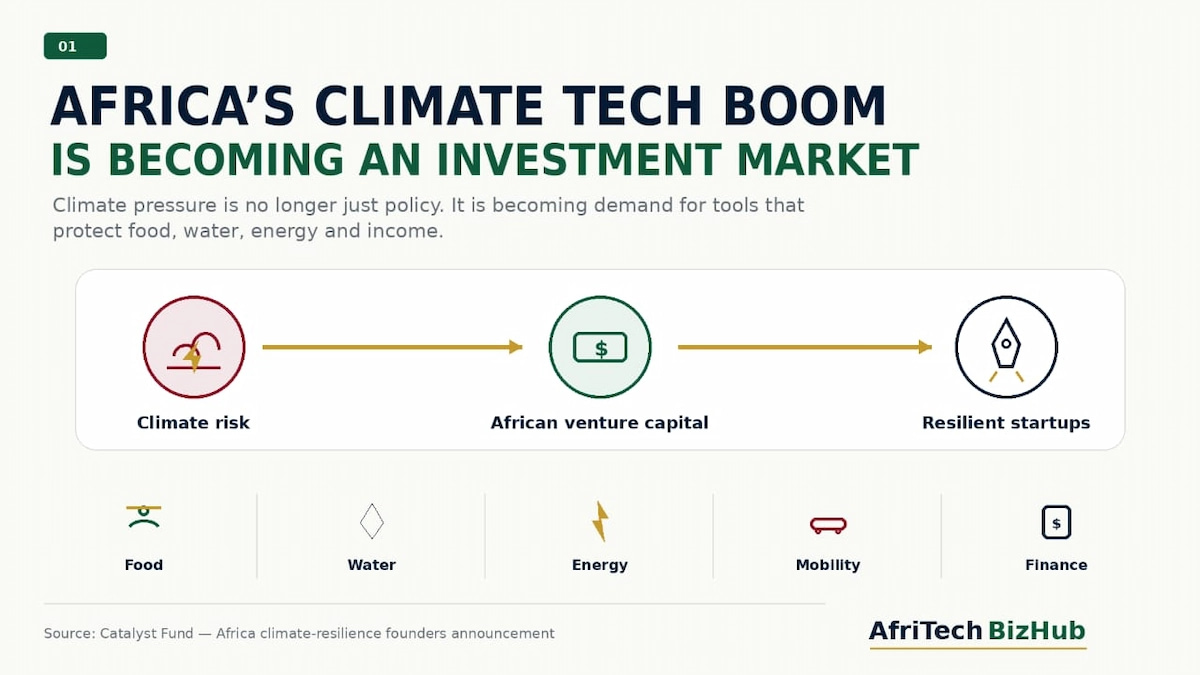
- African venture capital is paying closer attention to climate-tech startups because climate risk is now affecting food systems, water access, energy reliability, mobility, insurance, and small businesses.
- Catalyst Fund can strengthen Africa’s climate startup ecosystem by combining capital with venture-building support for early-stage companies.
- Climate adaptation investment is rising because African markets need practical technologies that help households, farmers, workers, and businesses manage climate pressure.
- African startup funding is helping climate technology investment move beyond clean energy into agriculture, fintech, data, insurance, water, transport, and essential services.
Africa’s climate-tech story is changing because the problem has moved closer to daily business life.
Farmers are dealing with unpredictable rainfall. Cities are managing floods, heat, and water stress.
Transport operators face fuel and infrastructure pressure.
Small businesses need tools that can protect income when climate shocks disrupt supply, demand, and cash flow.
That pressure is turning climate adaptation into an investment market.
Investors are no longer looking only at solar panels or carbon promises.
They are looking for startups that can help people and businesses stay productive in a harsher climate.
Catalyst Fund’s new momentum matters because it points to a wider shift in African venture capital: climate technology is becoming part of economic resilience, not just environmental policy.
The test is whether this funding can build companies that solve real problems and still grow commercially.
Why Is African Venture Capital Flooding Climate-Tech Startups Now?
Climate risk is becoming too expensive for investors to ignore.
It affects agriculture, logistics, housing, energy, health, insurance, and the cost of doing business across African markets.
That makes climate-tech startups more attractive because they are not only selling sustainability.
They are selling tools that help people adapt, reduce losses, improve productivity, and manage uncertainty.
African venture capital is also following demand that already exists.
Farmers need better data, irrigation, inputs, credit, and insurance.
Cities need cleaner mobility, waste systems, water solutions, and energy reliability.
Households and small businesses need affordable services that protect income when climate shocks hit.
The capital is moving because adaptation is becoming a commercial need, not only a development goal.
How Will Catalyst Fund Transform Africa’s Climate Startup Ecosystem?
Catalyst Fund’s role is important because many African climate startups need more than early cheques.
They need product support, market testing, investor access, talent networks, pricing discipline, and help proving that their solutions can scale.
Early-stage climate companies often work in difficult sectors where customers are low-income, infrastructure is weak, and business models take time to prove.
That is where a venture-building model can strengthen the ecosystem.
By combining capital with hands-on support, Catalyst Fund can help founders refine products, reach customers, improve unit economics, and prepare for follow-on investment.
The impact is not only on the startups it backs directly.
A stronger pipeline of investable companies can give climate tech investors more confidence in Africa’s early-stage market.
What is the Strategy of the Catalyst Fund?
The strategy is built around climate resilience rather than climate branding alone.
Catalyst Fund focuses on startups that help people, businesses, and communities manage climate risk and adapt livelihoods.
That makes its approach different from funds that only back emissions-reduction technologies or large infrastructure plays.
Its strategy also sits across several practical sectors.
Climate fintech can support insurance, credit, savings, and risk management.
Agriculture and food systems can help farmers protect yields and reach markets.
Climate-smart essential services can improve water, energy, mobility, and other daily needs.
This gives Catalyst Fund a broad investment map while keeping the focus clear: back early-stage African companies whose products can make vulnerable communities more resilient.
Why Is Climate Adaptation Investment Surging Across African Markets?
Adaptation is gaining investor attention because climate pressure is already changing how African markets function.
The opportunity is not theoretical.
Floods, droughts, heat, unstable harvests, water stress, and energy gaps are creating demand for tools that reduce risk and protect income.
That is why climate adaptation investment is moving into sectors that directly touch households, farmers, informal workers, and small businesses.
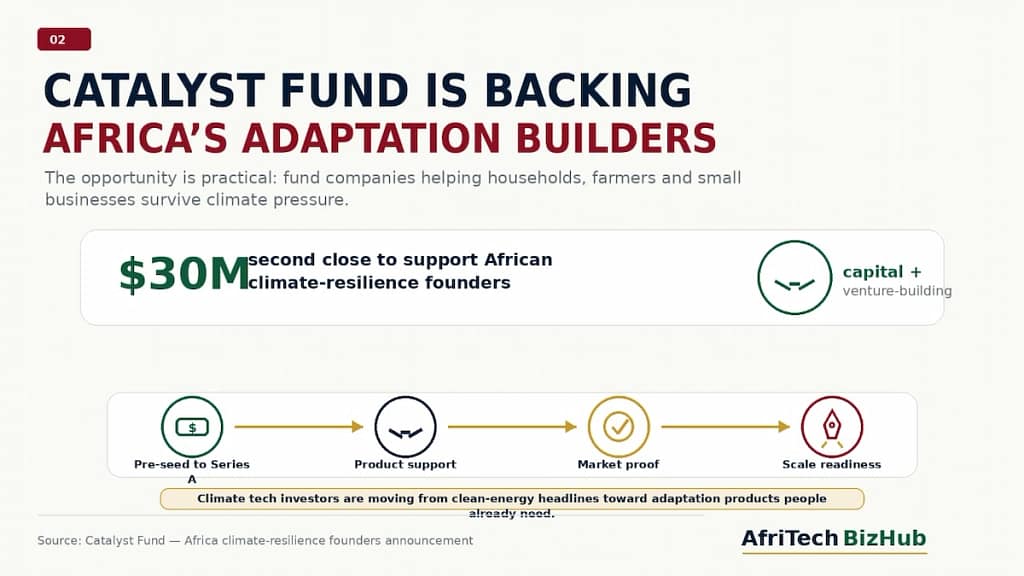
Catalyst Fund’s official announcement says its $30 million second close deepens its support for African climate-resilience founders.
The fund invests from pre-seed to Series A and combines equity investment with embedded venture-building support.
It focuses on climate fintech, agriculture and food systems, and climate-smart essential services such as water, energy, and mobility.
That source explains why climate tech funds are becoming more active in Africa: investors are backing adaptation because resilience is becoming part of economic survival and market growth.
How Is African Startup Funding Fueling Climate Tech Innovation?
African startup funding is helping climate technology move from isolated pilots into businesses with stronger products, customers, and expansion plans.
Capital allows founders to hire teams, build technology, test markets, improve distribution, and prove that customers will pay.
In climate tech, that support is especially important because many solutions require fieldwork, partnerships, hardware, data, or local infrastructure.
The strongest innovation will come from startups solving problems that African communities already understand.
A company helping farmers manage drought risk, a platform improving climate insurance, a startup expanding clean mobility, or a service making water access more reliable can create both impact and revenue.
That is why climate technology investment is becoming more serious.
Investors are not only backing climate narratives.
They are looking for companies that can turn adaptation into useful products, stronger livelihoods, and scalable African businesses.


Recent Comments