

Last updated: July 9, 2026
Featured Summary:
- Egypt financial aid is rising because Europe sees Egypt as a major stabilising partner in North Africa and the wider Mediterranean.
- The IMF programme strengthens Egypt economy by supporting exchange-rate flexibility, inflation control, fiscal discipline, and structural reforms.
- EU financial assistance is reshaping Africa-EU relations by linking economic support to stability, migration, energy, investment, and regional security.
- Africa remains important to the EU because the continent affects Europe’s trade, migration, supply chains, energy security, climate goals, and geopolitical influence.
Europe is not sending billions to Egypt because Cairo simply asked for help.
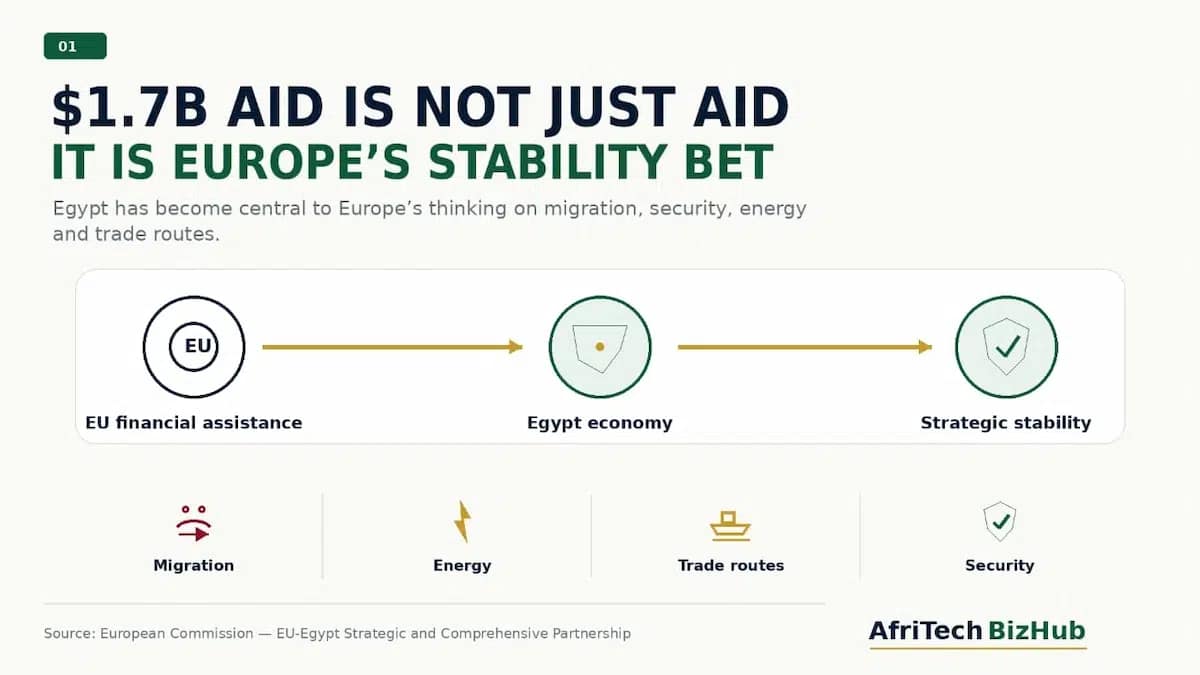
It is doing so because Egypt sits at the centre of several pressures Europe cannot ignore: migration routes, Red Sea disruption, Mediterranean security, energy links, food imports, debt stress, and North African stability.
That makes the latest $1.7 billion expected tranche more than financial relief.
It is a signal that Europe now sees Egypt’s economic stability as part of its own strategic protection.
Egypt needs money to support reforms and manage external pressure, but Europe also needs Egypt to remain stable, cooperative, and economically functional.
That turns aid into leverage on both sides. Cairo gains liquidity, credibility, and reform support.
Brussels gains a partner positioned between Africa, the Middle East, and the Mediterranean.
The question is whether this relationship becomes a balanced business partnership or another cycle where Africa’s largest economies are funded mainly because they are too strategic to fail.
Why Is Egypt Financial Aid Rising From The EU?
Europe’s support is rising because Egypt has become too important to treat as a normal neighbouring economy.
The country sits beside the Mediterranean, controls the Suez Canal route, borders conflict-sensitive regions, and remains central to migration management, energy discussions, and regional diplomacy.
When Egypt faces economic pressure, the effects can move beyond its borders.
That explains why Egypt financial aid is now tied to strategic stability.
The EU is not only trying to support Egypt’s budget or reform programme.
It is trying to reduce the risk of deeper economic strain in a country that affects Europe’s trade lanes, security calculations, migration policy, and Africa-EU engagement.
For Cairo, the funding helps ease financing pressure.
For Brussels, it helps protect a partner whose instability would be costly for Europe.
How Does The IMF Programme Strengthen Egypt Economy?
The IMF programme gives Egypt’s reform agenda a framework that external partners can measure.
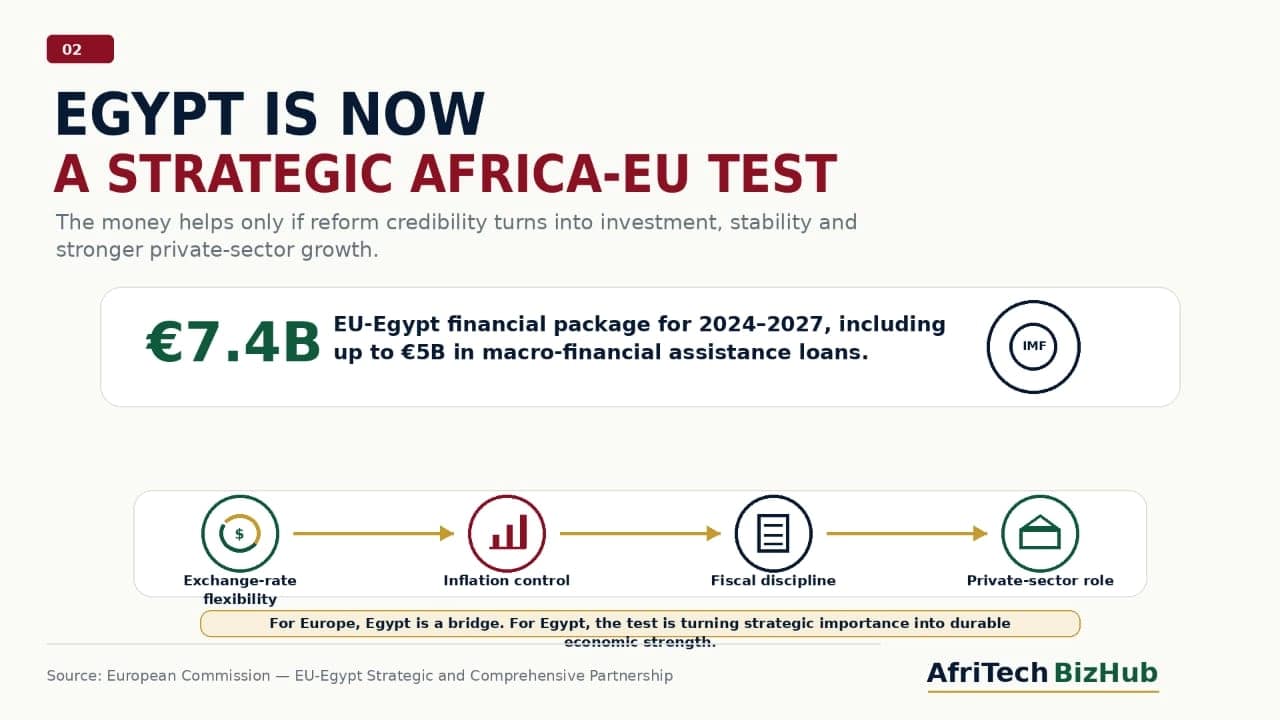
It supports policies around exchange-rate flexibility, inflation control, fiscal discipline, debt management, and a stronger role for the private sector.
That matters because financial aid alone does not rebuild confidence if investors believe reforms are temporary or politically weak.
The stronger value of the IMF programme is that it helps connect Egypt economy support to policy conditions.
The programme encourages Egypt to reduce imbalances, protect foreign reserves, manage inflation, and create a more competitive business environment.
It does not remove the pain of reform, especially when households face price pressure.
But it gives the EU and other partners a clearer basis for providing support because the money is linked to an economic reform path, not only emergency funding.
Why Is EU Financial Assistance Reshaping Africa-EU Relations?
EU financial assistance to Egypt shows how Africa-EU relations are becoming more transactional and strategic at the same time.
Europe is no longer engaging African economies only through development language.
It is using finance to secure partnerships around migration, energy, supply chains, trade routes, security, climate policy, and regional influence.
Egypt is one of the clearest examples of that shift.
The country is African, Arab, Mediterranean, and strategically connected to Europe through geography and trade.
That makes it useful to Brussels in ways that go beyond normal aid policy.
For Africa, the message is important: countries that sit at the centre of Europe’s security, energy, or migration priorities may attract larger and faster financial packages.
The risk is that Africa-EU relations become driven by Europe’s pressure points rather than Africa’s long-term development priorities.
Why is Africa Important to the EU?
Europe’s Africa strategy is increasingly shaped by the issues that affect European stability at home.
Migration, food security, energy transition, critical minerals, shipping routes, climate adaptation, investment opportunities, and geopolitical competition all make Africa more important to the EU.
Egypt concentrates many of those issues in one country, which is why Brussels is treating Cairo as a strategic partner rather than a routine aid recipient.
The European Commission says the EU-Egypt Strategic and Comprehensive Partnership is backed by a €7.4 billion financial package for 2024–2027, including up to €5 billion in macro-financial assistance loans.
The Commission also says Egypt has sizeable unmet financing needs and plays an important stabilising role amid regional geopolitical tensions.
That source explains why EU financial assistance to Egypt is not isolated.
It sits inside a wider European calculation about Africa economy stability, Mediterranean security, trade, migration, and investment.
What is the EU doing in Africa?
The EU is using money, trade tools, investment programmes, migration partnerships, climate finance, energy cooperation, and reform support to protect its interests and deepen influence across Africa.
In Egypt’s case, the approach is especially visible because financial assistance is linked to macroeconomic stability, reform conditions, and strategic partnership priorities.
Europe wants stable partners, secure trade routes, cleaner energy links, migration cooperation, stronger supply chains, and influence in a continent where China, Gulf states, Russia, and the US are also competing.
Egypt’s $1.7 billion expected tranche fits that wider strategy.
It is not just about supporting one economy.
It is about strengthening a country Europe sees as a bridge between Africa, the Middle East, and the Mediterranean.
For Egypt, the opportunity is to turn strategic importance into investment, trade, and reform credibility.
For Europe, the challenge is proving that its Africa partnerships are about shared growth, not only crisis management.


Recent Comments