

Featured Summary:
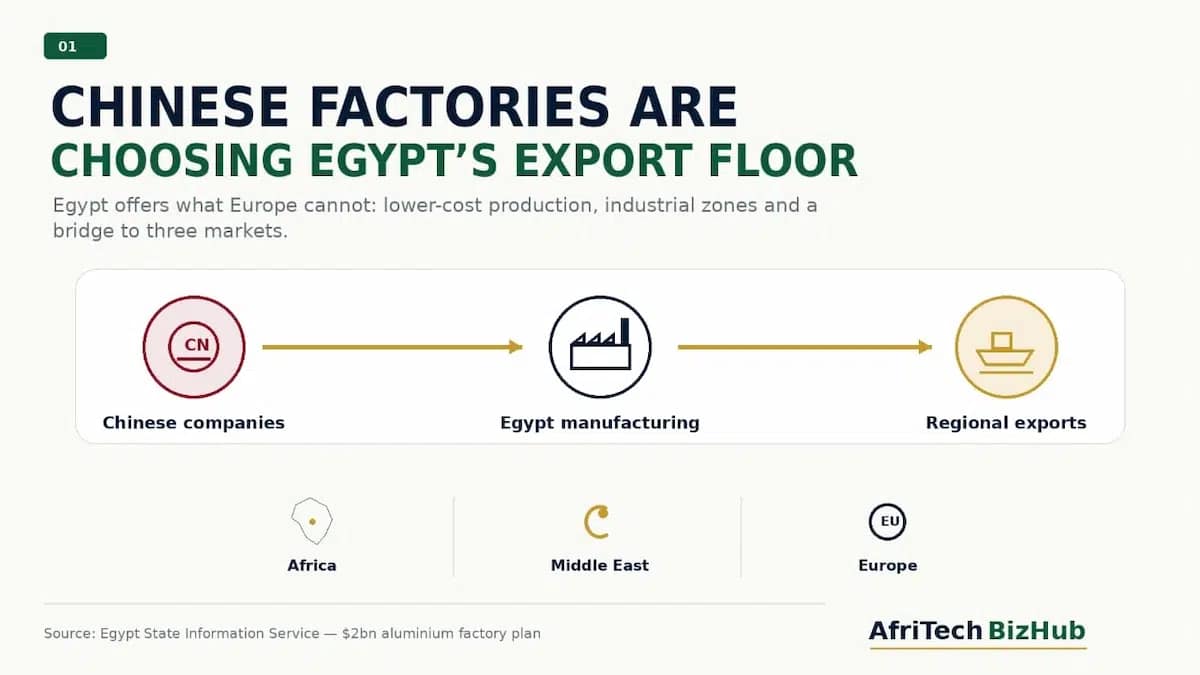
- Chinese investment Egypt is rising because manufacturers want a lower-cost production base with access to Africa, the Middle East, and Europe.
- Chinese companies are using Egypt manufacturing zones to build export-focused projects in aluminium, tyre materials, bead wire, and industrial components.
- Egypt exports are becoming more attractive because the country combines ports, industrial zones, trade access, and proximity to major consumer markets.
- The Suez Canal Economic Zone is central to the strategy because it gives Chinese factories a structured base for production, logistics, and regional distribution.
Europe has the consumers, but Egypt is offering the factory floor.
That is the calculation now pulling more Chinese companies toward Cairo, Ain Sokhna, East Port Said, and the Suez Canal Economic Zone.
For manufacturers facing higher costs, tighter rules, and slower industrial expansion in Europe, Egypt offers something different: land, ports, labour, incentives, and access to several markets from one location.
The shift is not only about cheaper production. It is about control over exports.
A Chinese factory in Egypt can serve African markets, reach the Middle East, and stay close to Europe without carrying the same cost structure as a European plant.
That is why the latest wave of Chinese investment Egypt matters.
It shows Egypt trying to move from a consumer market into an industrial platform, while Chinese companies use the country as a bridge between global supply chains and fast-growing regional demand.
Why Is Chinese Investment Egypt Surging So Rapidly?
The strongest pull is Egypt’s position between markets that manufacturers want to reach.
A company producing in Egypt can look toward Africa, the Gulf, Europe, and the Mediterranean from one base.
That gives Chinese investors a practical reason to choose Egypt over more expensive European locations, especially for industries where logistics, export access, and production costs shape profit margins.
Egypt also offers an industrial policy story that appeals to manufacturers.
The government wants more local production, more exports, more jobs, and deeper supply chains.
Chinese investment Egypt fits that agenda because Chinese companies bring capital, machinery, technical experience, and export-oriented manufacturing models.
The attraction is not only the size of Egypt’s domestic market.
It is the chance to build in Egypt and sell beyond Egypt.
How Are Chinese Companies Transforming Egypt Manufacturing Today?
A new industrial pattern is forming around Chinese factories that produce inputs other industries need.
Aluminium, tyre components, steel cord, bead wire, electronics inputs, textiles, chemicals, and automotive-linked materials all matter because they support wider manufacturing ecosystems.
When these products are made locally, Egypt can reduce import dependence and improve the competitiveness of factories that rely on those materials.
This is why Egypt manufacturing is becoming more strategic.
Chinese companies are not only opening assembly lines for finished goods.
They are entering sectors that can sit inside bigger supply chains.
A bead wire plant, for example, does not only produce one component.
It supports tyre manufacturing, automotive supply, industrial exports, and local sourcing.
The more Egypt attracts these linked industries, the more its manufacturing base becomes useful to exporters and investors.
Why Is Egypt Exports Strategy Attracting Chinese Factories?
Chinese manufacturers are following Egypt’s export logic because the country offers access without being limited to one market.
Egypt has ports on key shipping routes, trade links with African and Arab markets, and proximity to Europe.
That makes it useful for companies that want to produce near demand rather than ship everything from Asia.
The export strategy also reduces some of the pressure Chinese firms face in advanced markets.
Producing directly in Europe can be costly and heavily regulated.
Producing only in China can leave companies exposed to long shipping routes, trade tensions, and supply-chain delays. Egypt offers a middle position.
Chinese factories can manufacture closer to customers, use regional trade access, and build an export base that supports Africa, the Middle East, and Europe at the same time.
What are the Implications of China’s $2 billion Aluminium Investment for Egypt?
The proposed aluminium project matters because it would place Egypt deeper inside high-value industrial production.
Aluminium is not only a construction material.
It is used in transport, packaging, electronics, power systems, renewable energy, automotive components, and industrial manufacturing.
A large aluminium complex inside the Suez Canal Economic Zone would therefore support Egypt’s ambition to move beyond basic production into deeper value chains.
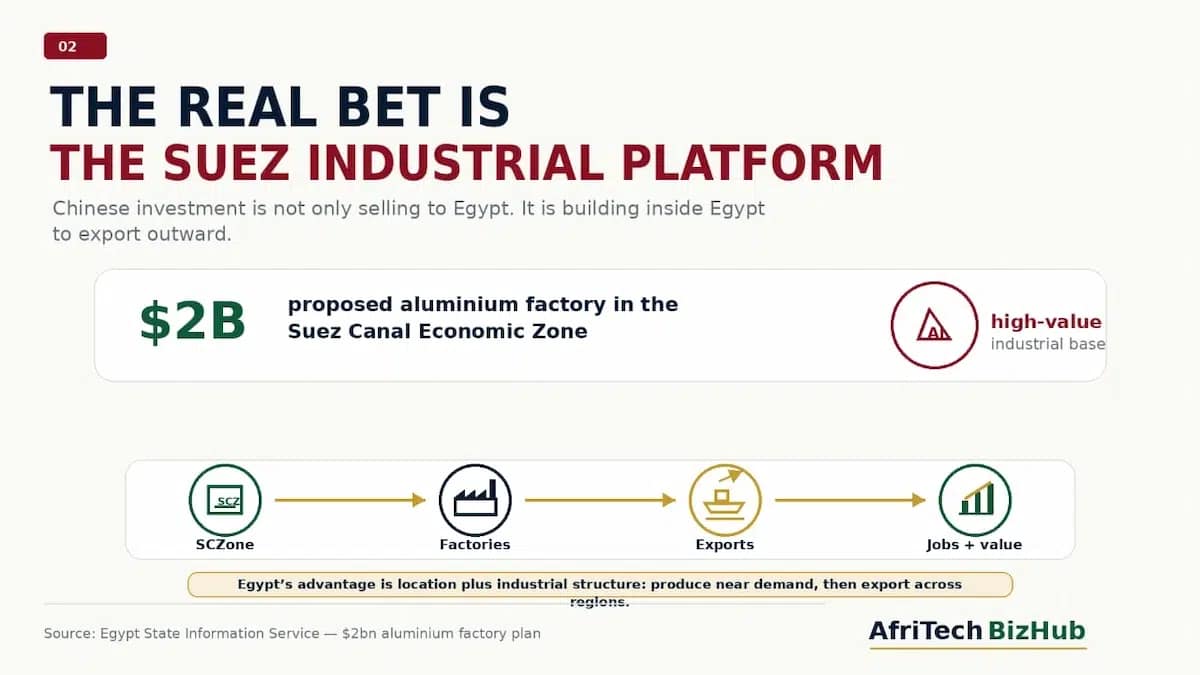
Egypt’s State Information Service reported that Prime Minister Mostafa Madbouly and Chinese firms reviewed plans to establish a $2 billion aluminium factory in the Suez Canal Economic Zone.
The government said the project is viewed as a major step toward localising high-value aluminium industries, meeting domestic demand, and closing import gaps.
That makes the deal important for Egypt exports, because a stronger aluminium base can support local manufacturers while also creating products for regional and international markets.
What is the Deal between China and Egypt?
The wider China-Egypt deal is about manufacturing, logistics, infrastructure, and market access.
China brings industrial capital and companies searching for efficient production locations. Egypt offers ports, labour, land, industrial zones, and access to nearby markets.
That combination explains why Chinese companies are not only selling to Egypt but also building inside Egypt.
The Suez Canal Economic Zone is the centre of this shift because it gives investors a clearer platform for production and exports.
For Egypt, the goal is jobs, technology transfer, local sourcing, and stronger exports.
For Chinese companies, the goal is to reduce distance to customers, manage costs, and build a stronger presence in markets outside China.
That is why the question is not simply why Chinese firms are avoiding Europe.
It is why Egypt now offers a more useful industrial route to Europe, Africa, and the Middle East at the same time.


Recent Comments