


Featured Summary:
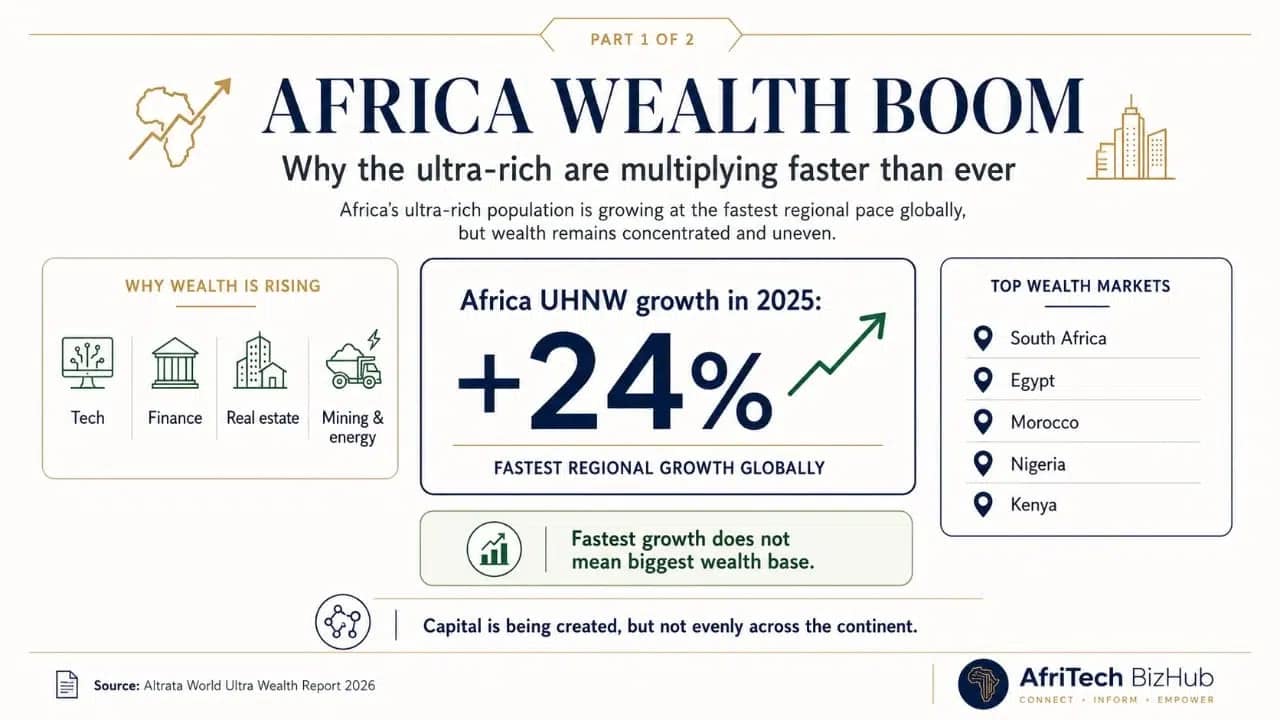
- Africa wealth is expanding quickly, with Altrata reporting that Africa recorded the strongest regional UHNW growth in 2025.
- Richest Africans remain concentrated in a few countries, led by South Africa, Egypt, Morocco, Nigeria, and Kenya in the latest Africa Wealth Report data.
- Global wealth rankings still show a wide gap between Africa and America because the US has deeper capital markets, larger companies, and stronger wealth infrastructure.
- Wealth creation is reshaping Africa’s richest nations, but the bigger test is whether private wealth supports productive investment beyond luxury assets and mobility planning.
Money is moving differently across Africa.
New fortunes are appearing in technology, finance, real estate, mining, logistics, consumer markets, and private investment, while older wealth centres are being challenged by smaller markets with stronger policy stability and faster millionaire growth.
The result is a continent where private wealth is expanding, but not evenly and not always in the countries people expect.
Africa is producing more ultra-rich individuals at a faster pace than any other region, yet its share of global wealth remains small beside America, Europe, and Asia.
That makes the Africa wealth boom both a signal and a test.
It signals that capital is being created on the continent.
It tests whether that capital will remain concentrated in a few cities and families, or whether it will help build stronger companies, deeper markets, and more productive economies.
Why Is Africa Wealth Growing Faster Than Expected?
Private wealth is rising because several African markets are moving through a new phase of capital formation.
Technology startups, fintech growth, critical minerals, real estate, private equity, energy projects, luxury property, and family-owned conglomerates are creating new sources of high net worth wealth.
In some countries, stronger currencies, better market performance, and improved investor sentiment have also lifted the value of existing assets.
Some markets are producing new wealth through innovation and investment, while others are losing millionaires because of currency weakness, policy uncertainty, insecurity, or capital flight.
That uneven pattern is important for understanding the Africa wealth story.
The continent is not becoming rich at one speed. Wealth creation is accelerating in markets where capital feels safer, assets are appreciating, and investors can see a clearer path to returns.
America vs Africa: Why Does America’s Wealth Continue to Dominate Africa and the World?
America’s dominance comes from the depth of its wealth system, not only the number of rich individuals it has.
The US has the world’s largest capital markets, some of the most valuable companies, deep venture capital networks, global technology firms, powerful asset-management institutions, and a long history of turning business ownership into liquid wealth.
That structure makes wealth easier to create, preserve, scale, and transfer.
Many fortunes remain tied to commodities, real estate, family businesses, banking, politics, and trade rather than globally scaled companies or deep public markets.
This is why global wealth rankings still favour America heavily.
Africa may be growing faster in percentage terms, but the US starts from a much larger base.
For Africa to close even part of that gap, it needs deeper stock markets, stronger property rights, more scalable companies, better financial systems, and more opportunities for wealth creation beyond a small elite.
Which Richest Africans Countries Lead the Continent in 2026?
The latest available Africa Wealth Report data shows that South Africa remains the continent’s leading private wealth market.
It is followed by Egypt, Morocco, Nigeria, and Kenya, which together form Africa’s biggest concentration of resident millionaires.
These countries dominate because they have larger financial systems, bigger cities, stronger business networks, established private-sector wealth, and more mature investment ecosystems than many smaller markets.
The ranking also shows how quickly the map can change.
South Africa still leads, but its millionaire population has faced pressure over the past decade.
Nigeria remains one of Africa’s biggest economies, but currency weakness and capital migration have reduced its high net worth population.
Mauritius, Morocco, and Rwanda have gained attention because political stability, investment migration, tax efficiency, and lifestyle appeal are becoming more important to wealthy Africans.
The richest Africans are no longer only choosing the biggest economies.
They are also choosing jurisdictions where wealth feels easier to protect and move.
What Does Africa Wealth Report Reveal About UHNWIs?
Africa’s ultra-wealth story is no longer invisible in global wealth data.
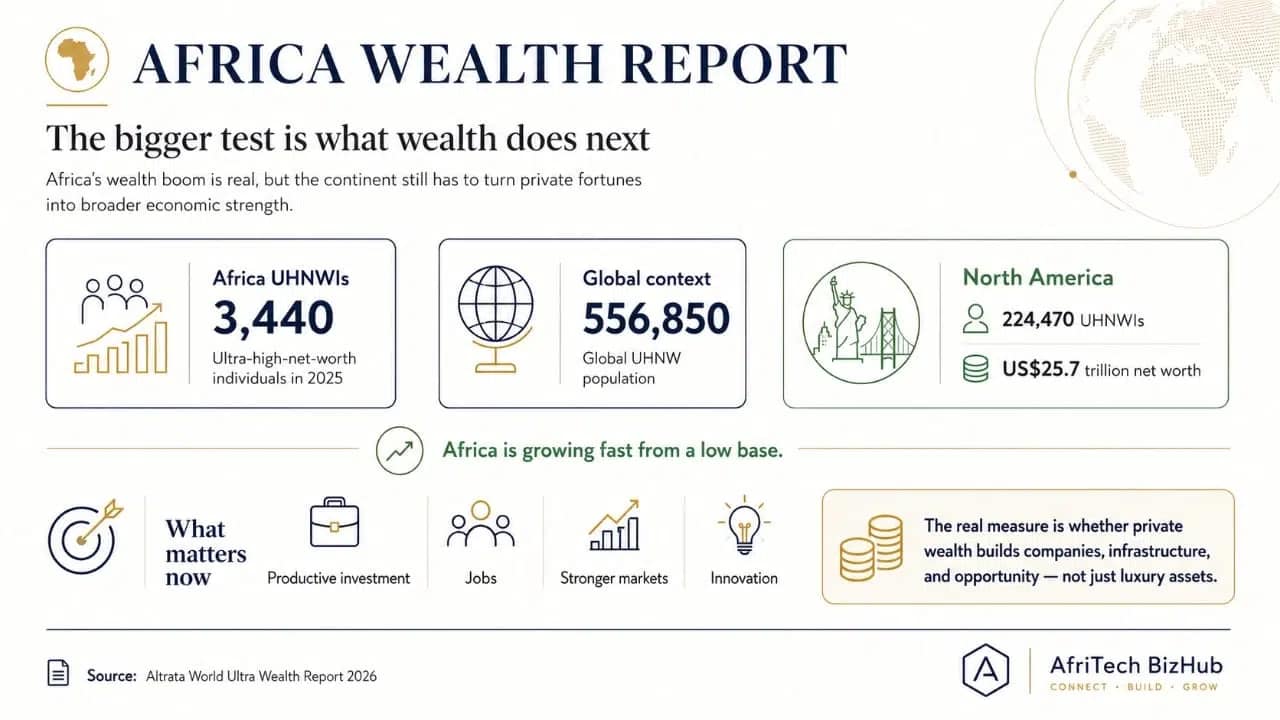
Altrata’s World Ultra Wealth Report 2026 says Africa recorded the strongest regional growth in ultra high net worth individuals in 2025, rising 24% to 3,440 people.
That is a small number in global terms, but the growth rate is significant because it shows how quickly Africa’s top wealth segment is expanding from a low base.
Altrata reported that the global UHNW population grew 14.4% to 556,850 individuals in 2025, while North America had 224,470 UHNWIs and $25.7 trillion in combined net worth.
Africa’s growth is therefore impressive, but its global share remains modest.
The Africa wealth report story is not that Africa has overtaken established wealth centres.
It is that the continent is now producing ultra-rich growth fast enough to attract closer attention from wealth managers, investors, luxury markets, migration advisers, and private banks.
How Is Wealth Creation Reshaping Africa’s Richest Nations?
Wealth creation is reshaping Africa’s richest nations by changing where capital moves, where wealthy families live, and which sectors attract long-term investment.
In the strongest markets, private wealth is moving into fintech, real estate, healthcare, education, logistics, mining services, green energy, digital infrastructure, and wealth management.
That can deepen local economies if capital is reinvested productively.
The risk is that wealth growth can remain separated from broad development.
A country can produce more millionaires while many citizens still face weak jobs, poor services, and limited access to finance.
That is why Africa’s wealth boom needs a sharper policy conversation.
The real measure is not only how many high-net-worth individuals the continent produces.
It is whether their capital helps build companies, fund innovation, expand tax bases, support infrastructure, and create more pathways for others to participate in wealth creation.
Africa’s ultra-rich are multiplying faster, but the continent’s strongest outcome will come when private wealth becomes productive national capacity.


Recent Comments