

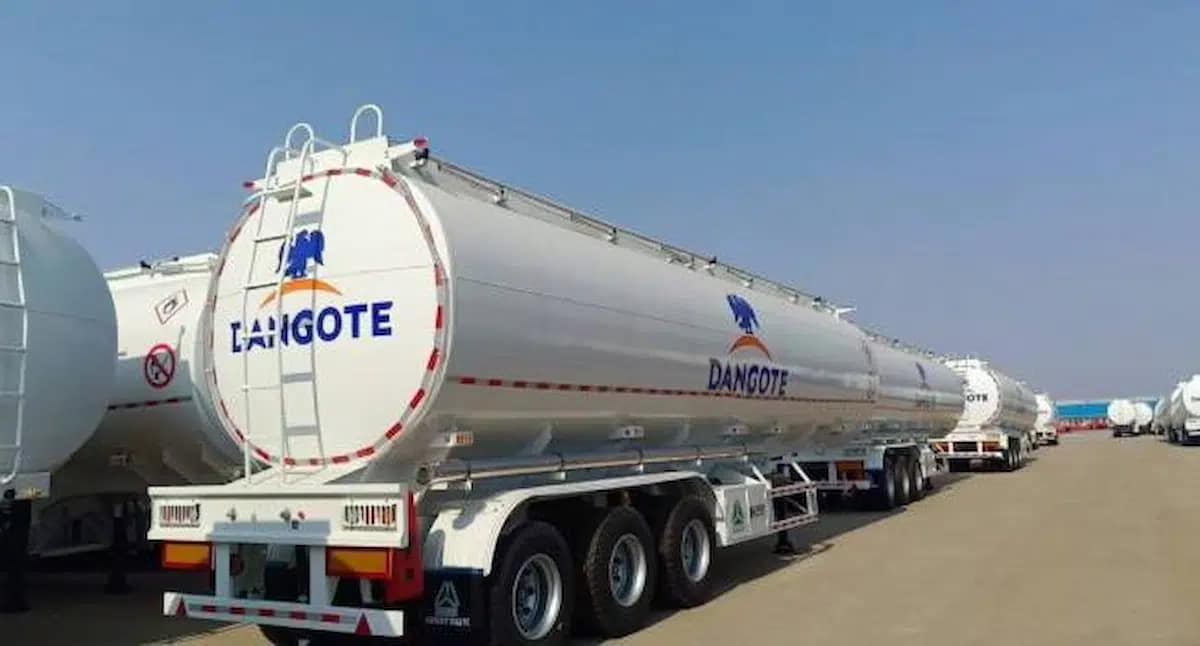
Featured Summary:
- Dangote Refinery price has fallen from recent highs, but pump prices remain elevated because crude costs are only one part of petrol pricing.
- Africa oil refinery fuel remains expensive when exchange rates, freight, storage, financing, distribution margins and taxes keep pressure on the fuel market.
- Global oil price declines do not immediately cut petrol because refined products, local logistics and currency costs can delay price transmission.
- Dangote Refinery fuel supply is changing Nigeria’s import dependence, but crude sourcing from domestic and foreign markets still shapes final fuel costs.
Nigeria’s petrol market is facing a familiar gap between global headlines and local prices.
Brent crude has fallen sharply from earlier war-driven highs, raising public expectations that fuel should become cheaper at the pump.
Dangote Refinery has also reduced its gantry price, but the relief has not fully reached consumers because petrol pricing is not determined by crude alone.
The fuel market still runs through exchange rates, crude sourcing, shipping, storage, depot margins, transport costs, taxes, credit conditions and retail competition.
The pressure sits at the centre of Nigeria’s refining transition.
Dangote Refinery has changed the country’s supply position by replacing a large share of imported finished fuel with local production, but local refining has not removed exposure to global oil market trends.
The refinery still needs crude at commercial prices, sometimes from outside Nigeria, while marketers and retailers price fuel through a deregulated market.
Falling global oil price can lower the base cost, but the final petrol price depends on how quickly that reduction moves through the full supply chain.
Why Is Africa Oil Refinery Fuel Still Expensive?
Africa oil refinery fuel remains expensive because refining capacity alone does not erase the cost structure around petrol.
Crude must be bought, shipped, financed, processed, stored, moved through depots and distributed to retail stations.
Each layer carries costs that can remain high even when global oil price begins to fall.
Nigeria’s case shows why local refining is only one part of the price equation.
Dangote Refinery can reduce dependence on imported petrol, but it still operates inside a fuel market exposed to crude supply arrangements, foreign exchange pressure, inland logistics, credit costs and retailer margins.
A refinery can shorten the supply chain. It cannot automatically remove every cost attached to fuel delivery.
Why Has Global Oil Price Not Cut Petrol?
Global oil price has not fully cut petrol because crude is not the same as refined fuel at the pump.
Petrol prices respond to crude movements, but the pass-through can be delayed by existing inventory, old cargo costs, depot pricing, distribution contracts and exchange-rate changes.
Marketers may still be selling products bought or financed when prices were higher.
Dangote Refinery price cuts have started to reflect the softer crude environment, but retail movement remains uneven.
A gantry price reduction does not immediately become a nationwide pump-price reduction when transport costs, retail margins and regional supply gaps remain in the chain.
The fall in Brent creates room for relief.
The domestic market decides how much of that relief reaches motorists.
How Are Oil Market Trends Affecting Fuel Costs?
Oil market trends are shaping fuel costs through crude prices, refinery margins, product availability and shipping patterns.
Reuters reported Brent at about $71.94 a barrel on July 3, with oil benchmarks near their lowest levels since before the U.S.-Israeli war with Iran began.
That softer market gives refiners more room to lower product prices, especially when fears around supply disruption begin to ease.
The same market shift has also changed Dangote Refinery’s crude sourcing.
Reuters reported that the refinery imported 2 million barrels from ADNOC in June, its first purchases from the UAE, after weaker global crude markets freed up more Middle Eastern supply.
The refinery still receives Nigerian crude from NNPC, but it needs more cargoes than domestic supply alone has reliably provided.
That mix keeps Nigeria’s fuel costs tied to international crude flows even when petrol is refined locally.
Which country in Africa has the Highest Price of Fuel?
Malawi currently has the highest petrol price in Africa, based on the latest GlobalPetrolPrices data.
The platform listed Malawi’s gasoline price at MWK 5,619 per litre, or $3.24 per litre, on June 29, 2026.
That figure is more than twice the global average listed on the same page and places Malawi far above Nigeria’s quoted African petrol-price level.
The data also shows why fuel prices cannot be read through crude production alone.
Some oil-producing countries keep pump prices lower through subsidies, regulated pricing or domestic policy choices, while import-dependent economies can face severe pressure from exchange rates, taxes, logistics and supply constraints.
Malawi’s position reflects how fuel pricing can become heavier when local currency weakness, import dependence and regulated price adjustments meet.
Does Nigeria Buy oil From the USA?
Nigeria has bought crude oil from the United States, especially as Dangote Refinery increased demand for crude feedstock.
The U.S. Energy Information Administration reported that U.S. gross crude exports to Nigeria reached 111,000 barrels per day in February 2025 and 169,000 barrels per day in March 2025.
During those months, the United States became a net exporter of crude oil to Nigeria for the first time.
That does not mean the old oil relationship disappeared.
The United States still buys crude and petroleum products from Nigeria, with EIA data showing U.S. imports from Nigeria continued into 2026.
The trade flow now moves in both directions depending on refinery needs, crude grades, maintenance schedules, freight economics and market prices.
Dangote Refinery fuel supply has made Nigeria less dependent on imported petrol, but it has also made crude sourcing more global.


Recent Comments