

Featured Summary:
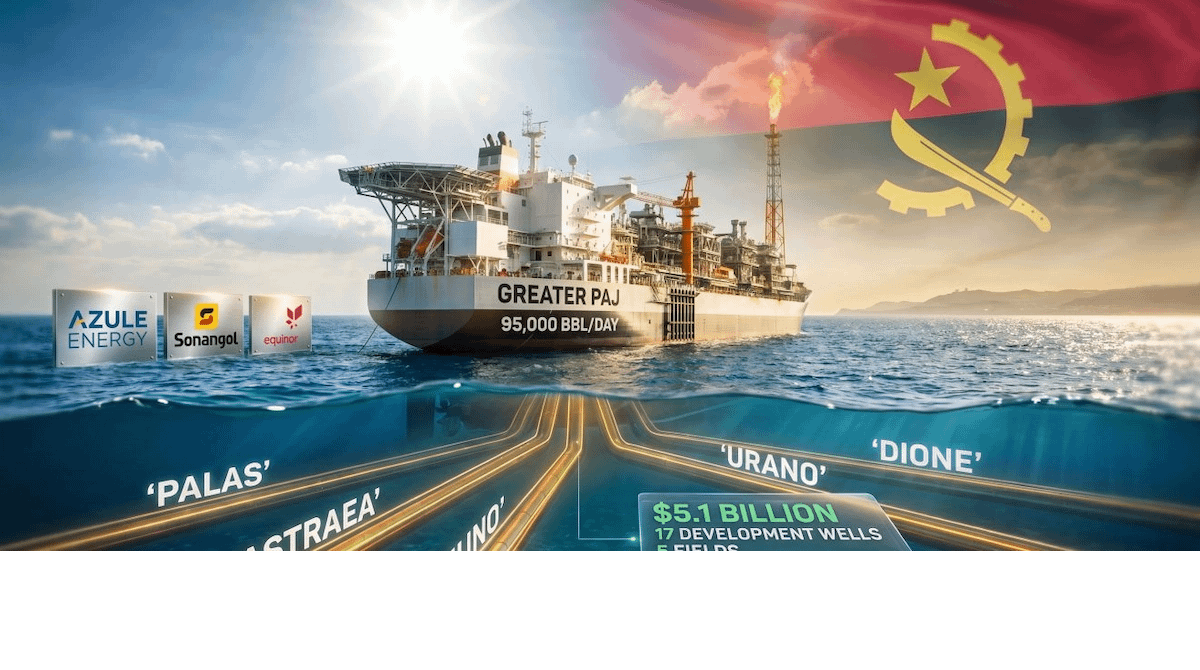
- Angola energy is drawing fresh attention after the $5.1 billion Greater PAJ project signaled renewed confidence in deepwater oil investment.
- Offshore development is central to Angola’s production revival because older fields are declining and new barrels increasingly depend on complex offshore projects.
- Offshore oil could help Angola remain among Africa’s major exporters if new projects reach production quickly enough to offset natural field decline.
- Oil futures may not move on Angola alone, but large offshore approvals show that investors still expect crude supply to matter in the energy transition.
Angola’s $5.1 billion Greater PAJ development has landed at a moment when African oil producers are under pressure to prove that offshore crude still has a future.
Global investors are more selective, energy companies are weighing climate commitments against supply needs, and mature African producers are fighting to replace declining barrels before output falls too far.
That is why this project matters beyond Angola’s coastline.
The development sends a signal that large offshore oil projects are not disappearing from Africa’s energy map.
Angola is using deepwater investment to defend production, attract capital, and strengthen its position after years of output pressure.
The bigger question is whether this kind of project can help reset confidence across Africa energy markets, especially as governments compete for funding, technology, and long-term operators willing to commit billions before first oil arrives.
How Will Angola Energy Reshape Africa’s Oil Investment Future?
Angola energy is reshaping Africa’s oil investment outlook by showing that deepwater projects can still attract major capital when the geology, partners, and commercial structure are strong enough.
Investors have become more cautious about long-cycle oil projects, especially in markets where regulation, infrastructure, and production decline create uncertainty.
A $5.1 billion approval therefore carries weight because it tells the market that Angola can still assemble operators, partners, contractors, and state institutions around a complex offshore development.
The message to other African producers is direct but not simple.
Capital is still available for oil, but it is moving toward projects that look technically credible, commercially disciplined, and capable of producing within a clear timeline.
Angola’s advantage is that it already has deepwater experience, existing offshore infrastructure, and an investment framework familiar to major energy companies.
If Greater PAJ delivers as planned, it could strengthen the case for other African offshore projects that are trying to move from discovery to final investment decision.
Why Is Offshore Development Driving Angola’s Production Revival?
Offshore development has become Angola’s most important route to production revival because many older fields are already past their strongest years.
Mature oil producers face a constant problem: every year, existing wells naturally decline unless new investment replaces lost output.
Angola’s offshore strategy is therefore not only about growing production; it is about preventing future weakness by bringing new fields into the system before older assets lose more capacity.
Greater PAJ fits that strategy because it connects multiple offshore fields across Blocks 31 and 31/21 through an integrated development plan rather than treating each discovery as a separate project.
That approach can lower duplication, make better use of shared infrastructure, and improve the economics of resources that might be harder to develop on their own.
For Angola, this is important because offshore oil is expensive, and projects must be designed carefully if they are to compete for capital in a global market where companies have many options.
Can Offshore Oil Keep Angola Among Africa’s Top Exporters?
Offshore oil can help keep Angola among Africa’s top exporters, but only if new projects arrive fast enough to offset the decline from older production areas.
Angola has remained one of the continent’s major crude producers because of its offshore base, but maintaining that position requires constant reinvestment.
A country cannot defend export strength on past discoveries alone, especially when ageing fields and changing investor priorities are already affecting long-term production plans.
The Greater PAJ development gives Angola a stronger answer to that pressure.
Its planned FPSO, new wells, and cross-block structure create a clearer path toward adding future barrels from deepwater assets that are already understood by industry partners.
The project will not solve every production challenge on its own, but it helps Angola avoid the more dangerous signal that major investors are walking away from its offshore sector.
In oil markets, confidence matters because future output is shaped years before the first barrel reaches export terminals.
What Do Oil Futures Signal After Angola’s $5.1bn Deal?
Oil futures are shaped by expectations as much as current supply.
Traders, refiners, and investors constantly assess whether enough future production is being developed to meet long-term demand.
That is why large offshore approvals attract attention beyond the countries where they occur.
The International Energy Agency continues to project that substantial oil demand will remain in the global energy system for years, even as energy transition policies accelerate.
Against that backdrop, projects such as Greater PAJ matter because they demonstrate that producers are still committing capital to future supply rather than simply harvesting existing production.
The deeper signal may not be about Angola alone.
Investors continue hearing that the future belongs to alternative energy, yet billions of dollars are still being deployed into complex offshore developments that may not produce first oil until the end of the decade.
The market appears to be making a different calculation.
Future energy systems may look different, but future crude supply is still being financed.
Why Is Africa Energy Attracting Massive Offshore Investment Again?
Africa energy is attracting renewed offshore investment because companies are becoming increasingly selective about where they deploy capital.
The winners are no longer necessarily the largest producers.
They are the jurisdictions capable of combining resource quality, regulatory stability, infrastructure, and commercial viability into projects that can compete globally for investment.
That creates a larger opportunity for Africa than production alone.
Offshore developments generate demand for engineering services, fabrication, logistics, training, marine operations, and industrial supply chains that extend far beyond the wellhead.
The countries that capture the greatest value may not be those that export the most oil, but those that build the strongest ecosystems around it.
Angola’s $5.1 billion approval therefore represents more than an offshore development decision.
It highlights a growing competition over where future energy investment will flow and who will benefit from the industrial activity that follows.
The real opportunity for Africa is not simply attracting capital.
It is converting investment into long-term economic capability that remains valuable long after the first barrel is produced.


Recent Comments