


Featured Summary:
- ALX AI training is expanding access to practical skills for Africans seeking roles in the emerging AI economy.
- Africa’s AI workforce is gaining urgency as businesses adopt AI tools across operations, services, and decision-making.
- AI skills now improve employability beyond tech jobs, strengthening opportunities in business, finance, media, and services.
- AI talent development has become a competitiveness test as Africa tries to build workers for the next labour market.
Africa’s workforce pressure is changing.
The challenge is no longer basic technology awareness; it is preparing people for jobs that increasingly expect workers to use intelligent tools, automate routine tasks, and make decisions faster.
Africa does not have an AI awareness problem anymore. It has an AI readiness problem.
ALX’s expansion into AI training targets that transition directly.
The programme focuses on practical AI capability that can improve employability, productivity, and labour-market relevance.
The larger opportunity is not only creating AI specialists; it is preparing African workers to compete inside industries already being redesigned by AI.
How Is AI Training Expanding Africa’s Workforce Opportunities?
AI training in Africa is expanding workforce opportunities by lowering the barrier to roles that now require workers to use intelligent tools, not only traditional technical expertise.
ALX’s AI training expansion fits that shift by preparing learners for AI-supported work across customer support, marketing, business operations, data analysis, content production, software workflows, and entrepreneurship.
The stronger opportunity comes when training produces proof of capability.
Portfolio projects, practical assignments, digital execution, and AI-supported problem solving give learners evidence they can show to employers, clients, or business partners.
Africa’s workforce gap will not be closed by awareness.
It will be closed by people who can use AI to produce measurable work.
What Is Driving Africa’s AI Workforce Growth?
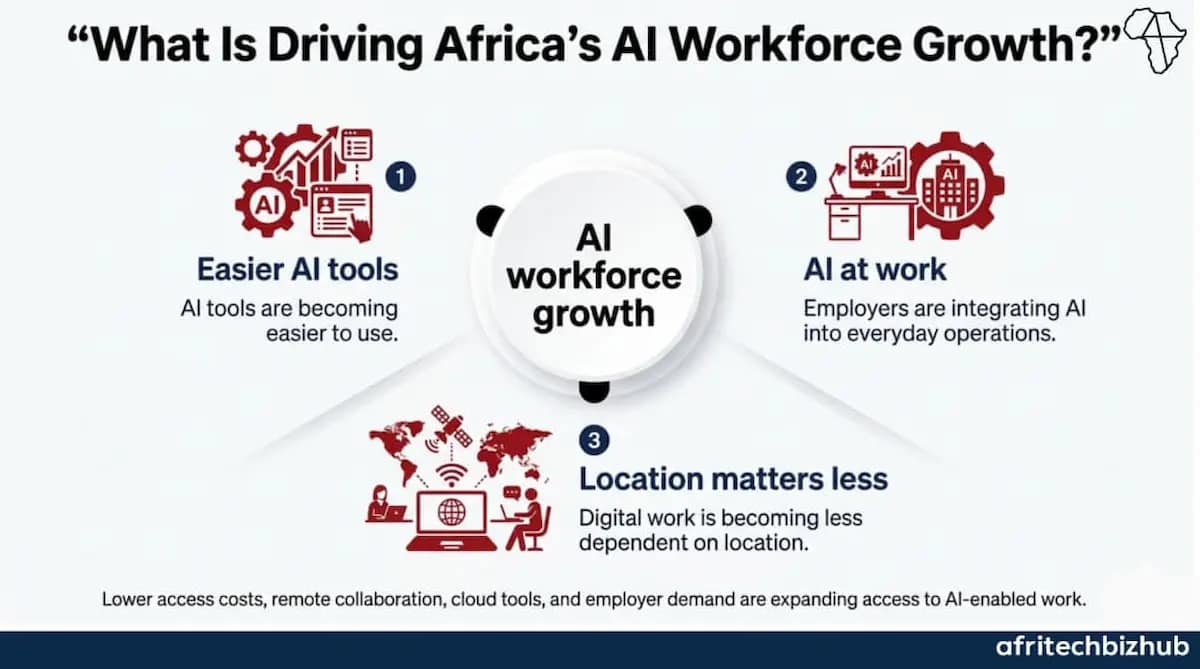
Africa’s AI workforce growth is being driven by a practical shift: AI is becoming a workplace tool before it becomes a specialist industry.
Easier AI tools, employer adoption, cloud platforms, remote collaboration, and lower access costs are allowing more workers to enter AI-enabled roles without waiting for advanced technical training.
That is why ALX’s AI training expansion matters.
Businesses increasingly need workers who can use AI to improve customer support, marketing, operations, research, content production, data tasks, and software workflows.
Africa’s workforce opportunity is widening, but only for people who can turn AI access into measurable productivity.
Why Are AI Skills Boosting African Employment?
AI skills are boosting African employment because they increase what workers can produce, not just what they know.
In labour markets where employers want faster execution, lower operating costs, and wider capability, workers who can use AI tools gain an advantage across research, customer support, marketing, operations, content production, data tasks, and software workflows.
That is why ALX’s AI training expansion carries labour-market relevance beyond the technology sector.
AI capability is spreading into retail, finance, education, logistics, media, enterprise services, and entrepreneurship.
The advantage is no longer limited to coders.
African workers who combine industry knowledge with AI execution become more employable because they can deliver more value across multiple roles.
How Is Africa Developing an AI Talent Pipeline?
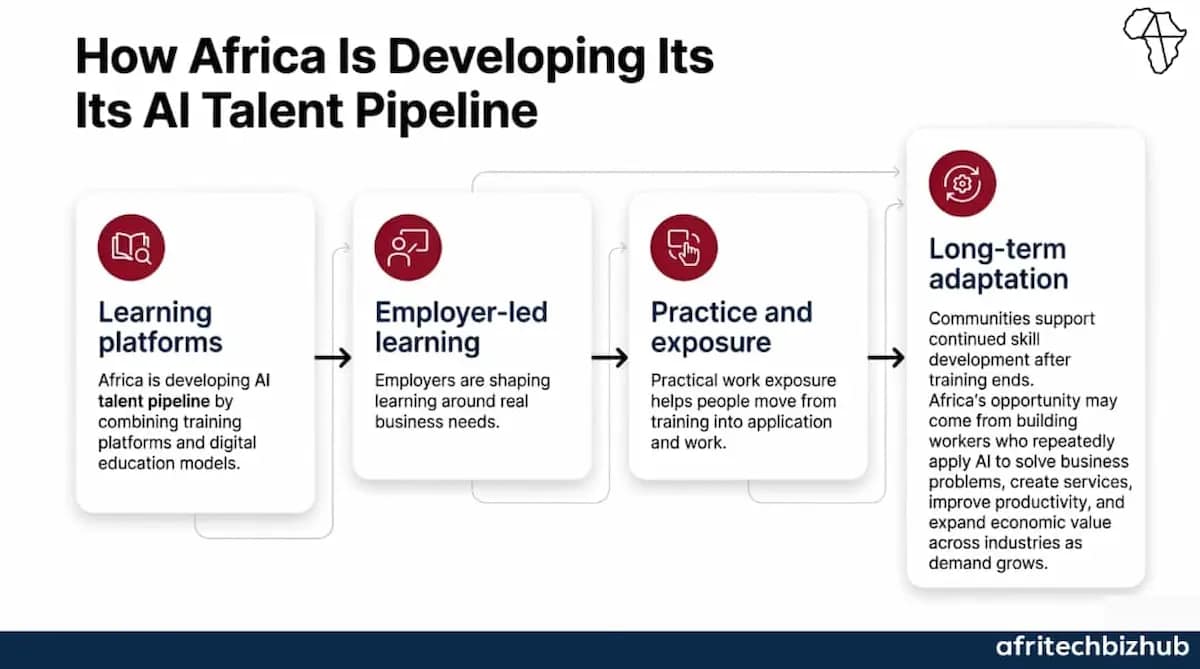
Africa is developing an AI talent pipeline through training platforms, employer-led learning, digital education, practical assignments, work exposure, and communities that keep skills improving after formal training ends.
ALX’s AI training expansion fits that model by focusing on practical capability rather than technology awareness alone.
The stronger pipeline moves people through learning, practice, application, work exposure, and long-term adaptation.
Africa’s AI talent pipeline will not be defined by the number of certificates produced.
It will be defined by workers who can apply AI to solve business problems, improve productivity, create services, and expand economic value across industries.


Recent Comments