


Featured Summary:
- Nutanix and Datamellon are advancing hybrid multicloud environments across African enterprise systems
- Africa cloud computing decisions are shifting from cloud adoption toward workload control and operational flexibility
- Hybrid cloud architecture is drawing stronger enterprise attention as organizations prepare for AI workloads and data growth
- Cloud infrastructure choices increasingly determine whether AI cloud solutions move beyond pilot stages
Africa cloud computing is entering a more selective phase where enterprises are becoming less concerned with moving everything into the cloud and more concerned with deciding what should remain under direct control.
The first wave of digital transformation rewarded migration speed. The next phase increasingly rewards control over workloads, data location, operating costs, system resilience, and the ability to support future AI demand without rebuilding infrastructure repeatedly.
Nutanix and Datamellon are positioning hybrid multicloud systems inside that transition.
Their approach is not built around replacing existing environments or concentrating operations inside one provider.
It is built around helping organizations operate applications across private infrastructure, public cloud environments, and future AI workloads while preserving greater control over governance, performance, continuity, and long-term infrastructure flexibility.
How are Nutanix advancing Africa cloud computing growth?
Nutanix is advancing Africa cloud computing by reducing the pressure on enterprises to choose between keeping infrastructure locally and moving completely into one cloud provider.
Its hybrid multicloud approach allows organizations to operate applications and workloads across private infrastructure, public cloud environments, and edge systems through a more unified operating environment.
That matters because many African enterprises do not operate inside clean technology environments.
Banks, telecom operators, retailers, logistics firms, and public institutions often run combinations of existing systems and newer digital platforms at the same time.
Hybrid cloud gives those organizations a path to modernize without interrupting operations that continue to support daily business activity.
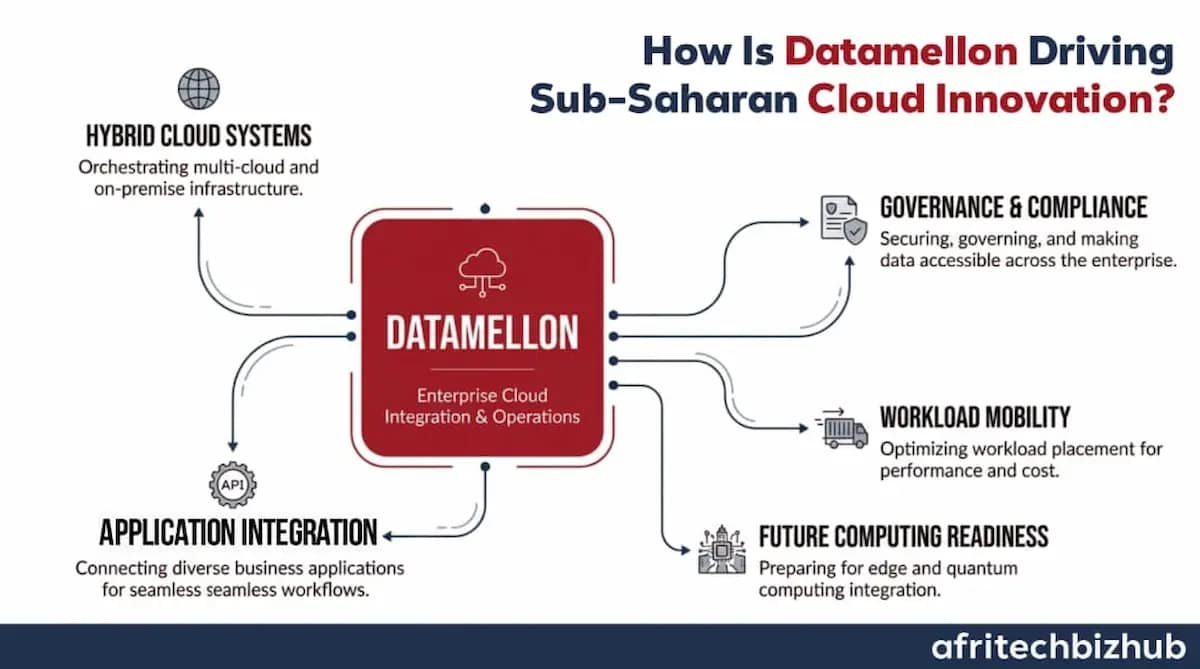
How Is Datamellon Driving Sub-Saharan Cloud Innovation?
Datamellon’s role inside Sub-Saharan cloud innovation sits less in owning infrastructure and more in helping enterprises deploy and operate it across complex environments.
As organizations adopt hybrid cloud systems, the challenge increasingly shifts from buying infrastructure to connecting applications, data environments, governance requirements, and operating systems without creating fragmented technology stacks.
That position is becoming more commercially important as enterprise cloud decisions move closer to execution outcomes.
Businesses increasingly want environments capable of moving workloads, integrating existing systems, and preparing for future computing demand without rebuilding infrastructure repeatedly.
Implementation capability is increasingly becoming part of cloud competitiveness rather than a support function.
Is Hybrid Cloud Reshaping Africa’s Digital Transformation?
Hybrid cloud is reshaping digital transformation because enterprises increasingly want control over where computing happens instead of replacing everything at once.
Businesses are separating workloads according to regulation, latency, cost, resilience, governance, and operational priorities rather than forcing applications into one environment.
The World Bank’s Digital Progress and Trends Report highlighted that stronger digital economies increasingly depend on adaptable digital infrastructure and that AI readiness depends on foundational capabilities including connectivity, compute, data, and skills.
The report frames cloud environments as part of the infrastructure layer supporting future digital growth rather than temporary technology upgrades.
Across Africa, the implication is becoming more practical: digital transformation increasingly depends less on migration speed and more on whether infrastructure remains flexible after deployment and capable of supporting future demand.
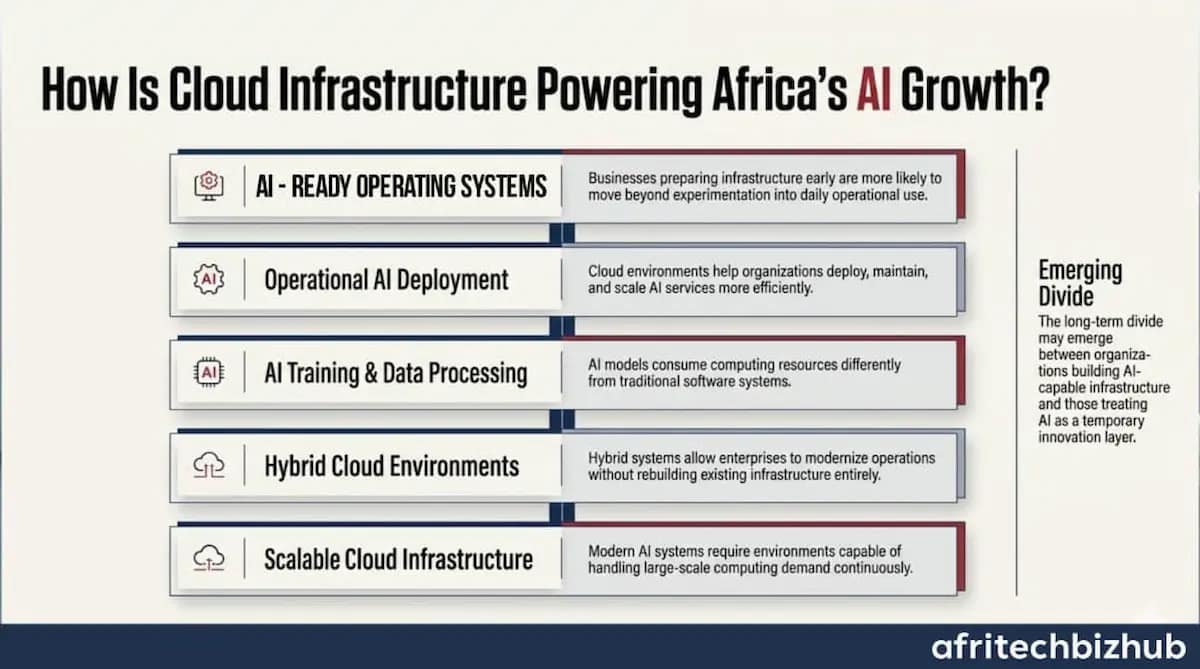
How Is Cloud Infrastructure Powering Africa’s AI Growth?
Cloud infrastructure is changing the economics of artificial intelligence because AI systems consume computing resources differently from traditional software.
Training models, processing data, deploying services, and maintaining performance all require environments capable of scaling without repeated infrastructure replacement.
That is why AI cloud solutions increasingly depend on infrastructure design as much as algorithms.
Hybrid cloud environments are becoming more important because they reduce forced infrastructure replacement and allow enterprises to modernize without rebuilding entire operating environments.
The stronger divide across Africa may not emerge between organizations adopting AI and those ignoring it.
It may emerge between organizations building environments capable of supporting AI continuously and those treating AI as a short-term innovation layer.
As Africa cloud computing moves beyond migration into infrastructure strategy, businesses that prepare cloud environments early are more likely to move from experimentation into operating systems people depend on daily.


Recent Comments