


Featured Summary:
- Airtel Malawi is using satellite-backed mobile coverage to reach regions where traditional network expansion remains commercially difficult
- Satellite connectivity is becoming more important as telecom operators confront rising rural infrastructure costs
- Airtel Africa’s direct-to-cell strategy reflects a wider shift toward satellite-backed digital connectivity across Africa
Africa’s next phase of telecom expansion may depend less on building more towers and more on reaching places where towers no longer make commercial sense.
Across African markets, operators are running into rising infrastructure costs, lower returns across sparsely populated regions, and slower economics around traditional network expansion.
Satellite-backed mobile systems are moving closer to mainstream telecom strategy as companies search for faster and more flexible ways to close coverage gaps.
Airtel Malawi’s move into satellite connectivity reflects that broader shift as telecom competition increasingly extends beyond tower ownership into coverage economics, infrastructure reach, and the ability to connect markets conventional rollout models continue to leave behind.
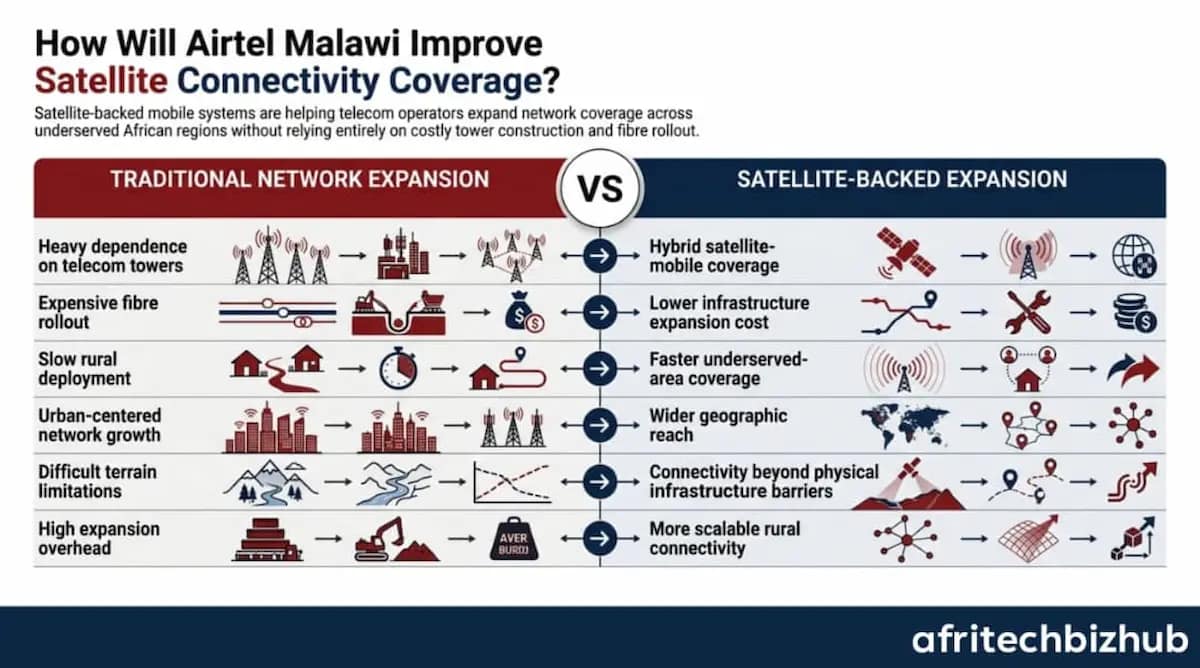
How Will Airtel Malawi Improve Satellite Connectivity Coverage?
Airtel Malawi is turning to satellite connectivity as rural coverage gaps expose the commercial limits of tower-based network expansion across parts of the country.
The move follows Airtel Africa’s partnership with SpaceX to support direct-to-cell mobile services across its African markets, pushing satellite-backed mobile coverage closer to mainstream telecom deployment.
The strategy allows telecom companies to reach underserved regions without relying entirely on costly tower construction and fiber rollout.
Satellite-backed mobile systems are becoming a serious infrastructure play across African telecom markets as operators race to strengthen rural coverage, reduce expansion costs, and widen mobile network reach beyond densely populated urban centers.
Why Is Airtel Malawi Investing In Satellite Connectivity?
Airtel Malawi is investing in satellite-backed mobile systems as telecom operators across Africa confront the high cost and slow pace of extending traditional network coverage into underserved regions.
Rural expansion continues to pressure operators with weaker infrastructure returns, difficult terrain, power constraints, and expensive tower deployment across low-density markets.
The move also reflects a wider revenue and coverage battle across African telecom markets where operators are searching for faster ways to add new mobile users and strengthen service reach outside major urban centers.
Airtel Africa’s direct-to-cell partnership with SpaceX signals how satellite-backed connectivity is moving closer to long-term commercial telecom strategy rather than remaining a niche infrastructure experiment.
Can Satellite Connectivity Transform Rural Africa Networks?
Rural connectivity across Africa continues to lag urban network access despite years of investment across mobile infrastructure.
The International Telecommunication Union highlighted persistent differences in internet access, coverage quality, and digital participation across rural and urban populations, reinforcing how millions remain outside reliable connectivity even as mobile adoption expands.
Airtel Malawi’s satellite push reflects a wider telecom shift rather than an isolated deployment decision.
Operators are increasingly confronting the economic limits of conventional rollout models across difficult terrain and lower-density regions.
Satellite-backed mobile systems are moving closer to becoming a complementary infrastructure layer where traditional expansion becomes slower or commercially weaker.
How Will Satellite Connectivity Transform Airtel Malawi Services?
Satellite connectivity gives Airtel Malawi a stronger route into regions where weak network reach continues limiting digital participation, mobile access, and long-term subscriber growth.
The approach reduces dependence on repeated tower deployment while extending service availability across harder-to-reach locations.
The broader signal extends beyond Malawi. Telecom competition across Africa is increasingly becoming less about tower concentration and more about how efficiently operators expand coverage.
Operators that build more flexible infrastructure models may ultimately capture the next phase of mobile growth across underserved markets.


Recent Comments