

Featured Summary:
- Africa Risk continues to push borrowing costs higher across the continent despite improving fundamentals in several economies
- Investors often price Africa as a single risk category, overlooking major differences between countries
- Higher risk premiums raise the cost of infrastructure, industrialisation, and private investment across African markets
- Africa’s next financing challenge may be changing risk perception as much as improving economic fundamentals
African leaders are increasingly arguing that Africa’s financing challenge is not a shortage of capital but a problem of perception.
Speaking at recent investment forums, including discussions in London, policymakers challenged the way Africa Risk continues to be priced in global markets despite reforms, debt restructuring efforts, and improving economic fundamentals across parts of the continent.
The argument is simple but uncomfortable. If risk is being assessed too broadly, Africa may be paying more for capital than its underlying realities justify.
As governments search for financing to support infrastructure, industrialisation, and growth, the debate is shifting from how much capital is available to how Africa itself is being perceived.
Why Does Africa Continue Paying More for Capital?
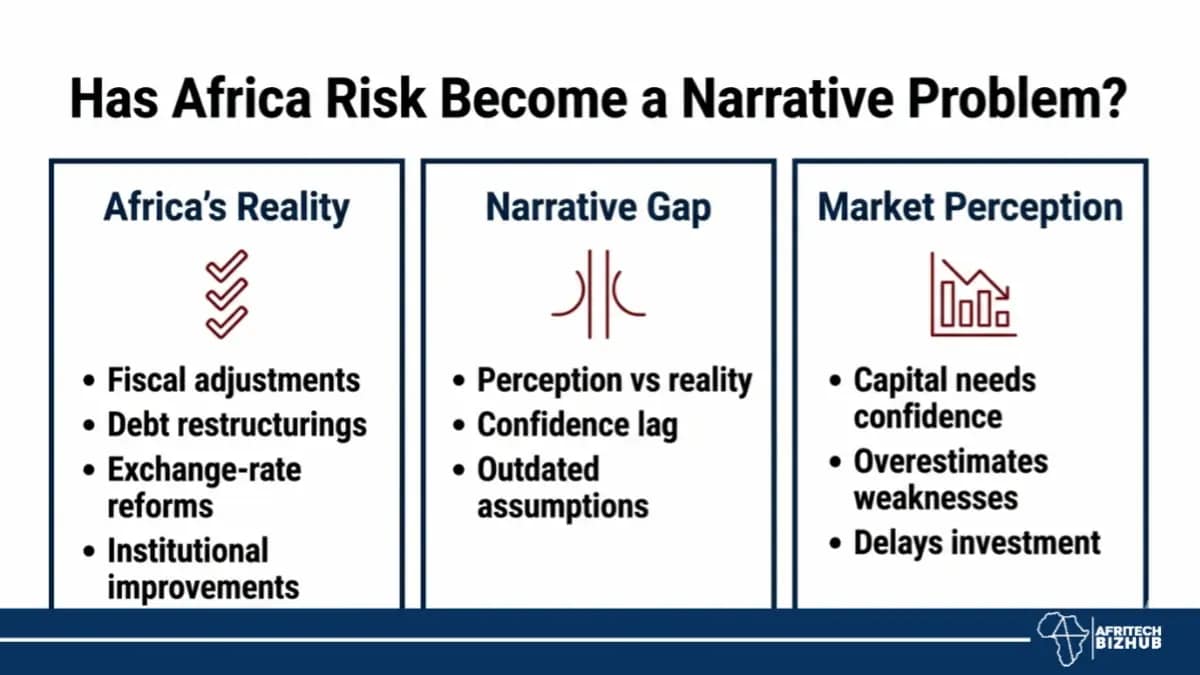
Africa does not pay more for capital because capital is scarce. It pays more because risk is expensive.
Sovereign defaults, currency instability, policy reversals, governance concerns, and infrastructure gaps have created a financing environment where investors demand compensation before money moves.
Whether those risks materialise is often secondary. Markets price the possibility that they might.
The consequence is visible across the continent. Governments borrow at higher rates.
Businesses face more expensive credit. Infrastructure projects carry larger financing costs before construction begins.
Africa Risk has become embedded in the cost of capital itself. Some of that pricing reflects reality.
Some of it reflects memory. Financial markets rarely forget a crisis, and they are often slower to recognise improvement than deterioration.
Is Africa Being Treated as One Investment Destination?
Global investors rarely analyse Africa the way they analyse Europe, Asia, or Latin America.
Markets routinely separate Germany from Greece, Vietnam from Japan, and Brazil from Chile.
Africa often receives less distinction.
Forty-plus investable economies are frequently viewed through a single continental lens despite vast differences in debt profiles, growth trajectories, institutional quality, and economic structure.
That approach creates a pricing problem.
Weaknesses in one market can influence perceptions far beyond its borders, while improvements elsewhere struggle to receive equal recognition.
Africa Risk therefore becomes larger than any individual country. Investors are not only pricing specific economies. They are often pricing a continental narrative.
The result is that risk can spread faster than confidence, even when the underlying fundamentals do not.
What Does Africa Risk Actually Look Like Today?
The Africa Risk story presented to global markets often resembles the Africa of previous decades more than the Africa that exists today.
Several economies have spent recent years addressing the very vulnerabilities that continue to dominate investor discussions.
Exchange-rate reforms, debt restructuring programmes, stronger banking systems, fiscal adjustments, expanding technology sectors, and deeper regional trade integration have altered the risk profile across large parts of the continent.
That does not mean risk has disappeared. It means the gap between perception and reality may be wider than commonly assumed.
Nigeria’s currency reforms, Ghana’s debt restructuring process, Kenya’s growing digital economy, and South Africa’s position within global capital markets point to economies that are confronting challenges rather than ignoring them.
Africa Risk remains real, but it increasingly appears to be priced as a worst-case scenario rather than a constantly evolving set of national realities.
How Does Risk Perception Affect Africa Development?
Risk perception does not stop at financial markets. It eventually determines how much development costs.
When Africa Risk pushes borrowing costs higher, governments spend more servicing debt, businesses face more expensive credit, and infrastructure projects require larger amounts of capital before construction even begins.
The economic consequences are significant.
An IMF study found evidence that Sub-Saharan African countries face higher borrowing costs than comparable peers, while UNDP estimates cited by Brookings suggest that 16 African countries may be paying more than necessary because of lower-than-warranted credit ratings, creating an estimated loss of more than $74 billion.
That is capital that could finance power generation, transport networks, industrial expansion, and digital infrastructure.
Africa’s development challenge is therefore not only about attracting capital. It is also about reducing the cost at which that capital arrives.
Has Africa Risk Become a Narrative Problem?
The next phase of the Africa Risk debate is no longer solely about economic reform.
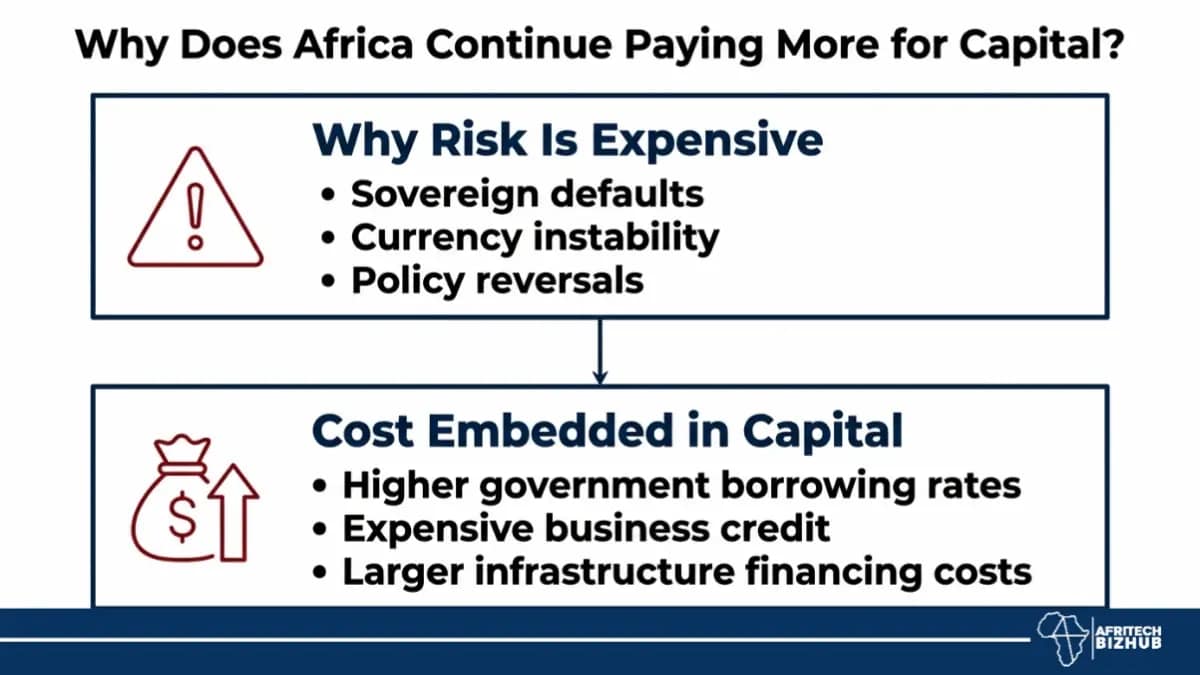
Many governments have already implemented fiscal adjustments, debt restructurings, exchange-rate reforms, and institutional improvements.
The larger challenge is whether financial markets are prepared to recognise those changes.
Capital does not move on data alone. It moves on confidence, credibility, and expectations about the future.
That makes perception an economic variable in its own right.
Countries that strengthen fundamentals but fail to change investor confidence may continue paying a premium for capital they can no longer justify.
The risk for Africa is not simply that markets overestimate weaknesses. It is that outdated assumptions delay investment, infrastructure, and industrial growth.
The countries that attract the next wave of capital will not necessarily be those with the loudest growth story.
They will be those that succeed in narrowing the gap between how they are changing and how they are perceived.


Recent Comments