

Featured Summary:
- Oil routes around Hormuz are carrying more Gulf crude through Yanbu and Fujairah
- Saudi Arabia is sending more barrels west through Yanbu as Red Sea exports rise
- The UAE is building Fujairah into a larger crude outlet outside the strait
- Suez and SUMED are carrying more of the westbound flow into Mediterranean and Atlantic markets
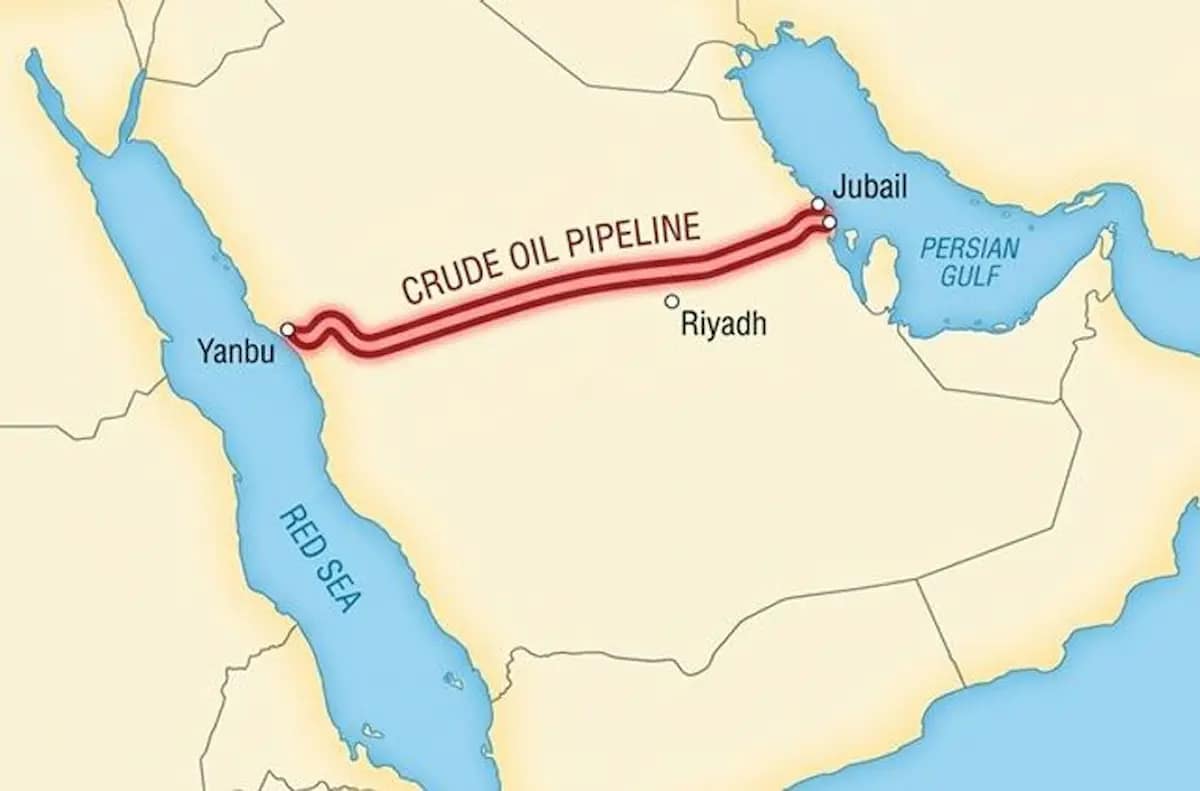
Saudi Arabia is moving as much as 5 million barrels a day of export crude west through Yanbu, while the UAE can push about 1.8 million barrels a day through Fujairah without entering the Strait of Hormuz.
Even with those flows, Gulf exports remain below pre-war levels, leaving part of the lost supply unrecovered.
Riyadh is considering another 2 million barrels a day of westbound pipeline capacity, and ADNOC is accelerating a second Fujairah line for 2027.
U.S. imports of Middle Eastern crude are expected near 600,000 barrels a day in August, the highest since the Iran war began, with Saudi cargoes moving from Yanbu through Suez toward American ports.
Hormuz still carries the larger share of Gulf oil, but the market response is already shifting volume and investment elsewhere.
Yanbu and Fujairah are taking more of the flow, and both are being built out for a longer disruption.
Yanbu Is Taking a Larger Share of Saudi Oil Exports
Kuwait has explored access to Saudi Arabia’s East-West route, while Bahrain and Qatar remain heavily dependent on Hormuz.
Riyadh is considering another 2 million barrels a day of westbound capacity, putting Yanbu closer to a wider Gulf role if disruption through the strait persists.
Houthi threats are also changing how Saudi barrels leave the Red Sea. More cargoes are moving north toward Suez, while some tanker activity is running without visible tracking.
Yanbu is already carrying more Saudi exports; the next phase is whether neighboring producers begin leaning on the same westbound system.
Fujairah Is Expanding Outside the Strait
ADNOC’s second Fujairah pipeline is already about halfway complete and targeted for 2027, extending the UAE’s position along the oil routes around Hormuz.
The new line is expected to roughly double the crude volume that can reach Fujairah without entering the strait.
Fujairah opens directly onto the Gulf of Oman, putting more UAE export capacity beyond Hormuz before the tanker loads.
As the second line comes online, more Emirati crude will be able to leave through an eastern outlet already separated from the chokepoint.
Suez and SUMED Are Carrying the Yanbu Route Further West
Saudi crude reaching Egypt’s Sidi Kerir is rising as more barrels from Yanbu move north through Suez and SUMED.
The system can handle about 2.5 million barrels a day, extending the oil routes around Hormuz from the Red Sea into Mediterranean and Atlantic trade.
The IEA has cut its 2026 global oil-supply outlook by about 4.3 million barrels a day, with Middle East production still below pre-war levels.
Suez and SUMED are taking a larger share of the barrels still moving west as that shortfall persists.
Yanbu now feeds into a wider corridor carrying Gulf crude beyond the Red Sea and into global markets.
Capital Is Concentrating Along Oil Routes Around Hormuz
The next round of Gulf energy investment is moving toward infrastructure that can carry crude without depending on a single chokepoint.
Saudi and Emirati projects are extending export options on both sides of the region, while Egypt’s corridor is taking on more of the westbound flow.
The oil routes around Hormuz are becoming a larger part of how the market plans for prolonged disruption.
Hormuz still carries the bigger share of Gulf crude, but investment is now advancing through routes built to keep supply moving beyond the strait.
The global economy is adjusting through new routes, added infrastructure and wider trade flows, with the next oil network already taking shape outside Hormuz.


Recent Comments