

Featured Summary:
- Local Currency Trade is entering a more complex phase as Africa reduces dollar dependence while China’s yuan expands across African trade corridors
- Africa’s currency debate is no longer about replacing the dollar. It is about strengthening African currencies inside regional and global trade
- China’s RMB clearing network can improve trade efficiency, but it also raises a bigger question about Africa’s long-term monetary independence
- The next stage of African trade will depend less on which global currency dominates and more on how much trade settles in African currencies
Africa’s currency debate has moved into a more difficult phase. For years, the argument focused on reducing dependence on the US dollar in trade, finance, reserves, and settlement.
Now another global currency is moving deeper into African trade infrastructure.
Standard Bank and ICBC’s authorisation to clear renminbi across Africa gives businesses a faster route for China-linked payments, but it also exposes the next contradiction.
Local Currency Trade cannot mean moving from dollar dependence to yuan dependence.
Africa’s stronger position will come when African currencies become more useful inside African trade.
Africa Is Moving Beyond Dollar Dependence. The Next Debate Has Already Started
Africa’s de-dollarisation argument began with a real commercial frustration.
Too many African transactions still lean on hard currencies, even when the goods, buyers, sellers, and final markets sit within the continent.
That dependence raises costs, slows settlement, pressures foreign reserves, and weakens local currencies in trade systems they should help carry.
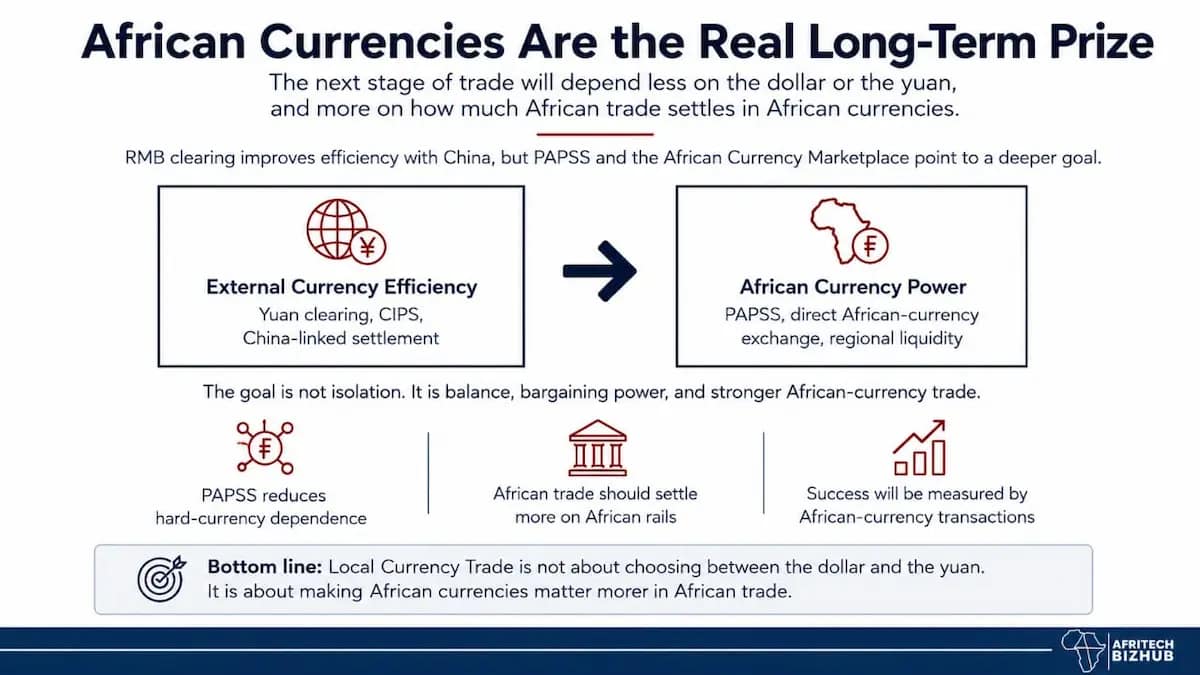
The old debate was about reducing dollar dominance. The new debate is about what replaces that dependence.
That distinction matters now. A trade system that shifts from the dollar to the yuan may reduce friction for Africa-China commerce, but it does not automatically deliver monetary independence.
African businesses need faster settlement with China, Europe, the Gulf, and other markets.
But Africa’s deeper advantage will come from making its own currencies more liquid, trusted, and usable across regional trade.
Reducing dependence on one global currency is not the same thing as building currency power.
Yuan Expansion Is Changing Africa’s Trade Landscape
The yuan is no longer expanding in Africa only through Chinese lending, imports, or trade invoices.
It is entering through financial infrastructure.
Standard Bank and ICBC have been authorised by the People’s Bank of China to clear renminbi across Africa, creating a formal RMB clearing channel with operational capacity in 19 African countries.
That gives banks, corporates, importers, exporters, and investors a more direct route into China-linked settlement.
This is not a small technical change. China is already central to African trade, and payment infrastructure deepens that position.
Standard Bank’s CIPS participation gives African institutions a channel for RMB-based interbank payments between Africa and China, while clearing status strengthens liquidity and settlement efficiency.
For companies importing Chinese machinery, inputs, electronics, equipment, and consumer goods, the benefits are practical.
The warning is just as practical: financial infrastructure shapes trade power long after the transaction is complete.
Local Currency Trade Has Become Africa’s Bigger Opportunity
Local Currency Trade is now Africa’s bigger opportunity because the continent’s deepest settlement problem is not only the dollar.
It is the limited use of African currencies in African commerce. AfCFTA can reduce tariffs and open markets, but businesses still need payment systems that allow them to settle across borders without routing ordinary African transactions through foreign reserve currencies.
That is why PAPSS matters.
The yuan can make Africa-China trade more efficient, but it cannot solve Africa’s internal currency challenge.
A Nigerian trader paying a Ghanaian supplier, a Kenyan business buying from Rwanda, or a Senegalese firm selling into Côte d’Ivoire should not need the dollar or yuan by default.
The long-term prize is not choosing between Washington and Beijing’s currencies.
It is building enough African currency liquidity, trust, convertibility, and settlement infrastructure to make regional trade work on African terms.
Institutions Are Building the Foundations for Local Currency Trade
Institutions are now building two different layers of Africa’s currency future.
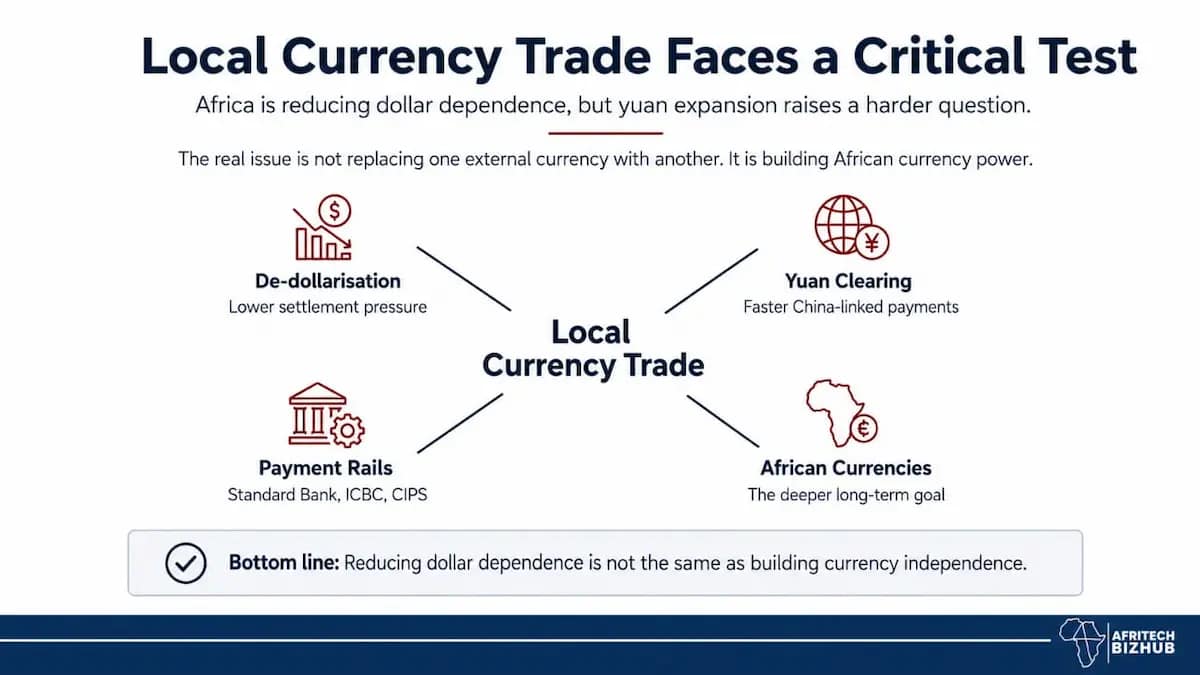
Standard Bank and ICBC’s RMB clearing authorisation strengthens the yuan channel for Africa-China trade, while CIPS participation gives Africa-China payments a more direct settlement route.
On the African side, PAPSS and Afreximbank are building infrastructure designed to reduce reliance on hard currencies for intra-African trade.
These systems are not competing in the same lane, but they reveal the same shift: trade power is moving through payment rails.
Afreximbank and PAPSS frame the African challenge clearly through the PAPSS African Currency Marketplace.
Africa’s many currencies, limited convertibility, and fragmented regulatory systems have created a hard-currency bottleneck that makes intra-African trade more expensive than it should be.
The marketplace is designed to support direct African-currency exchange and create a continent-wide liquidity pool.
That is the real test for Local Currency Trade. Africa’s financial architecture is becoming more diversified, but success will not be measured by how quickly the yuan grows.
It will be measured by how much African trade ultimately settles in African currencies.
Monetary Independence May Become Africa’s Next Trade Advantage
Monetary independence will not come from rejecting every global currency. Africa will still trade in dollars, euros, yuan, and other currencies where global commerce requires them.
The issue is balance. Global currencies should serve African trade, not dominate transactions that African currencies should be able to carry.
That is the line between payment efficiency and currency dependence.
The future of African trade will not be decided simply by whether the dollar or the yuan wins more settlement share.
It will be decided by whether Africa builds enough trust in its own currencies, payment systems, liquidity pools, and regional trade institutions.
Local Currency Trade is not a slogan about de-dollarisation. It is a competitiveness strategy.
If Africa can settle more regional trade in African currencies while using global currencies only where they are commercially necessary, it will gain more than cheaper payments.
It will gain bargaining power.


Recent Comments