

Featured Summary:
- Africa Trade is entering a more strategic phase as geopolitical disruption forces governments and companies to rethink supply chains, sourcing, and production networks
- Afreximbank’s Africa Trade Report points to stronger African fundamentals, including 4.5% GDP growth in 2025, easing inflation, and merchandise trade of about US$1.5 trillion
- Africa has the demand, resources, and market scale to benefit from global fragmentation, but trade finance gaps and weak value addition still limit its leverage
- The opportunity is no longer simply exporting more commodities. It is building African production networks, expanding intra-African trade, and turning disruption into bargaining power
Global disruption has usually reached Africa as a bill to be paid, not an opening to be seized.
Commodity shocks, shipping volatility, currency pressure, food insecurity, and external policy decisions have repeatedly exposed how much of the continent’s trade position still depends on systems built elsewhere.
Afreximbank’s latest Africa Trade Report changes the frame. It argues that geopolitical fragmentation, supply-chain diversification, friendshoring, and shifting trade routes can become an African growth opportunity if the continent moves from passive exposure to deliberate positioning.
Africa is still vulnerable to global shocks, but the same fractured global economy is creating room for countries that can industrialise, integrate markets, finance trade, and build stronger regional value chains.
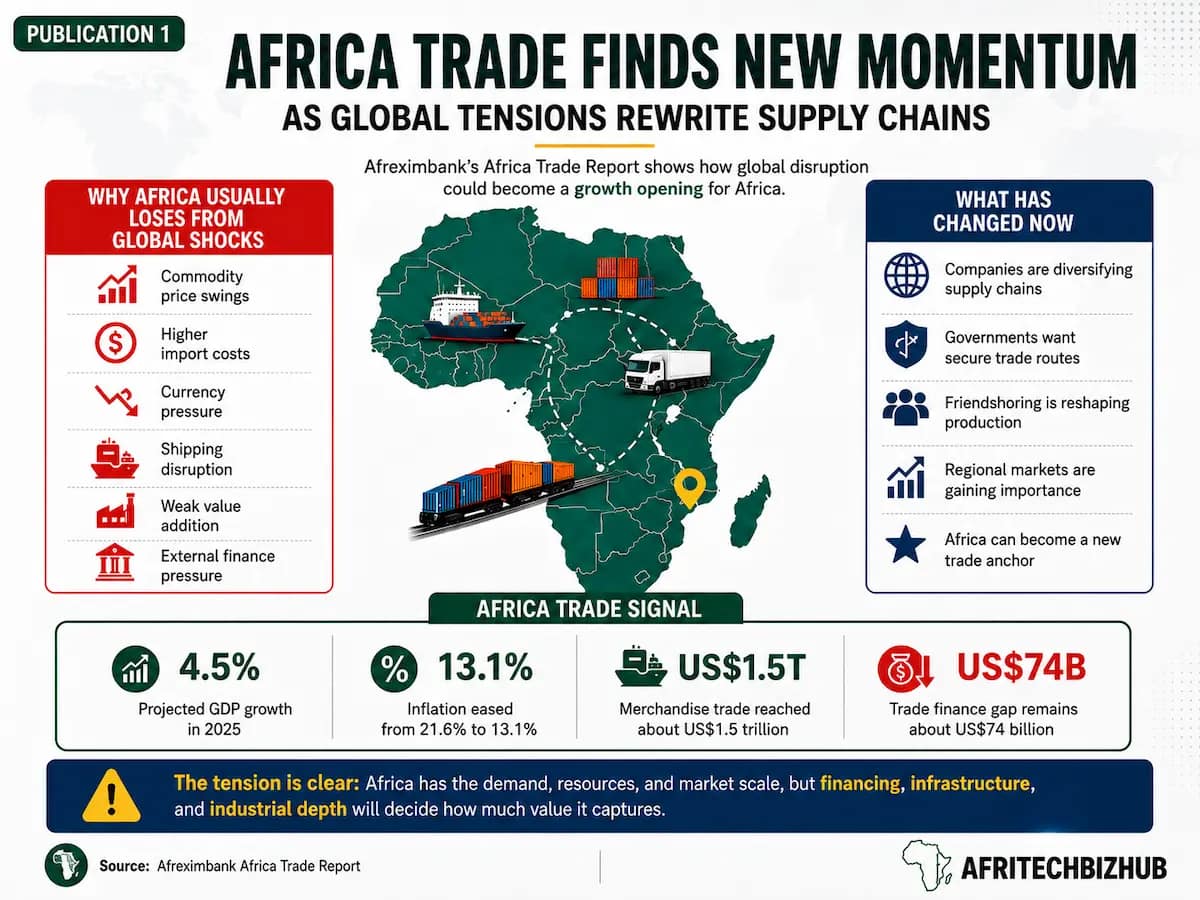
Why Has Africa Usually Lost When Geopolitics Changes?
Africa has often absorbed geopolitical change through price swings, supply disruptions, currency pressure, and weaker access to external finance.
The continent’s export structure remains heavily exposed to commodities, while much of the value from those commodities is captured through processing, logistics, finance, and manufacturing outside Africa.
When global conflict, sanctions, tariff disputes, or shipping disruptions hit trade routes, African economies often face higher import costs before they gain export leverage.
That pattern has made the continent more reactive than strategic.
The deeper weakness is structural. Africa has supplied raw materials into global systems it did not design, while importing many of the finished goods, technologies, and industrial inputs needed for growth.
That imbalance has turned geopolitical shifts into external shocks rather than competitive openings.
The result is a familiar cycle: the world changes, trade routes move, financing tightens, and African economies are left managing the consequences after larger powers have already repositioned.
What Is Different About Today’s Global Trade System?
The global trade system is no longer rewarding efficiency above everything else.
Security, resilience, political alignment, and supply-chain control now sit beside cost in boardroom and government decisions.
Friendshoring and nearshoring are no longer slogans; they are reshaping where companies place factories, source inputs, and manage risk.
That shift gives Africa a rare opening, but only if the continent moves faster than the disruption around it.
The old globalisation playbook is being rewritten by risk.
Companies need alternative sourcing locations, governments need secure access to strategic inputs, and regional markets are gaining new importance as global routes become less predictable.
Africa’s advantage is no longer only its population or resources.
It is the possibility of becoming a production, processing, logistics, and consumption platform at a time when the world is searching for new trade anchors.
Why Is Africa Trade Entering a New Phase?
Africa Trade is entering a new phase because the continent’s opportunity is moving beyond shipment volumes.
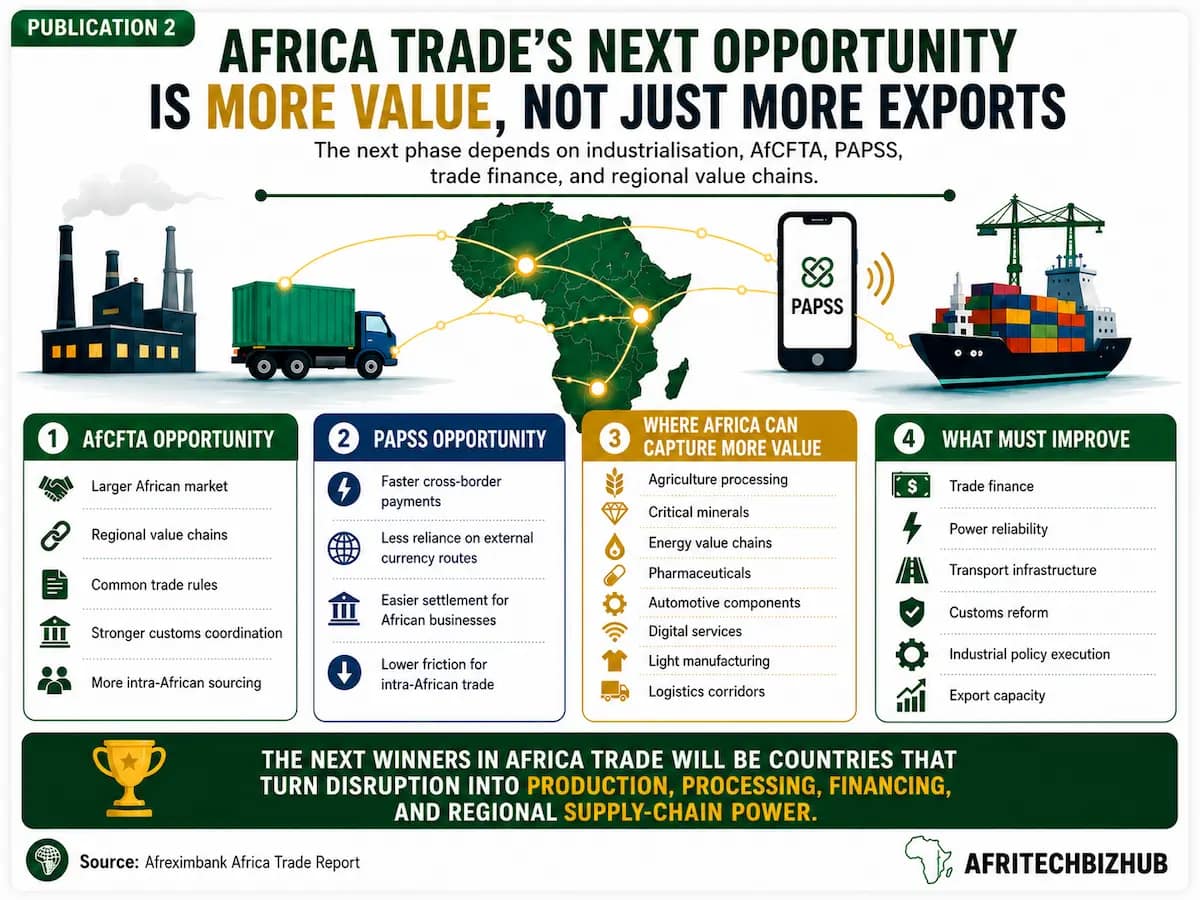
The real shift is toward industrialisation, regional value chains, trade finance, payment systems, and market integration.
AfCFTA gives Africa the framework for a larger internal market, while PAPSS addresses one of the continent’s most expensive trade frictions: cross-border settlement through external currencies.
These systems matter because trade cannot scale if payment, logistics, standards, and financing remain fragmented.
The Afreximbank report places this transition inside a wider geopolitical moment. Africa can use global supply-chain disruption to expand processing in agriculture, minerals, energy, pharmaceuticals, automotive components, digital services, and light manufacturing.
That would change the trade story from exporting more raw materials to capturing more value before goods leave the continent.
The new phase of Africa Trade is therefore not volume alone. It is production depth, regional coordination, and the ability to make African markets work as connected economic territory.
What Does the Afreximbank Africa Trade Report Reveal?
The Afreximbank Africa Trade Report gives the argument its institutional weight.
The report shows Africa’s real GDP growth strengthening to 4.5% in 2025, while inflation declined from 21.6% to 13.1%.
Merchandise trade rose to about US$1.5 trillion, confirming that the continent’s trade base is expanding even as global conditions remain unsettled.
These figures matter because they show resilience at a moment when fragmentation, conflict, and tighter financial conditions are testing emerging markets.
The report also exposes the constraint. Africa still faces a trade-finance gap of about US$74 billion, while Afreximbank disbursed US$17.5 billion under its Strategic Plan VI to support trade and economic activity.
That gap explains why improved fundamentals are not enough.
AfCFTA and PAPSS can strengthen Africa Trade, but execution will decide the outcome: financing must reach firms, payment systems must scale, infrastructure must improve, and industrial policy must move from speeches to factories, corridors, and export capacity.
Why Could Geopolitics Become Africa’s Next Competitive Advantage?
Geopolitics becomes an advantage only when countries position before the next shock arrives.
Africa has the market size, resources, demographic weight, and regional integration agenda to benefit from a world searching for more resilient supply chains.
But advantage will not come from geography alone.
It will come from infrastructure, industrial policy, trade finance, customs reform, logistics, energy reliability, and leadership willing to treat integration as economic strategy rather than conference language.
The next winners in Africa Trade will not simply be the countries least damaged by global disruption.
They will be the countries that use disruption to attract production, process raw materials locally, build regional supply chains, and finance exporters through African institutions.
Afreximbank’s report points to that harder opportunity.
Africa can remain the recipient of geopolitical decisions, or it can become one of the regions that benefits from the world’s search for new trade anchors.


Recent Comments