


Featured Summary:
- Cross-Border Payments are no longer waiting for new ideas. They are waiting for everyday adoption
- Africa is building payment infrastructure faster than people are using it
- PAPSS and PAPSSCARD show that implementation is advancing. The next test is trusted, everyday use
- Africa’s payment success will be measured less by launches and more by transactions
Africa’s biggest payment challenge is no longer building the infrastructure. It is proving that the infrastructure is becoming part of everyday commerce.
Payment systems are expanding, partnerships are growing, and cross-border settlement is moving closer to African currencies.
Yet launches have become easier to measure than everyday use. The contradiction has quietly changed.
Africa is no longer being judged by what it can build. It is beginning to be judged by what businesses and citizens actually use.
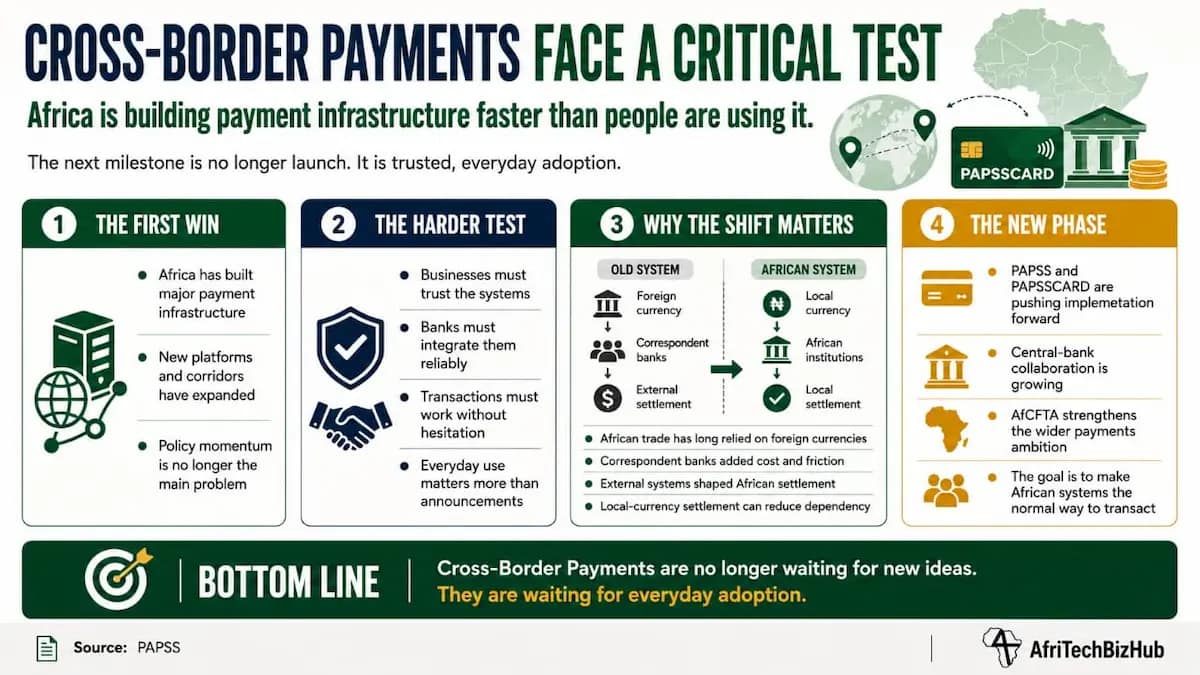
Africa Has Built the Infrastructure. Everyday Use Remains the Harder Test
For years, success was measured by whether Africa could build its own cross-border payments infrastructure.
New platforms were launched, partnerships expanded, and payment corridors announced as milestones of continental integration.
Those achievements matter, but they belong to the first phase of the story. Launching infrastructure and making it part of everyday business are two different achievements.
The harder test begins after the announcement.
Payment systems create value when businesses trust them enough to use them repeatedly, banks integrate them reliably, and transactions move without users questioning whether they will succeed.
Africa’s next payment milestone will not be another launch. It will be the moment reliable, everyday use becomes more visible than the announcement itself.
Cross-Border Payments Have Entered a New Phase
Africa is no longer building payment infrastructure simply to move money faster. The larger ambition is to change where African trade is settled.
For decades, businesses trading across the continent often depended on foreign currencies, correspondent banks, and financial systems located outside Africa.
That made African trade vulnerable long after goods had already crossed the border.
The shift is now more strategic. PAPSS, PAPSSCARD, central-bank collaboration, and AfCFTA are gradually moving cross-border payments towards African financial infrastructure and local-currency settlement.
The next phase is therefore not about launching another payment platform.
It is about making African trade increasingly settle through African systems, with enough reliability that businesses choose them as the normal way to transact.
Why Adoption Is Becoming More Important Than Innovation
Africa has reached the point where another payment innovation, by itself, changes very little.
The next breakthrough will come when businesses and citizens stop thinking about the infrastructure behind a transaction because using it has become the obvious choice.
Financial systems become part of the economy only after they become part of everyday behaviour.
That is why adoption now matters more than innovation.
Businesses will only shift from familiar payment routes when African systems become consistently trusted, widely accepted, and seamlessly integrated into banks, merchants, and everyday commerce.
An innovation solves a continental problem only when people choose it without hesitation.
The next measure of Africa’s payment progress will not be how many systems exist, but how naturally those systems become part of daily trade.
How Far Have Cross-Border Payments Actually Progressed?
Africa has moved further than many people realise.
PAPSS continues to expand its network of participating central banks, commercial banks, payment providers, and payment corridors, while PAPSSCARD extends the ambition of settling more African transactions through African financial infrastructure.
New integrations, including Kenya’s Pesalink, show that implementation is no longer confined to policy discussions.
Cross-Border Payments have entered an operational phase where more institutions are connecting to the system and local-currency settlement is becoming increasingly possible.
Official milestones point to steady institutional progress rather than isolated announcements.
The next measurement is becoming harder than the first.
Institutions can report new participants, partnerships, and payment corridors, but the long-term success of Cross-Border Payments will ultimately be reflected in everyday commercial use. Building the infrastructure was the first milestone.
Making that infrastructure the default way Africans move money across borders is the milestone that still lies ahead.
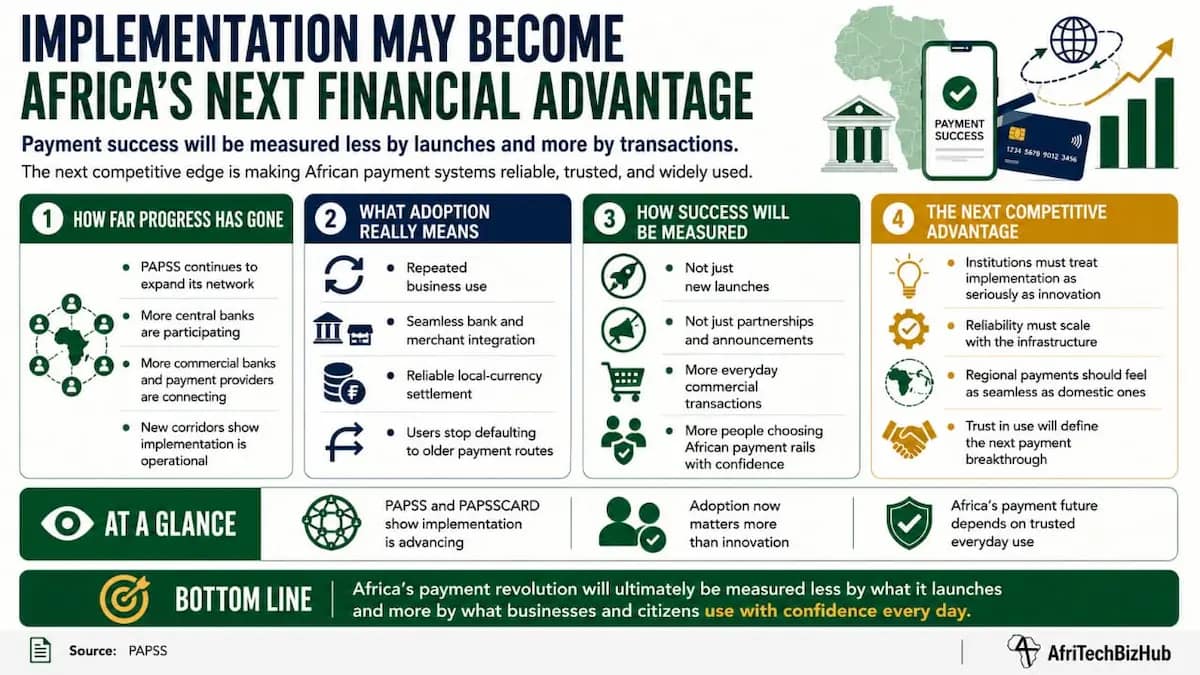
Implementation May Become Africa’s Next Financial Competitive Advantage
Africa’s next payment breakthrough will not come from announcing another platform.
It will come from making the platforms already built more reliable, more trusted, and more deeply integrated into everyday trade.
Institutions have carried the harder task of building the infrastructure.
The next responsibility is ensuring it performs consistently at the scale African businesses and citizens expect.
Implementation is no longer a technical exercise. It is becoming a competitive advantage.
The larger opportunity extends beyond Cross-Border Payments.
Africa’s financial future will be shaped by institutions that treat implementation as seriously as innovation, strengthen reliability as quickly as they launch new systems, and make regional transactions feel as seamless as domestic ones.
The continent’s payment revolution will ultimately be measured less by what it creates and more by what people and businesses use with confidence every day.


Recent Comments