


Featured Summary:
- Private Sector Financing remains constrained as banks support a smaller share of African trade
- DFIs are carrying more of Africa’s trade-finance burden as commercial appetite weakens
- Foreign-exchange shortages have become the biggest obstacle to trade-finance growth
- Africa’s challenge is no longer finding capital. It is getting capital to productive businesses
African trade is growing, but the financing behind it is becoming harder to ignore.
The African Development Bank reported that intra-African trade accounted for 34% of total bank-intermediated trade between 2020 and 2024, well above pre-pandemic levels.
Yet commercial banks are supporting a smaller share of African trade while foreign-exchange shortages continue constraining trade-finance growth.
Development finance institutions are becoming increasingly important to keeping trade moving.
The question is no longer whether Africa can trade more. It is whether African financial systems can finance that growth without relying more heavily on institutional support.
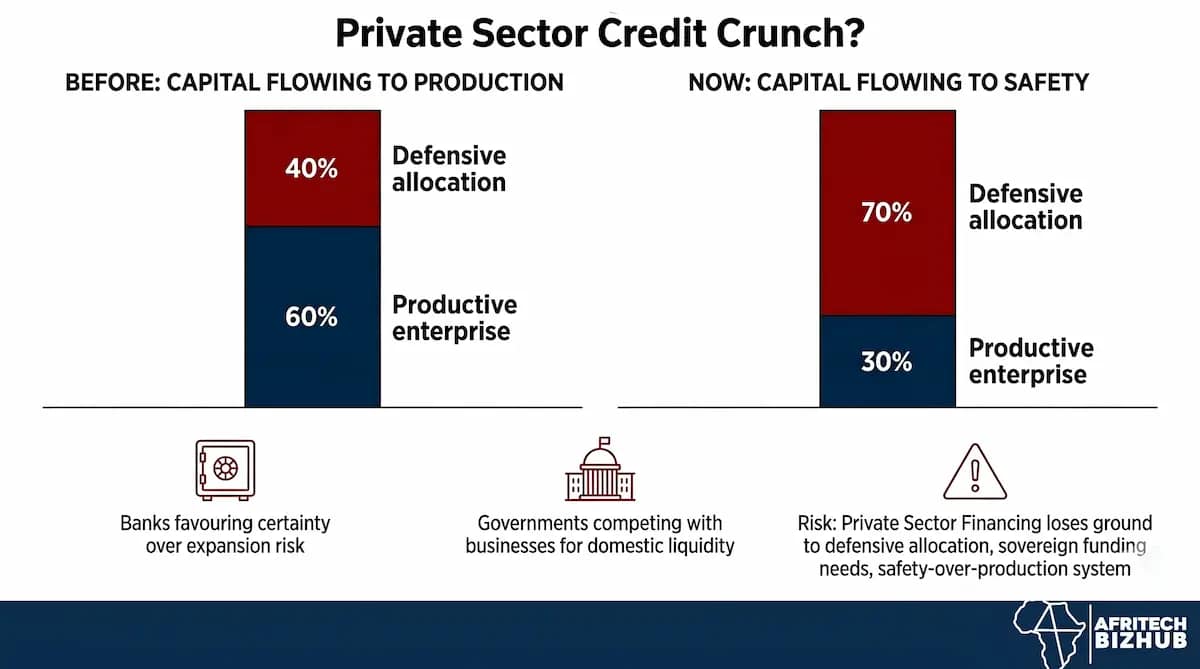
Why Is Private Sector Financing Becoming Scarcer Across Africa?
Private sector financing is becoming scarcer not because economic activity has disappeared, but because liquidity is becoming harder to deploy.
The African Development Bank’s trade-finance data points to the pressure.
Foreign-exchange liquidity shortages became the primary constraint on trade-finance growth between 2020 and 2024, with 36% of banks identifying FX availability as their biggest obstacle.
The problem is no longer demand for capital. The problem is access to deployable liquidity.
Banks can remain profitable and well-capitalized while becoming more defensive.
As foreign-currency liquidity becomes harder to secure, lending horizons shorten, risk tolerance weakens, and capital becomes more selective.
Productive businesses increasingly compete for liquidity that is being preserved rather than deployed.
Private sector financing is becoming scarcer not because money disappeared, but because the financial system is becoming less willing to take risk.
How Are Global Capital Markets Draining African Liquidity?
Africa’s liquidity squeeze increasingly begins outside Africa.
Much of the continent’s trade remains financed, settled, or guaranteed through dollar-based channels.
As U.S. interest rates remain elevated, global investors can earn attractive returns in developed markets without taking additional frontier-market risk.
Capital becomes more selective. Dollar liquidity becomes more expensive.
The consequences reach African financial systems quickly.
Banks face higher foreign-currency funding costs. Trade-finance capacity tightens.
Importers and exporters compete for scarcer dollar liquidity. Financing conditions become more restrictive even when domestic demand remains intact.
The result is a market where liquidity is not disappearing. It is being repriced.
Businesses increasingly face financing conditions shaped by global capital markets rather than local economic activity.
That pressure eventually reaches domestic credit markets, where productive enterprise absorbs the cost.
Why Are Banks Financing Governments Instead of Businesses?
Banks are not abandoning businesses. They are responding to a financial system that increasingly rewards sovereign lending over productive risk.
Government securities offer predictable repayment, stronger liquidity, and lower regulatory risk.
Businesses operate in a different environment. Manufacturers face rising operating costs.
Importers manage currency volatility. SMEs navigate infrastructure gaps, logistics disruptions, and uneven demand conditions.
Capital follows certainty. Governments need funding. Banks need repayment. The alignment is obvious.
The consequence reaches far beyond bank balance sheets. Every additional allocation toward sovereign financing reduces the capital available for productive enterprise.
Private Sector Financing becomes harder to secure, not because demand disappeared, but because financial institutions increasingly prefer certainty over risk.
This is where the liquidity squeeze becomes a growth constraint. Governments secure financing. Businesses secure less of it.
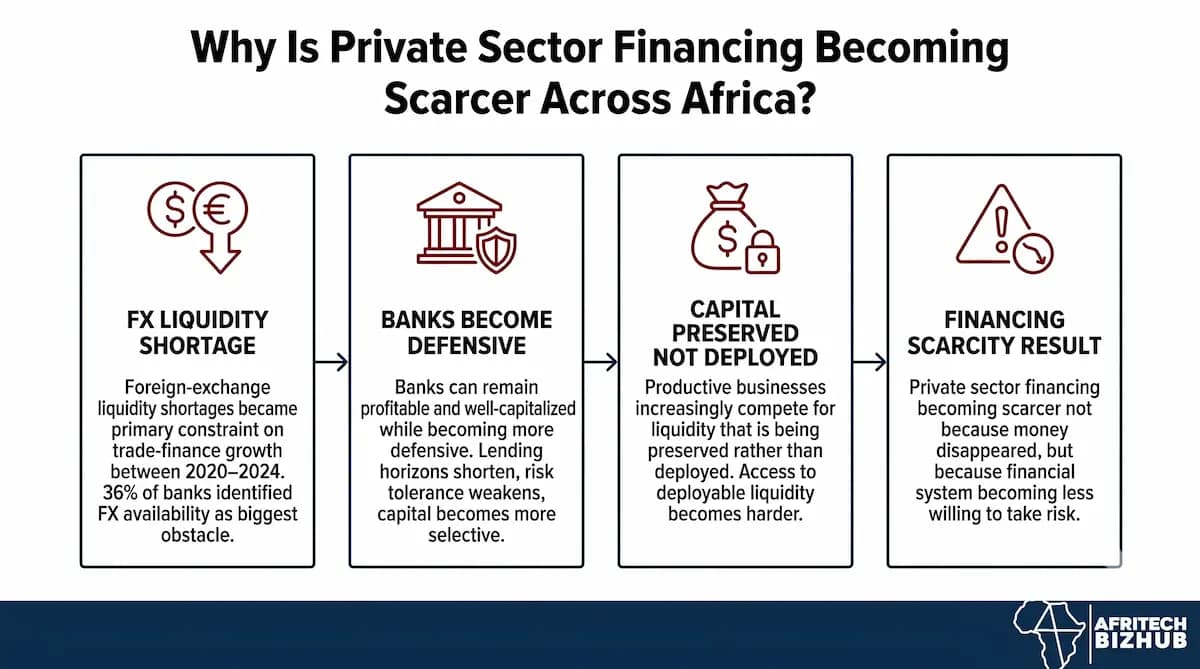
Why Is Africa’s Own Capital Missing From Private Sector Financing?
Africa is not operating from a position of capital scarcity. It is operating from a position of defensive capital allocation.
The Africa Finance Corporation has argued that African economies collectively hold more than $4 trillion across domestic savings, banking assets, pension funds, insurance assets, and reserves.
Yet much of that capital remains concentrated in low-risk instruments, short-duration assets, and defensive mandates rather than flowing into infrastructure, industrial expansion, and productive investment.
That contradiction increasingly defines the continent’s financing challenge.
African economies continue searching for external funding while substantial domestic capital remains positioned away from productive risk.
Pension funds preserve capital. Insurance assets prioritise liquidity. Financial institutions protect balance sheets.
The logic is understandable. The developmental consequences are harder to ignore.
Private Sector Financing is becoming more constrained even as domestic financial assets continue expanding.
The continent is accumulating larger pools of capital while productive sectors continue competing for scarce financing.
That is not a shortage of capital.
It is a shortage of capital reaching production.
The Hard Verdict: Is Africa Entering a Private Sector Credit Crunch?
The debate is no longer whether Africa needs more capital. The debate is whether existing capital can reach productive enterprise before financing conditions become even more restrictive.
Global investors continue pricing risk conservatively. Banks continue favouring certainty over expansion risk.
Governments continue competing with businesses for domestic liquidity. None of those pressures appear temporary.
The consequence is becoming harder to ignore. Private Sector Financing is tightening at the same moment African economies need more industrial investment, more infrastructure, and more business expansion to sustain growth.
African institutions are right to call for deeper domestic capital mobilisation.
The harder question is whether financial systems, regulatory frameworks, and capital-allocation structures can move quickly enough to redirect existing resources toward productive sectors.
No external investor will finance Africa’s development at the scale Africa requires. That responsibility increasingly rests with African capital itself.
The risk is no longer that Africa lacks capital.
The risk is that Private Sector Financing continues losing ground to defensive capital allocation, sovereign funding needs, and a financial system that increasingly rewards safety over production.


Recent Comments