

Featured Summary:
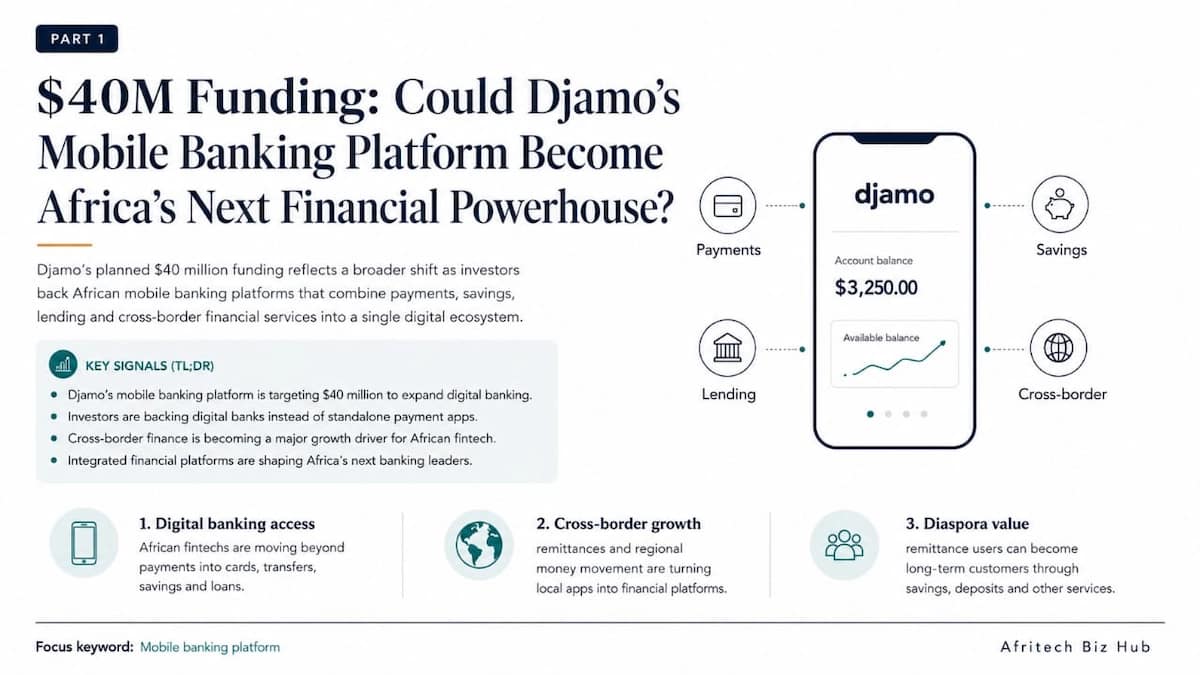
- Djamo’s mobile banking platform is targeting $40 million to expand digital banking.
- Investors are backing digital banks instead of standalone payment apps.
- Cross-border finance is becoming a major growth driver for African fintech.
- Integrated financial platforms are shaping Africa’s next banking leaders.
African fintech is moving beyond payments into full-service digital banking.
Djamo’s planned $40 million raise reflects a broader shift in investor strategy as capital increasingly tracks platforms capable of combining payments, savings, lending and cross-border financial services inside one customer relationship.
The next generation of African financial leaders is being built around depth, not single-use transactions.
Djamo’s position in Francophone Africa places that shift inside one of the continent’s most underbanked financial regions.
The company has grown from card access and mobile banking into a wider platform with credit, remittances and everyday financial services.
A mobile banking platform that owns the customer relationship can move from transaction volume into deposits, lending, business payments and long-term financial activity.
How Are African Fintech Companies Expanding Digital Banking Access?
African fintech companies are expanding digital banking access by moving from narrow payment tools into platforms that manage more of a customer’s financial life.
The first wave solved transaction problems: sending money, paying bills, receiving transfers and accessing cards.
The stronger platforms are now adding savings, credit, remittances and business tools around the same user base.
Djamo fits that wider movement.
Its mobile banking platform gives users access to cards, transfers, savings tools, loans and remittance services in markets where traditional banking remains expensive, slow or inaccessible for many consumers.
Payments remain the entry point, but the larger opportunity sits in long-term banking relationships.
The platform that keeps the customer active after the first transaction carries the stronger growth case.
Why Are Cross-Border Payments Solutions Becoming Djamo’s Growth Engine?
Cross-border payments are becoming strategic financial infrastructure for African fintech companies.
Domestic payments helped build the first wave of digital finance, but regional and international money movement is now carrying more weight.
Workers, traders, freelancers, families and small businesses need faster ways to move value across borders without relying on costly and fragmented channels.
Djamo’s remittance services to and from Côte d’Ivoire place that opportunity close to its core business.
Cross-border finance gives a mobile banking platform more than transaction volume.
It creates customer dependence, repeat usage and stronger links between diaspora income, household finance and business payments.
As African fintech companies expand beyond national markets, cross-border payments become the route from local app to regional financial platform.
How Do Remittance Services Help Djamo Win Diaspora Customers?
Remittance services help Djamo reach customers whose financial lives already cross borders.
Diaspora users are not only sending money once.
They support households, pay bills, fund education, invest in small businesses and maintain financial ties with home markets.
A platform that handles those flows can move closer to the centre of the customer relationship.
That gives Djamo a path beyond transfer fees.
Remittances can become the first layer of a wider banking relationship involving savings, deposits, credit, insurance, wealth products and merchant payments.
Diaspora customers were once treated mainly as payment users.
Digital banks are now using those flows to build longer-term financial value.
The more services connected to each transfer, the stronger the customer lifetime value.
Can Mobile Loans Transform Africa’s Mobile Banking Platform Future?
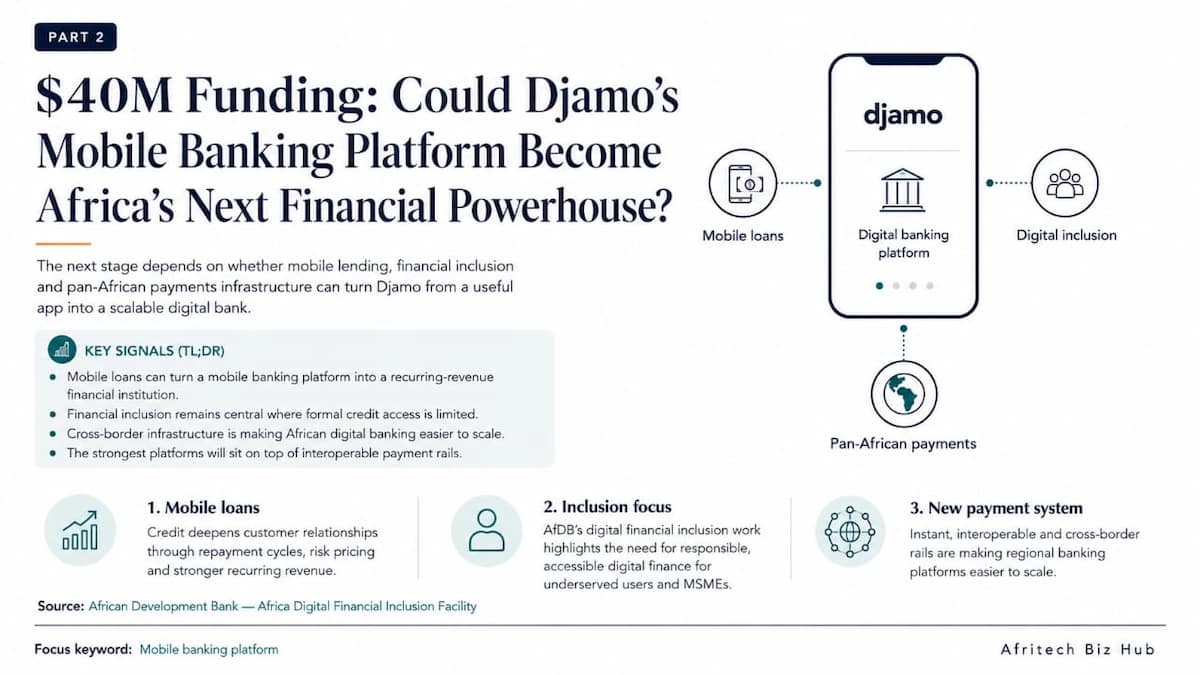
Mobile loans can turn a mobile banking platform from a transaction channel into a financial institution with recurring revenue.
Payments attract users, but credit deepens the relationship.
Lending creates repayment cycles, risk pricing, customer data, product stickiness and stronger commercial value for platforms that can manage credit responsibly.
The African Development Bank’s Africa Digital Financial Inclusion Facility works to address systemic barriers limiting the growth and use of digital financial solutions, especially for women, micro, small and medium-sized enterprises.
That institutional focus sits directly inside the opportunity Djamo is trying to capture.
Mobile loans can expand access where traditional collateral, branch banking and formal credit histories remain limited, but the model will scale only where underwriting, consumer protection and repayment discipline keep pace with growth.
What Is the New Payment System in Africa?
Africa’s new payment system is being built around instant, interoperable and cross-border financial infrastructure.
The Pan-African Payment and Settlement System is one of the clearest examples, connecting banks, payment service providers and financial institutions so payments can move across African countries more securely and efficiently.
That infrastructure increases the value of digital banking platforms by making regional financial services easier to scale.
The opportunity for platforms like Djamo is not only faster payments.
Continental payment infrastructure can support cross-border commerce, remittances, merchant payments, regional banking and digital trade.
African payment systems once operated largely within national borders.
Connected infrastructure is turning payments into banking infrastructure.
The mobile banking platform that can sit on top of that system has a stronger path toward pan-African expansion and long-term fintech growth.


Recent Comments