


Featured Summary:
- Kenya banking is attracting more African banks as the country strengthens its position as East Africa’s financial gateway
- Banking consolidation is accelerating as higher capital requirements and regional expansion reshape competition across Africa
- Kenya’s local lenders continue leading through customer relationships, deposits, payment networks, and digital banking ecosystems
- Kenya’s role in East African trade and finance is making the country a strategic hub for regional banking and cross-border capital
Kenya has become the focal point of Africa’s latest banking expansion.
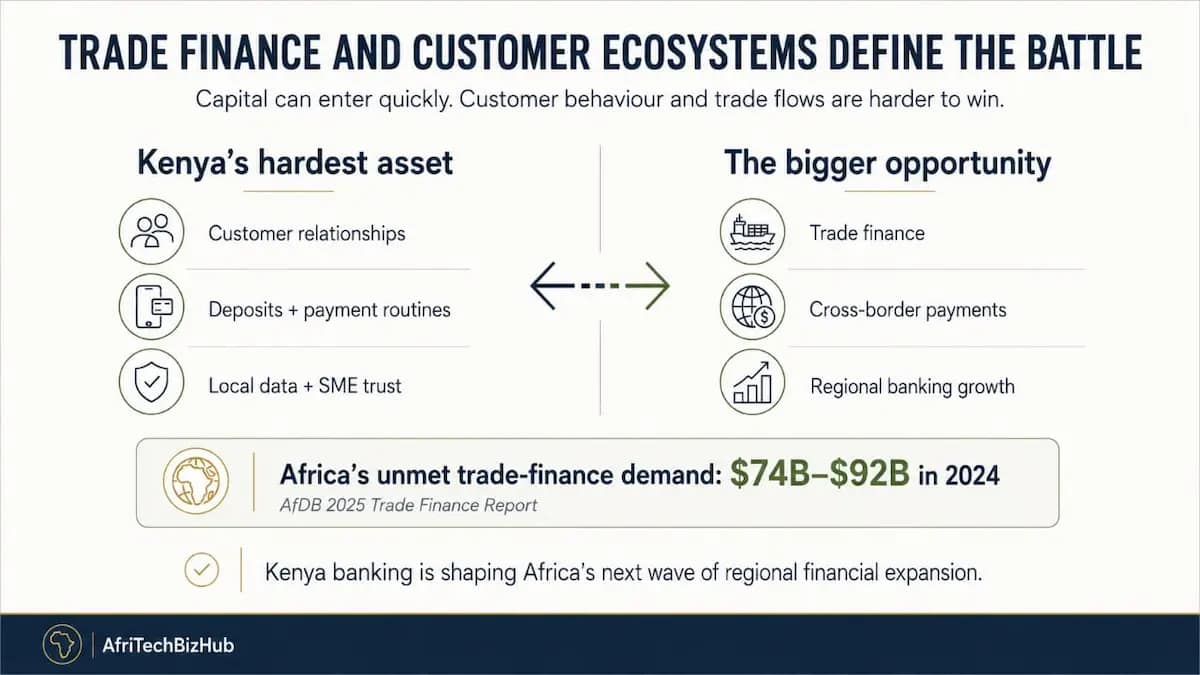
Access Bank has completed its acquisition of National Bank of Kenya, Nedbank is pursuing a controlling stake in NCBA, Absa is increasing its investment, and Egypt’s Commercial International Bank continues expanding despite slower-than-expected returns.
Those transactions are unfolding as global banks narrow their African footprint and regional lenders deepen theirs, concentrating more capital around one of East Africa’s most important financial markets.
The timing reflects a broader shift in African banking.
Kenya sits at the centre of one of the continent’s busiest trade corridors, supported by established financial regulation, a mature digital payments ecosystem, growing corporate activity, and expanding regional commerce.
Kenya banking is becoming more than a domestic market. It is increasingly serving as a strategic platform for banks seeking greater participation in East Africa’s financial system.
Banking Expansion Is Becoming Bigger Than Market Entry
Access Bank’s acquisition of National Bank of Kenya, Nedbank’s proposed investment in NCBA, Absa’s increased ownership, and Commercial International Bank’s continued expansion all follow the same pattern.
Rather than building new operations from the ground up, African banks are expanding through institutions that already hold banking licences, customer deposits, branch networks, experienced management teams, and established corporate relationships.
That approach reflects how expansion is unfolding across Africa’s banking industry.
Higher capital requirements, rising investment in technology, and increasing regional competition are raising the cost of building scale organically.
Acquiring an established bank shortens that process by providing immediate access to regulated financial infrastructure that has already been built.
Kenya banking is therefore attracting more than new entrants. It is attracting institutions seeking faster participation in one of Africa’s most established financial markets.
Regional Growth Is Becoming More Valuable Than Immediate Returns
East Africa is one of the fastest-growing economic regions on the continent, with expanding trade, rising urbanisation, growing private investment, and deeper regional integration continuing to increase demand for financial services.
Kenya occupies a central position within that economy, serving businesses that operate across multiple East African markets rather than within a single national border.
Banking activity therefore extends beyond domestic deposits and retail lending into trade finance, payments, treasury services, foreign exchange and regional corporate banking.
That broader financial role changes how investment is assessed.
Building a meaningful presence inside a regional banking hub often takes longer than entering a less competitive market, but it also provides access to larger and more diversified financial activity over time.
Kenya banking is attracting institutions prepared to compete in a market where regional connectivity has become as commercially important as domestic market share.
Customer Behaviour Remains Kenya Banking’s Hardest Asset
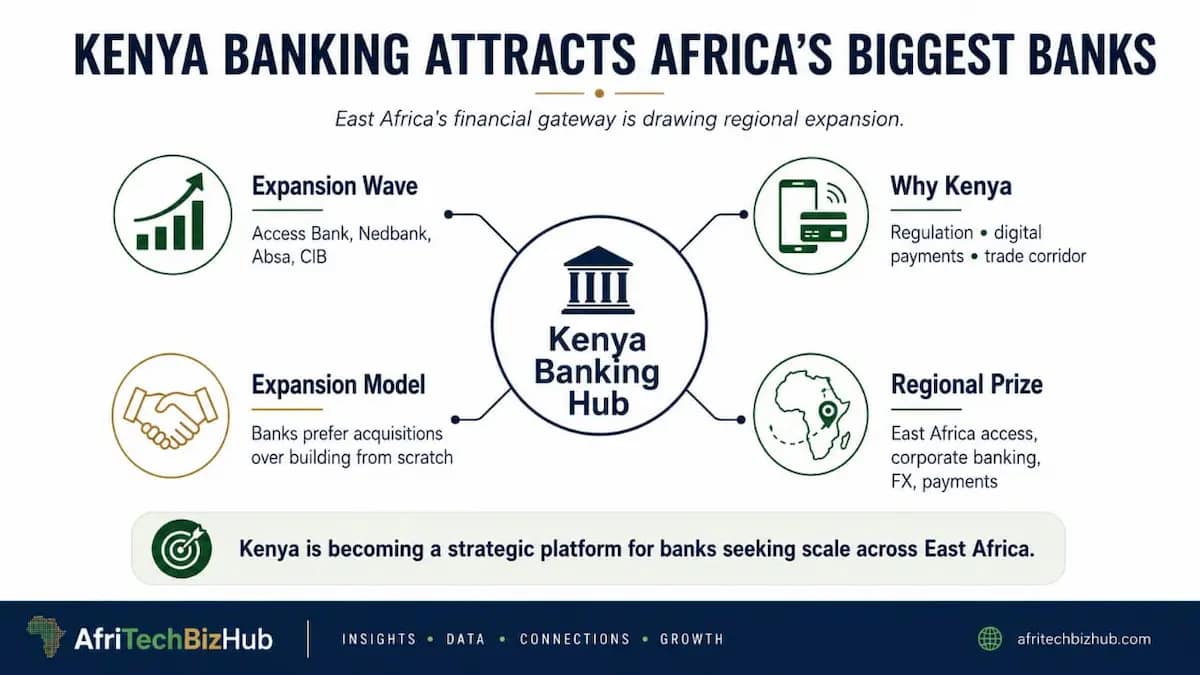
Kenya’s established lenders hold an advantage that does not transfer automatically through capital, licences, or branch networks.
Customer deposits, salary accounts, merchant payments, mobile banking routines, SME relationships, and credit histories are built through repeated use over time.
Equity, KCB, Co-operative Bank, NCBA and other local players operate inside financial habits that new entrants must earn rather than purchase.
The strength of Kenya’s market is also what makes it difficult to disrupt.
Customers already move money through familiar digital channels, businesses already rely on established payment relationships, and lenders with deeper local data can price risk with more confidence.
New capital can enter the market quickly, but customer behaviour changes more slowly.
That gap explains why Kenya can attract major banking investment while local institutions continue to defend the daily financial activity that makes the market valuable.
Trade Finance Is Expanding the Banking Opportunity
Regional banking growth is being shaped by more than retail customers and deposits.
Businesses trading across borders require banks that can provide letters of credit, foreign exchange, guarantees, working capital, and payment services that support the movement of goods between African markets.
As regional commerce expands, banking activity expands with it.
The African Development Bank’s 2025 Trade Finance Report estimates that Africa’s unmet demand for trade finance ranged between $74 billion and $92 billion in 2024, highlighting the scale of financing still required to support trade across the continent.
The report also found that commercial banks intermediated only 23% of Africa’s total trade between 2020 and 2024, down from 40% before the pandemic, leaving significant room for regional financial institutions to expand their role.
Kenya’s position within East Africa’s trade corridor places its banking sector close to that opportunity as banks compete for a larger share of regional financial flows.
Kenya Banking Is Shaping Africa’s Next Financial Expansion
Kenya’s banking sector is illustrating how African banking competition is evolving.
Regional expansion is becoming more closely linked to trade corridors, cross-border financial activity, and established banking ecosystems than to national boundaries alone.
As capital requirements rise, technology investment accelerates, and regional integration deepens, banks are increasingly seeking markets that connect multiple economies rather than serving a single domestic market.
That direction is likely to influence banking expansion well beyond East Africa.
Markets that combine strong financial regulation, digital payment infrastructure, regional trade links, and established banking ecosystems are expected to attract a growing share of cross-border investment as African banks continue building continental scale.
Kenya banking is providing an early view of that transition, where long-term growth is increasingly shaped by regional connectivity as much as by domestic market share.


Recent Comments